Can you imagine a world without lawyers? I’ll bet Amanda Knox can’t.

Share

Lawyers are routinely vilified. Epithets abound. We are the subject of the cruelest jokes.

And yet, where do people turn when they are in trouble? Whom do they go to for advice when they want to protect their rights? Who defends the indefensible?

Amanda Knox was just released from an Italian prison after a four year nightmare. Without lawyers, she would still be languishing in her cell.

Without lawyers fighting the good fight, our rights, our entire way of life, would devolve and anarchy would ensue. We must never forget how important we are, not just to the individuals we serve, but to the society we live in.

In Shakespeare’s Henry VI, Dick the Butcher says, “The first thing we do, let’s kill all the lawyers”. This is often quoted as a denouncement of lawyers but it is a misreading. Dick was referring to ways a rebellion in the planning might be successful. He recognized that to succeed, they must get rid of those who know and enforce a system of laws. It is, in a roundabout way, an endorsement of lawyers.

Lawyers, be proud of what you do. Defend not just your clients but your profession. Educate your clients and your friends about what you do, but also why it matters.

But don’t stop there. When you see a colleague behaving in a way that belies the dignity of our profession, call him on it. Counsel him. And, if necessary, report him.

Be a champion of the high standards our oath demands and exemplify those standards in your words and deeds. Our profession must police itself. The alternative is a Bar that does it for us, but too often, they go too far.

In a victory for common sense, a Florida court just struck down as vague one of its Bar Association’s limits on lawyer advertising. A bar association should enact rules of professional conduct that define standards of behavior and it should provide redress for the most egregious transgressions of those standards. But when a bar association imposes vague, arbitrary, and unreasonable standards upon its members, as Florida has long been criticized for doing, it says to the world, “We don’t trust our members and neither should you.”

Bar associations can improve the image of lawyers not by policing them more but by trusting them more.

Share

Attorneys: Will you be sending holiday greeting cards again this year? (Read this before you do)

Share

‘Tis the season. . .

Yep, the holidays are right around the corner. Will you be sending cards this year?

If you are, this excellent 13-step holiday greeting card guide for law firms will help you create a plan and a timetable.

You don’t want to wait until the last minute. Not with so many decisions to make. Remember last year? You spent way too much time looking through catalogs to find just the right card (mustn’t offend anyone) and then spent way too much money because you didn’t want your clients to think you couldn’t afford a nicer card. . .

I’d like to propose an alternative to this annual ritual of pain.

Don’t misunderstand me, I do recommend communicating with your clients and professional contacts and the holidays are an especially good time to do that. Communication is the sine qua non of relationship building, after all. What I don’t recommend is sending the same commercial greeting cards everyone else sends.

Why? Because a mass market, commercial greeting card that your client reads for three seconds before placing on the fireplace mantle sends an unwritten message:

We’re sending this to you because it is expected of us and we didn’t want to take a chance that you would notice if we didn’t. We couldn’t be bothered to put any thought into it, so we spent some money instead. We want to remind you that we still exist and we hope you will remember us if you need an attorney or know someone who does.”

Commercial holiday cards, the same cards sent by every insurance agent and dentist, are nothing more than advertising, and everyone knows it.

Look, you know these people and you do appreciate them, and they you. You helped them through a tough time or you helped them achieve something important. You met their family or their employees. You really do care about them as individuals, but your holiday card says they are just names on a mailing list.

So, what do I advise instead?

A letter. Send a personal letter to your clients that says what you really want to say.

Tell them what you would tell them if you were sitting with them in person.

Tell them that you appreciate knowing them and you are proud that you have been able to help them. Share news about what happened this year in your practice and personal life and your thoughts about next year. Share a story about a remarkable case, a client who opened a new business, or a new hire in your firm.

Write about the economy and offer solace and advice. Write about books that changed your thinking, and quotes that inspired you. And, because it’s a personal letter, you can write about your kids, your hobbies, or your vacation. Whatever you write about, make sure you tell your clients how grateful you are to know them and have them as clients.

When your clients receive these annual missives, they will read every word. They will tell their friends and families about their attorney’s letter. And because they know you didn’t have to do it, they will call you and send you emails thanking you for taking the time to write a personal message.

My wife and I have friends who send out a family newsletter every year. It’s written by the husband and reads like a newspaper, with headlines, photos with captions, and “news” stories. Very funny news stories. Humor is not easy to pull off, but my friend does it like a pro. My wife and I read it cover to cover, laughing all the way. Our friends moved to the Midwest a few years ago, so we don’t see them much (they visited recently) but their newsletter keeps us informed about what’s going on in their lives and makes us feel like we are still a part of it.

Send your clients and others you care about a year-end personal letter. If not a complete letter, at least add a note inside the card. If you really want to make an impact, add a personal, hand written P.S., something that lets your client know you know who they are.

You don’t need much, just something personal. “Tell Michael I wished him good luck in his soccer tournament!” will be appreciated and long remembered, and so will you.


Share

The Big Idea: Taking a Quantum Leap in the Growth of Your Law Practice

Share

Donny Deutsch’s cable program, “The Big Idea,” features interviews with entrepreneurs who scored big (or are trying to) in the world of business. The guests discuss their “big idea,” the one that makes their company or product different from all the rest.

In the crowded, competitive world of business, a big idea can propel a company from the depths of obscurity to the heights of financial success. But the big idea isn’t necessarily a new invention or a revolutionary concept. More often, it is a new spin on an old idea that capitalizes on a current trend (e.g., “fast food” restaurants that serve nothing but breakfast cereal).

Allstate Insurance company is running ads that promise to pay cash rebates for every six months of good driving. That’s nothing more than a new way of offering a good driver discount but in my view, it qualifies as a big idea because instead of a discount, the customer gets paid. Getting a check from your insurance company every six months re-sells you on staying with that company because you don’t want to lose “your” check. (It also reminds you to drive safely.)

Amazon’s latest big idea is low priced tablets. They don’t do everything an iPad does but they will probably appeal to a big segment of the market that will pay $200 (or less) but not $500 (or more).

How could you create a big idea in your practice? It might be as simple as taking something every attorney in your market does (e.g., house calls), and re-positioning it (e.g., “We’ll send a limo to pick you up”). It might be something few attorneys do, like the radio spot I just heard by an estate planning firm that prepares living trusts. Their big idea: “free lifetime updates”.

Take some time to brainstorm ideas with your employees or mastermind group. What do you do that everyone else does that you could promote as “your big idea”? Or, what do you do (or could you do) that nobody else does that could be an even bigger big idea?

Share

Testimonials vs. endorsements: why attorneys need both and how to get them

Share

Earlier today, I reported the news about one of my posts being chosen Pick of the Week by SmallLaw, a Technolawyer email publication. It is an honor to be recognized by one’s peers and I hope you are being similarly recognized.

From a marketing standpoint, awards and other mentions, particularly from a peer, are an endorsement of your character or abilities, providing a form of “social proof” to the market that what you do has value and can be trusted. This kind of approbation is even more valuable when it comes, as did this award, unsolicited.

Attorneys should have both endorsements and testimonials in their marketing tool box and leverage them to get new clients and build their reputation.

Testimonials are words of praise from satisfied clients attesting to your manner and abilities. They hired you, they were happy with what you did for them, and they recommend your services to others.

Endorsements are words of praise from peers or other highly regarded individuals attesting to your character or some aspect of your abilities with which they are familiar. Awards from peers are a form of endorsement. A letter from a judge you have appeared before, photos of you with heads of state, or a letter of thanks from the head of a charitable committee you served on are other forms of endorsements.

Testimonials and endorsements can be used throughout your marketing materials to convince people to hire you, to send you referrals, or to otherwise engage with you (e.g., booking you to speak). Their power lies in the value of “third party.” When you say you are good, you risk sounding arrogant (even if it’s true) and your words may be doubted. When a third party sings your praises, it is accepted and far more persuasive.

From this day forward, I encourage you to not only collect and use testimonials and endorsements, but to actively seek them.

You will get them without asking, just as I did my Pick of the Week award. But don’t limit yourself to what may come to you unexpectedly.

When a client says something nice about you, write it down. Send their words to them and ask if you can use those words in a testimonial. Yes, write your own testimonial, based on what your client says.

Or, call your best clients and ask them for a favor: “You’ve been happy with my services, haven’t you? Would you mind providing me with a testimonial letter I can use in my marketing?” When they agree, tell them you want to make it easy for them and ask them to say a few words about your services. Write them down and send them to the client for approval.

You can also solicit endorsements. Call an attorney you know who respects you and ask them. Tell them it’s for marketing purposes and offer to reciprocate.

Another type of endorsement can be had by volunteering on a Bar committee, community group, or other “good work”. You may not get an award for your efforts, but you will get the implied endorsement of the group by simply including your participation in your bio.

Clients often don’t understand what you do and are usually poor judges of your ability to do it. Third party testimonials and endorsements bridge the gap and convince them that you can help them because you helped someone “just like them” or because someone important says you can.

Share

The Attorney Marketing Center: Technolawyer’s “SmallLaw Pick of the Week”

Share

Each week, the editorial staff of SmallLaw, Technolawyer’s email newsletter, sifts through hundreds of articles on the legal Web. From these articles, they select one as their Pick of the Week.

I’m proud to report that my post on “What to give new clients when they sign up,” was chosen Pick of the Week in the September 20, 2011 issue of SmallLaw.

Neil Squillante, publisher of SmallLaw, had this to say about the significance of the award:

Many awards given out these days are meaningless because marketing can play a role in determining who wins. By contrast, those who win our SmallLaw Pick of the Week don’t even know they’re in the running, and could not influence us even they did. It’s a pure editorial award. We think this process makes it meaningful and a true honor.

I am indeed honored to be chosen and proud to share this news with my readers.

Share

Farming for law firms: getting a higher yield from your client relationships

Share

To be productive, a farm needs acres and acres of land. Rich top soil,  seeds planted a few inches under the surface, within reach of the sun’s rays, regular water, and the loving care of the farmer. The farmer knows that each seed can yield only so much, so he plants lots of them. More seeds, bigger harvest.

A farm is “an inch deep and a mile wide.” Unfortunately, so are many law firms. They plant a lot of seeds, going wide instead of deep, collecting fees and moving from new client to new client. But while a seed planted in the Earth can only yield so much, clients can yield far more than the fees they initially pay.

Each client can also:

  • Hire you again
  • Hire you for other services
  • Provide referrals
  • Introduce you to prospects, referral sources
  • Promote you via social media
  • Send traffic to your web site
  • Recommend your newsletter, ezine, blog
  • Distribute information by and about you
  • Invite their colleagues to your seminars
  • Provide information to you about their industry and/or key people
  • Give you testimonials and endorsements
  • Provide feedback about your marketing

The big money in a law practice is not the initial harvest, the fees earned on front end. The big money is earned on the back end. You may earn $10,000 from a client today, but $100,000 over their lifetime.

To bring in his big crop, the farmer must nurture his seedlings. So must you nurture your clients. Communicate with them. Appreciate them. Acknowledge them. Give to them. Build strong relationships with your clients and they will bear much fruit and continue to blossom for many seasons.

A farm is an inch deep and a mile wide; a law firm should be an inch wide and a mile deep.

Share

Five ways lawyers can leverage a win or other successful outcome to get more clients

Share

Most lawyers go from case to case, client to client, never stopping to use the successful outcomes they create as marketing leverage for bringing in more clients. That’s because they’re thinking like a lawyer, not a rainmaker.

Instead of rushing from one case to the next, take a few minutes to think about how you can use the successful outcome (verdict, settlement, closing the deal, estate plan, etc.) to get the story told to the people who can bring you more business.

Here are five ways you could do that.

  1. Your client. The best time to talk to clients about referrals is right after a successful outcome. When you hand them a check, sign papers, or otherwise bring things to a climax, it’s prime time to ask for referrals, for a testimonial, or for other help.

    Ask consumer clients to refer you to their friends and family or to other professionals they know. Ask your business clients to introduce you to their vendors or distributors, to write about the case in their newsletter or blog, or submit an article to their local paper. (You can write the article for them).

    The favor you ask your client doesn’t have to be related to their case. They’re happy and willing to help, so ask them to distribute your new report, “like” your new blog post, or invite their friends to your upcoming seminar. And ask them to ask their friends to do the same.

  2. Your other clients and prospects. Write about your successful outcome in your blog and newsletter. Post it on your web site. Do a little bragging on social media channels. Take advantage of the win to let others see you doing what you do, helping others “just like them” achieve the same benefits they seek.
  3. Other parties/witnesses. Send a quick note to the other parties and/or their counsel, thanking them for their professionalism. Send a thank you note to experts and other witnesses, for a job well done. It’s not uncommon to see the losing side hiring the winning attorney or sending referrals or opposing counsel referring clients when they have a conflict. By the way, do the same thing when you lose a case or settle for less than hoped.
  4. Your colleagues. Tell other lawyers you know about your case. Send a letter, speak about it at Bar functions, write an article, point them to your blog post. Tell the story and share the legal nuances, give them tips about the judge or arbitrator or experts. Help them do better on their next case and they will appreciate you, reciprocate with good information on their next case, and send business your way when they have a conflict.
  5. The media. Find something newsworthy or otherwise interesting about the case, your clients or their company and issue a press release or write an article for publication in their trade journal or home town paper. The media are starved for good stories; don’t assume there’s no news value to preparing a living trust for your blue collar client. In the hands of a good writer, there’s always a story to be told.

Leverage means getting more results from the same effort. From now on, leverage your successful outcomes to get more publicity, more speaking engagements, more traffic to your web site, and more new clients.

Share

[Book Review] Evernote: The Unofficial Guide To Capturing Everything And Getting Things Done

Share

If you’re a proponent of David Allen’s Getting Things Done (GTD) productivity system like I am, you’ve probably tried numerous ways to incorporate it into your work flow, from paper and file folders to web and mobile apps, and everything in between. Many of these are complicated, with lots of bells and whistles and a steep learning curve. Others, like plain paper or a Moleskine notebook are simple but for many of us, too limited.

Enter Evernote.

I’d been using Evernote for a long time, first for collecting information and ideas, eventually, for all of my documents. One day, I decided to see if I could also use it to manage my tasks and projects. Although Evernote isn’t designed as a task management application and it is limited in that realm, I found a way to make it work for me, and today I use it every day for exactly that purpose.

I like having one app for almost everything I do. I like having all of my notes and documents in the same place as my tasks and projects. It’s simple, reliable, and flexible and provides me with a complete system for managing my work and my life.

I went looking for others who use Evernote for Getting Things Done, and my search led me to fellow attorney and blogger, Dan Gold. Dan is a maven in the world of technology and productivity and has tried just about every productivity app under the sun. He used Evernote like I did, for collecting information, but was unable to find the right way to use it for GTD. In his quest to achieve a “mind like water,” he finally found the right combination.

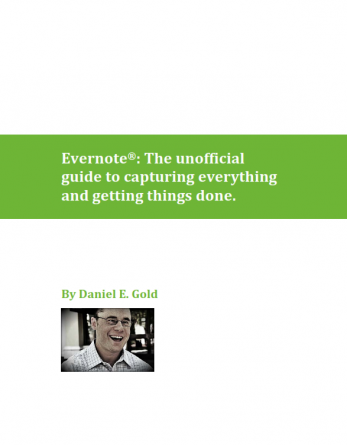
The story of his journey is told in his newly published ebook, “Evernote: The Unofficial Guide To Capturing Everything And Getting Things Done,” (aff. link) now featured in Evernote’s Trunk (store). It’s a great read and provides a much needed lesson for using an extraordinary piece of technology in conjunction with a seminal productivity system, to manage your work and your life.

I read the book and found that to a great extent, Dan’s journey paralleled my own. We both liked the power and ubiquity of Evernote but were frustrated with its limitations as a productivity tool. After trying various apps and workarounds, we eventually found the solution.

In his book, Dan credits my blog post about how I use Evernote for GTD (and another blogger’s post on that subject) with providing some of the missing pieces in his set up. I appreciate his saying so but in reality, Dan had most of the pieces already in place. Like I had, he was adding elements–other apps that integrate with Evernote and a more complex arrangement of notebooks and tags. My post and the other blogger he credits simply showed him that Evernote didn’t need anything else, it could be used “as is” for GTD.

The key is not adding elements but subtracting them. Not using more notebooks to organize everything but fewer, and using enough tags, but not too many, to manage everything.

If you are a newcomer to Evernote or GTD, Dan’s book will sell you on why you need to be using them; it won’t tell you everything you need to know about how. What it will do is show you how you can use them together to create a complete system for getting things done.

“Evernote: The Unofficial Guide To Capturing Everything And Getting Things Done,” is a quick read and available for immediate download for just $5. Dan promises free updates and since Evernote is continually being developed, this makes a great value even greater.

Share

How to stay focused when you need to get things done

Share

You’ve got work to do, deadlines to meet, things that must get done, and you know you need to focus but it’s difficult because there are so many interruptions.

How do you cope?

“6 Ways to Minimize Interruptions When You Need to Focus,” offers some ideas:

  1. Close the door while you’re working
  2. Wear headphones to prevent colleagues chatting
  3. Say, “Could you come back in ten minutes?”
  4. Let your phone go to voice-mail
  5. Turn off Skype, Email, Facebook, Twitter, etc. . .
  6. Get into the office early

In short, these tips remind us to, “avoid outside stimuli”. That’s why we went to the library to study for exams, isn’t it?

Interruptions by others are easy to fix, if you want to. But do you really want to? I think we enjoy interruptions–we like the respite they provide from the tedium of our work.

I’ve found that when I really do need to shut off outside stimuli, because of a deadline, for example, I do it. The fear of loss of the looming deadline motivates me to do what we need to do–and I do it.

The greater challenge is not with outside stimuli or interruptions by others, it is with interruptions we impose on ourselves.

When we’re working, we’re also thinking about other things we have to do. Our neurons are firing, reminding us of promises unkept, other tasks that must get done, thinking about the game tonight, and imagining what will happen if we don’t meet our deadline. It is this internal chatter that is so hard to turn off.

So, how do you focus when your brain keeps interrupting you?

One way to do that is by removing all of those tasks and reminders from your brain and putting them into a “trusted system” to be processed and done at a later time. The term “trusted system” comes from the Getting Things Done™ (GTD) system which I’ve written about before.

Another technique for increasing focus is to give yourself short segments of time during which you are committed to working on the task at hand. Twenty-five minutes, fifteen, ten, or two, whatever you can handle. No matter how busy your brain may be, it can focus for two minutes. Once those two minutes are up, you are allowed to do something else or think about something else for, say, another two minutes. And then, you return to the work you were doing in the first segment, or onto something else.

It’s called, “The Pomodoro Technique.”

The most common implementation is a twenty-five minute block of time, followed by a five minute break. A timer is set, and when the bell sounds, you take your break. Kinda like prize-fighting. After the break, you return for the next round.

The technique was originally promoted via the use of a kitchen timer resembling a tomato (“pomodoro is Italian for tomato”) , like the one depicted above. I use something a bit more high tech.

On my PC’s desktop is an icon to launch an app that takes the place of a kitchen timer. There are many apps that do the same thing. The one I use is called, “Focus Booster,“ and it’s available for free for Mac and PC.

Give it a try. Start with a twenty-five minute pomodoro. When you’re done and you’ve taken a break, go for another. If you can’t stay focused for twenty-five minutes, start with ten. Or one.

Have you tried the Pomodoro Technique? How has it worked for you? Do you have a favorite app or do you use a kitchen timer?

Share

Working smart doesn’t mean sacrificing quality or personal attention

Share

I got an email from an attorney who read my story about the changes I made in my practice that increased my cash flow. (If you’re on my newsletter list, you have or will get the email, promoting my Cash Flow for Attorneys program). One of the things I did was delegate as much of my work as possible, eventually getting to the point where I did “only those things that only I could do.”

In reply, this attorney said,

“The lesson may be that sacrificing quality and personal attention to the clients can raise your bottom line. The moral should be: what client would pick that savvy business owner over the harder working practitioner?”

I understand how one might think that delegating as much as possible and running your practice like a business would lead to a lower level of quality or personal attention. In reality, it is just the opposite.

My clients got a higher level of service and more personal attention because I wasn’t trying to do everything myself. Think about it: attorneys works long hours and are stretched so thin they often don’t have time for lunch. They have less time for clients because they’ve got too many other things to do.

When you delegate work, it frees you up to do the things that really matter. You have time to greet new clients and introduce them to the staff who will take care of the mundane work. You have time and energy to oversee the important legal work, and to perform the work that “only you can do”. And you have time for marketing, so you can bring in more good clients, allowing you to hire more staff to better serve your growing practice.

If you’re trying to do too much yourself, you must find a way to delegate as much as possible. Continue to supervise your employees, to make sure the work is getting done and the clients are getting served, but let go of the notion that just because nobody can do it better than you means nobody but you should do it.

Do the math: you’re worth at least $300 an hour and, arguably, much more. If you continue to do $25 an hour clerical work, you’re working for your practice, not the other way around.

A law practice is first, a business. That business hires you, the professional. As the owner of that practice, you earn for what you do as a professional and you earn a profit on what your business takes in from paying clients. If your business doesn’t bring in clients, you won’t have anyone for whom to practice your profession.

I was a sole practitioner for my entire legal career, and I worked hard. Damn hard. Early on, I worked long hours and was always on the brink of exhaustion. I did my best to serve my clients but my best was limited to what I was able to give them with the limited time and energy at my disposal. It wasn’t until I starting working smart and delegated as much as possible that I was able to achieve the levels of financial success and time freedom I ultimately enjoyed. And because I was “selfish” enough to make that leap, my clients got better service than they ever got when I was doing almost everything myself.

Share