Attorneys: Will you be sending holiday greeting cards again this year? (Read this before you do)

Share

‘Tis the season. . .

Yep, the holidays are right around the corner. Will you be sending cards this year?

If you are, this excellent 13-step holiday greeting card guide for law firms will help you create a plan and a timetable.

You don’t want to wait until the last minute. Not with so many decisions to make. Remember last year? You spent way too much time looking through catalogs to find just the right card (mustn’t offend anyone) and then spent way too much money because you didn’t want your clients to think you couldn’t afford a nicer card. . .

I’d like to propose an alternative to this annual ritual of pain.

Don’t misunderstand me, I do recommend communicating with your clients and professional contacts and the holidays are an especially good time to do that. Communication is the sine qua non of relationship building, after all. What I don’t recommend is sending the same commercial greeting cards everyone else sends.

Why? Because a mass market, commercial greeting card that your client reads for three seconds before placing on the fireplace mantle sends an unwritten message:

We’re sending this to you because it is expected of us and we didn’t want to take a chance that you would notice if we didn’t. We couldn’t be bothered to put any thought into it, so we spent some money instead. We want to remind you that we still exist and we hope you will remember us if you need an attorney or know someone who does.”

Commercial holiday cards, the same cards sent by every insurance agent and dentist, are nothing more than advertising, and everyone knows it.

Look, you know these people and you do appreciate them, and they you. You helped them through a tough time or you helped them achieve something important. You met their family or their employees. You really do care about them as individuals, but your holiday card says they are just names on a mailing list.

So, what do I advise instead?

A letter. Send a personal letter to your clients that says what you really want to say.

Tell them what you would tell them if you were sitting with them in person.

Tell them that you appreciate knowing them and you are proud that you have been able to help them. Share news about what happened this year in your practice and personal life and your thoughts about next year. Share a story about a remarkable case, a client who opened a new business, or a new hire in your firm.

Write about the economy and offer solace and advice. Write about books that changed your thinking, and quotes that inspired you. And, because it’s a personal letter, you can write about your kids, your hobbies, or your vacation. Whatever you write about, make sure you tell your clients how grateful you are to know them and have them as clients.

When your clients receive these annual missives, they will read every word. They will tell their friends and families about their attorney’s letter. And because they know you didn’t have to do it, they will call you and send you emails thanking you for taking the time to write a personal message.

My wife and I have friends who send out a family newsletter every year. It’s written by the husband and reads like a newspaper, with headlines, photos with captions, and “news” stories. Very funny news stories. Humor is not easy to pull off, but my friend does it like a pro. My wife and I read it cover to cover, laughing all the way. Our friends moved to the Midwest a few years ago, so we don’t see them much (they visited recently) but their newsletter keeps us informed about what’s going on in their lives and makes us feel like we are still a part of it.

Send your clients and others you care about a year-end personal letter. If not a complete letter, at least add a note inside the card. If you really want to make an impact, add a personal, hand written P.S., something that lets your client know you know who they are.

You don’t need much, just something personal. “Tell Michael I wished him good luck in his soccer tournament!” will be appreciated and long remembered, and so will you.


Share

Farming for law firms: getting a higher yield from your client relationships

Share

To be productive, a farm needs acres and acres of land. Rich top soil,  seeds planted a few inches under the surface, within reach of the sun’s rays, regular water, and the loving care of the farmer. The farmer knows that each seed can yield only so much, so he plants lots of them. More seeds, bigger harvest.

A farm is “an inch deep and a mile wide.” Unfortunately, so are many law firms. They plant a lot of seeds, going wide instead of deep, collecting fees and moving from new client to new client. But while a seed planted in the Earth can only yield so much, clients can yield far more than the fees they initially pay.

Each client can also:

  • Hire you again
  • Hire you for other services
  • Provide referrals
  • Introduce you to prospects, referral sources
  • Promote you via social media
  • Send traffic to your web site
  • Recommend your newsletter, ezine, blog
  • Distribute information by and about you
  • Invite their colleagues to your seminars
  • Provide information to you about their industry and/or key people
  • Give you testimonials and endorsements
  • Provide feedback about your marketing

The big money in a law practice is not the initial harvest, the fees earned on front end. The big money is earned on the back end. You may earn $10,000 from a client today, but $100,000 over their lifetime.

To bring in his big crop, the farmer must nurture his seedlings. So must you nurture your clients. Communicate with them. Appreciate them. Acknowledge them. Give to them. Build strong relationships with your clients and they will bear much fruit and continue to blossom for many seasons.

A farm is an inch deep and a mile wide; a law firm should be an inch wide and a mile deep.

Share

Five ways lawyers can leverage a win or other successful outcome to get more clients

Share

Most lawyers go from case to case, client to client, never stopping to use the successful outcomes they create as marketing leverage for bringing in more clients. That’s because they’re thinking like a lawyer, not a rainmaker.

Instead of rushing from one case to the next, take a few minutes to think about how you can use the successful outcome (verdict, settlement, closing the deal, estate plan, etc.) to get the story told to the people who can bring you more business.

Here are five ways you could do that.

  1. Your client. The best time to talk to clients about referrals is right after a successful outcome. When you hand them a check, sign papers, or otherwise bring things to a climax, it’s prime time to ask for referrals, for a testimonial, or for other help.

    Ask consumer clients to refer you to their friends and family or to other professionals they know. Ask your business clients to introduce you to their vendors or distributors, to write about the case in their newsletter or blog, or submit an article to their local paper. (You can write the article for them).

    The favor you ask your client doesn’t have to be related to their case. They’re happy and willing to help, so ask them to distribute your new report, “like” your new blog post, or invite their friends to your upcoming seminar. And ask them to ask their friends to do the same.

  2. Your other clients and prospects. Write about your successful outcome in your blog and newsletter. Post it on your web site. Do a little bragging on social media channels. Take advantage of the win to let others see you doing what you do, helping others “just like them” achieve the same benefits they seek.
  3. Other parties/witnesses. Send a quick note to the other parties and/or their counsel, thanking them for their professionalism. Send a thank you note to experts and other witnesses, for a job well done. It’s not uncommon to see the losing side hiring the winning attorney or sending referrals or opposing counsel referring clients when they have a conflict. By the way, do the same thing when you lose a case or settle for less than hoped.
  4. Your colleagues. Tell other lawyers you know about your case. Send a letter, speak about it at Bar functions, write an article, point them to your blog post. Tell the story and share the legal nuances, give them tips about the judge or arbitrator or experts. Help them do better on their next case and they will appreciate you, reciprocate with good information on their next case, and send business your way when they have a conflict.
  5. The media. Find something newsworthy or otherwise interesting about the case, your clients or their company and issue a press release or write an article for publication in their trade journal or home town paper. The media are starved for good stories; don’t assume there’s no news value to preparing a living trust for your blue collar client. In the hands of a good writer, there’s always a story to be told.

Leverage means getting more results from the same effort. From now on, leverage your successful outcomes to get more publicity, more speaking engagements, more traffic to your web site, and more new clients.

Share

Are you branding your law firm? Here’s why you shouldn’t.

Share

When one of your clients has a friend or business contact who needs a lawyer, they’ll hand their friend your business card (we hope) and say, “Here, call my lawyer”.

Notice they don’t say, “Here, call my law firm.”

Your clients have a relationship with you, not your firm. Even if you are a partner, your brand is “you” and “you” is what you should be promoting.

If permitted, you should have your own web site or blog, your own social media accounts, your own domain name, and your own email account (you@yourdomain.com).

If all you do is promote and brand your firm, what happens if you leave the firm or the firm disbands?

Your brand is valuable. It should be protected, nurtured, and grown.

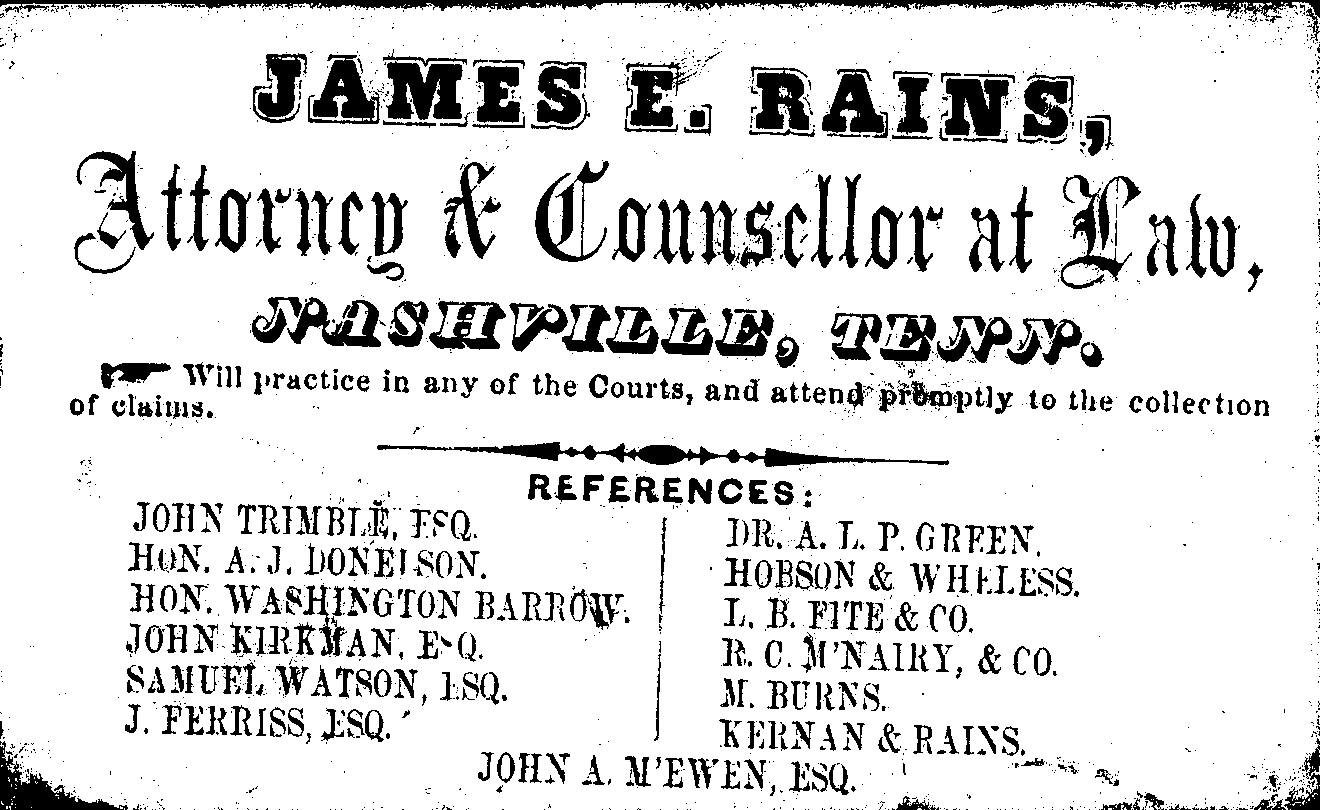
(Note, the above photo is a business card from lawyer James Rains, circa 1857. It says, “Will practice in any of the Courts, and attend promptly to the collection of claims.” It looks like he was a partner in the firm of “Kernan & Rains,” yet the card promotes Mr. Rains.)

Share

What do SEO and client relations for lawyers have in common?

Share

“I’m a busy lawyer. I don’t have a lot of time to write a newsletter or blog.”

Good. If you have time to write a lot, your clients and prospects might not read what you send them.

While frequency of contact is important, quality is far more important. Instead of writing low-quality weekly messages, you’ll do far more to strengthen your relationships and build your reputation by sending a high-quality missive once a month.

I am subscribed to hundreds of blogs and email newsletters. My email inbox and RSS feed reader are inundated. Several times a day I peruse these offerings. I spend most of that time skimming the headlines and deleting or archiving nearly every article. I may scroll through ten or twenty percent but I probably read no more than two percent. The ones I read (and, often save) are where the real value for me lies.

I stay subscribed to this multitude of newsletters and blogs because they give me a sense of what’s trending in my areas of interest. I also find articles I can share with my Twitter and Facebook companions. And, I do find articles worth reading. If I don’t have time to read them on the spot, I save them to read later. Many of the publications I follow publish several times per week; some of the bigger publications publish twenty or thirty articles per day.

I filter through a large quantity of articles looking for the few of high quality. Sometimes they come from the multitude. More often, they come from the handful of sources that consistently provide high quality material. They may not post frequently and not everything they post is golden, but the most useful material (for me) usually comes from the same sources. Those are the ones I look forward to and make sure I read.

So, if you write a newsletter or blog, you don’t have to write every day or three times a week or even weekly. Write when you can but make it worth reading. Your clients and prospects will appreciate it.

Apparently, uncle Google agrees. Carolyn Elefant writes that while in the past, quantity of keywords and links to a web site determined primacy in search engine ranking, Google has modified its algorithm to better reflect the quality of those keywords and links. You don’t need everyone linking to your site, so long as you have the right ones.

Share

Other ways lawyers may use social media (besides marketing)

Share

Lawyers are usually not early adopters. Although more and more lawyers are using social media for marketing, many others feel constricted by their employers’ policies (i.e., firms that insist the attorney promote the firm instead of themselves), by concerns about ethical issues, or, simply, by their natural tendency to “play it safe”.

Many attorneys who have no objection to using social media but are either overwhelmed by the myriad of choices or (believe they) just don’t have the time.

I see social media as nothing more than an electronic extension of the “real world”. It’s still just communication with people you know and people you want to know. We’ve been networking all our lives; why should networking online be any different?

True, the Internet provides reach and permanency that do not exist at a Chamber of Commerce dinner, although the presence of cameras on our phones tends to blur that distinction. But if we mind our P’s and Q’s (does anyone use that expression anymore?) it isn’t difficult to stay out of trouble. And let’s face it, it’s a lot easier and less time consuming to interact via your iPhone than it is to press the flesh, although, arguably, not as effective.

Whatever your viewpoint and experiences with social media, one thing we can all agree on is that it’s here to stay. Like any trend that changes the way people communicate, we ignore social media at our peril.

Social media is starting to be used as evidence, for example.

So, like it not, use it not, we all have to pay attention. Experts say, “lawyers already tuned into social media are not only on the right track, but will have a head start on the competition.”

How about you? How are you using social media in your law practice? Please add your comments below.

Share

Social media marketing for attorneys

Share

This isn’t an attorney but he offers a cogent explanation of how social medial should fit into an attorney’s marketing mix. What’s that? You don’t have a mix? Oh my, you really should have a mix. . .

[mc src=”http://www.youtube.com/watch?v=zn1cspHx7DU” type=”youtube”/]

Share

The quickest way to bring in clients

Share

Q: How do I bring in quality clients fast? I think the best way to bring in a steady stream of [type of] clients is to find a good referral source. What should I do?

A: Referrals are the BEST source of quality clients, but they are usually not the FASTEST. It takes time to build relationships, earn trust, develop a reputation.

If you can compensate those sources (i.e., referral fees to other attorneys, if permissible), or work out other kinds of alliances (paid advertising, cross-promotions) where the source has a more immediate incentive for working with you, then you could get some quick business.

Of course your clients are the first place to look. They should be willing to refer, but they may not be able.

Generally speaking, nothing is faster than advertising (except publicity, but you have limited control with that). Cost is obviously an issue. You could try writing for targeted publications and speaking and networking at targeted events. You’ll get access to the right markets, at no cost, plus the unspoken endorsement of the meeting holder or publication, and if you get your message in front of the right people, you will get clients.

Remember that you are always marketing to at least two separate markets: prospective clients and prospective referral sources. One is not necessarily better than another, nor faster.

Q: How do I know if I’m targeting the right market?

A: A market is only as good as your ability to communicate with it. Do prospects have an organization you can join? Meetings you can speak at? Publications you can write for or advertise in? Can you find centers of influence in that market with whom you can network?

Most lawyers look at their services first and then look for people who need those services. Better is to find a market with a need, then look for ways you can satisfy that need.

Start with professionals and business contacts you already know. What markets do they serve? What unresolved needs do those markets have? Find the market first, then work backwards.

You’ll have greater success giving people what they WANT, which may or may not be what they NEED. Find out what people want and then look for ways to help them get it.

Share