Farming for law firms: getting a higher yield from your client relationships

Share

To be productive, a farm needs acres and acres of land. Rich top soil,  seeds planted a few inches under the surface, within reach of the sun’s rays, regular water, and the loving care of the farmer. The farmer knows that each seed can yield only so much, so he plants lots of them. More seeds, bigger harvest.

A farm is “an inch deep and a mile wide.” Unfortunately, so are many law firms. They plant a lot of seeds, going wide instead of deep, collecting fees and moving from new client to new client. But while a seed planted in the Earth can only yield so much, clients can yield far more than the fees they initially pay.

Each client can also:

  • Hire you again
  • Hire you for other services
  • Provide referrals
  • Introduce you to prospects, referral sources
  • Promote you via social media
  • Send traffic to your web site
  • Recommend your newsletter, ezine, blog
  • Distribute information by and about you
  • Invite their colleagues to your seminars
  • Provide information to you about their industry and/or key people
  • Give you testimonials and endorsements
  • Provide feedback about your marketing

The big money in a law practice is not the initial harvest, the fees earned on front end. The big money is earned on the back end. You may earn $10,000 from a client today, but $100,000 over their lifetime.

To bring in his big crop, the farmer must nurture his seedlings. So must you nurture your clients. Communicate with them. Appreciate them. Acknowledge them. Give to them. Build strong relationships with your clients and they will bear much fruit and continue to blossom for many seasons.

A farm is an inch deep and a mile wide; a law firm should be an inch wide and a mile deep.

Share

What to give new clients when they sign up

Share

I hired an attorney recently. After I signed the retainer agreement, he gave me a copy of the agreement and my check. Nothing else. Nor has he sent me anything in the mail or email in the several weeks since.

No letters, no phone calls, no information.

It’s true, nothing has happened yet that would require an update. Nevertheless, not sending me anything or communicating with me in any way is a big mistake.

Attorneys need to give new clients as much information as possible, and stay in touch with them as often as possible:

  • To thank them for choosing you instead of any other lawyer
  • To educate them on what you will be doing and how the client can help you do a better job for them
  • To inoculate the client from doing or saying anything that could harm them
  • To clarify and commemorate what you told the client and what the client told you
  • To give them something to show their spouse or partner that explains what you are doing and why it is necessary
  • To show clients you are organized and experienced and that they can trust you to stay on top of their matter
  • To ensure the client knows what will be happening, and when, so they don’t expect too much, too soon
  • To let the client know that even though they haven’t heard from you, you are working on their case
  • To reduce the client’s anxiety–about their case and about working with a lawyer
  • To add value to the transaction and exceed the client’s expectations; to give them a “wow” experience
  • To clarify billing and payment requirements so there are no misunderstandings or unpleasant surprises
  • To set the stage for cross-sales and referrals by educating the client about other services your firm offers

Every law firm should send new clients home with as much information as possible. Create a simple “new client kit” and supplement this with regularly scheduled letters and phone calls. Let them know what you are doing for them, even if what you are doing is waiting for something from them or from another party.

Many attorneys do this but too many don’t. How about you? What do you send your new clients and how has this helped your practice?

Share

Are you branding your law firm? Here’s why you shouldn’t.

Share

When one of your clients has a friend or business contact who needs a lawyer, they’ll hand their friend your business card (we hope) and say, “Here, call my lawyer”.

Notice they don’t say, “Here, call my law firm.”

Your clients have a relationship with you, not your firm. Even if you are a partner, your brand is “you” and “you” is what you should be promoting.

If permitted, you should have your own web site or blog, your own social media accounts, your own domain name, and your own email account (you@yourdomain.com).

If all you do is promote and brand your firm, what happens if you leave the firm or the firm disbands?

Your brand is valuable. It should be protected, nurtured, and grown.

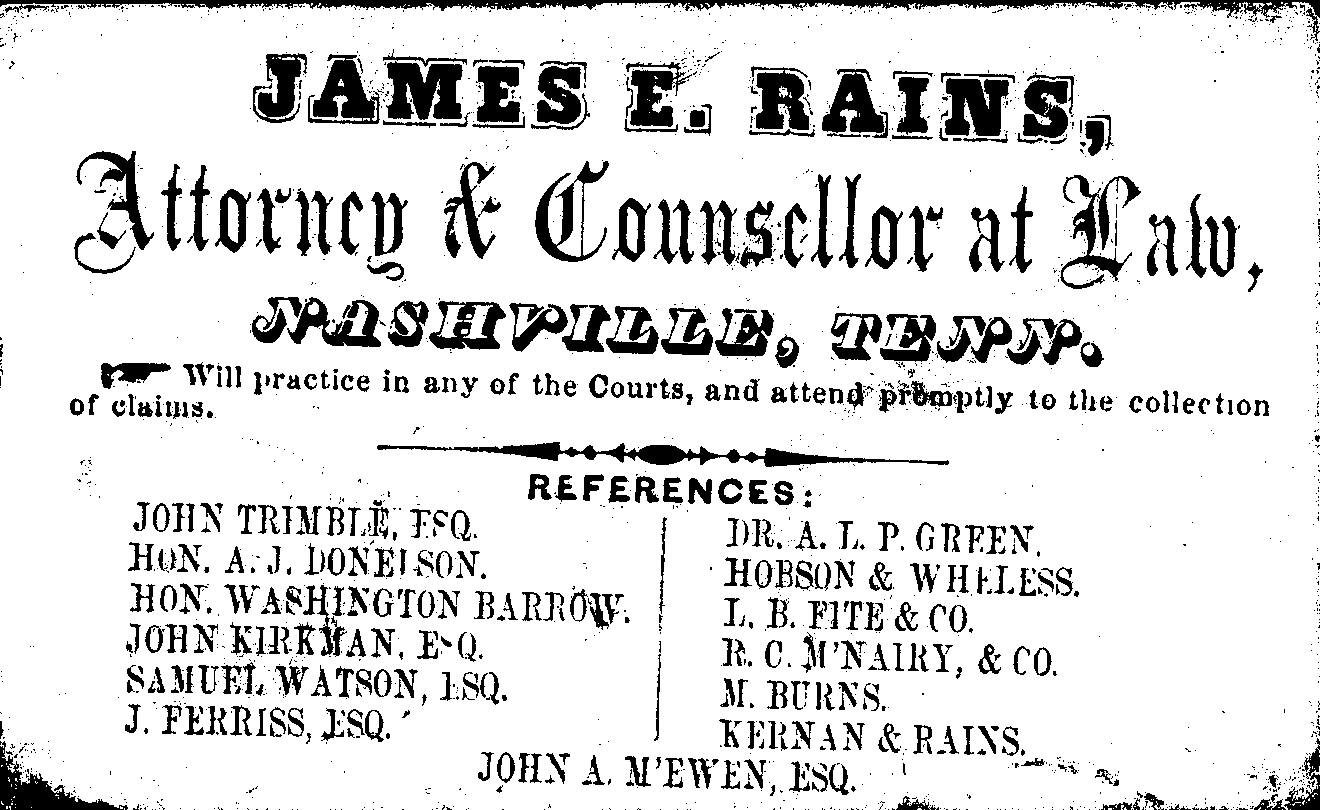
(Note, the above photo is a business card from lawyer James Rains, circa 1857. It says, “Will practice in any of the Courts, and attend promptly to the collection of claims.” It looks like he was a partner in the firm of “Kernan & Rains,” yet the card promotes Mr. Rains.)

Share

What do SEO and client relations for lawyers have in common?

Share

“I’m a busy lawyer. I don’t have a lot of time to write a newsletter or blog.”

Good. If you have time to write a lot, your clients and prospects might not read what you send them.

While frequency of contact is important, quality is far more important. Instead of writing low-quality weekly messages, you’ll do far more to strengthen your relationships and build your reputation by sending a high-quality missive once a month.

I am subscribed to hundreds of blogs and email newsletters. My email inbox and RSS feed reader are inundated. Several times a day I peruse these offerings. I spend most of that time skimming the headlines and deleting or archiving nearly every article. I may scroll through ten or twenty percent but I probably read no more than two percent. The ones I read (and, often save) are where the real value for me lies.

I stay subscribed to this multitude of newsletters and blogs because they give me a sense of what’s trending in my areas of interest. I also find articles I can share with my Twitter and Facebook companions. And, I do find articles worth reading. If I don’t have time to read them on the spot, I save them to read later. Many of the publications I follow publish several times per week; some of the bigger publications publish twenty or thirty articles per day.

I filter through a large quantity of articles looking for the few of high quality. Sometimes they come from the multitude. More often, they come from the handful of sources that consistently provide high quality material. They may not post frequently and not everything they post is golden, but the most useful material (for me) usually comes from the same sources. Those are the ones I look forward to and make sure I read.

So, if you write a newsletter or blog, you don’t have to write every day or three times a week or even weekly. Write when you can but make it worth reading. Your clients and prospects will appreciate it.

Apparently, uncle Google agrees. Carolyn Elefant writes that while in the past, quantity of keywords and links to a web site determined primacy in search engine ranking, Google has modified its algorithm to better reflect the quality of those keywords and links. You don’t need everyone linking to your site, so long as you have the right ones.

Share

Attorneys can benefit from a unique selling proposition

Share

A few years ago, Progressive Insurance ran TV commercials touting that they assign a dedicated claims specialist claimants their policyholders can count on for the life of their claim. The benefit is that you can always call "your" representative and never have to worry about what’s going on with your claim. Policyholders want to be able to talk to the same person each time they call, someone who understands their claim and is staying on top of it "for them".

Now, most other insurance companies probably do the same thing. But because those companies aren’t saying they do it, when Progressive says it, they virtually OWN that benefit.

You can do the same thing. You can promise prospective clients that they will have a dedicated member of your firm assigned to their claim, so that they don’t have to worry about who to ask for when they call. They’ll feel better just knowing that someone is assigned to their case and that it’s not lost in the shuffle.

The fact that most lawyers do the same thing is not important. If you say it and they don’t, or you say it FIRST, you can effectively "own" that benefit and preempt other lawyers in your market from using it. It can become your "Unique Selling Proposition" (USP), the competitive advantage that sets you apart from other lawyers in the minds of clients and prospects.

In marketing, perception is everything. If you appear to offer a unique advantage, people will see a benefit to hiring you instead of your competition.

Your USP can be about any meaningful benefit you offer. What do you do faster, better, or more thoroughly? What do you do that you know clients like?

A great way to find a powerful USP is to learn what your clients DON’T like about lawyers in your field, and promise them the opposite. If clients consistently complain that lawyers who do what you do take to long to do it, for example, your promise to do it quickly would likely be seen as valuable and desirable to those who can hire you.

The number one complaint received by state bar associations is lack of communication by their lawyer. Many lawyers have difficulty, it seems, keeping their clients informed about the progress of their legal matter. Even worse, many complaints involve lawyers who don’t return phone calls. Something this common, and this easy to fix, would seem to be a great USP for lawyers in many practice areas.

If you’re bad at keeping clients informed (or returning calls), resolve to get better. In fact, I’d suggest a goal to become not just better but the best. Make a promise to yourself to return calls within 24 hours, for example. Raise the bar. It’s so easy to do and it will have a profound impact on your practice. Fewer unhappy clients, more repeat clients and referrals.

Then, proclaim it to your clients and everyone else. Let them know of your commitment. Make it your unique selling proposition.

If you’re already good at keeping clients informed and returning calls, the odds are you don’t tell people this, or you don’t tell them enough. Consider doing so before some other attorney decides to make it her unique selling proposition.

Share

A simple way to make a good first impression

Share

If I could recommend only one book on the keys to success, it would be "How to Win Friends & Influence People" by Dale Carnegie. It is a classic, a masterpiece of simple, effective advice for getting people to like you.

Mr. Carnegie’s second of six keys is this:

"SMILE"

When we smile, there is a chemical reaction in our brains that makes us good. Try it! Even if you don’t feel like smiling right now, do it anyway and take note of how it makes you feel.

When we smile at people, they tend to smile back at us. It is a natural human reaction. Our smile says "I like you" and people like people who like them, so they smile back. And they feel good when they do, and associate that feeling with their perception of you.

The more you smile, the better you feel and the more people will like you. This is clear. So why is it that people don’t smile more often? One reason is they don’t like their teeth. They may be discolored or crooked or there may be gaps or missing teeth. If your teeth need work or aren’t as white as they used to be, it’s hurting your business and probably your social life, too. Get them fixed, make them whiter, and SMILE!

Share