Attorney Marketing 101: The psychology of referrals

Share

The psychology of referrals--lawyer marketingThere are two kinds of referral sources: those who can refer and those who will.

If you’ve done a good job for your clients, most are probably willing to give you referrals. That doesn’t mean they will. If they don’t know people who need your services, they can’t refer them.

Others — professionals, business owners, centers of influence — who are able to refer you a lot of business, often don’t.

Understanding why people do or do not give referrals can help you get more of them.

So why do people provide referrals? Your clients are willing to send referrals for several reasons:

First, your clients want to help their friends and colleagues to the benefit of your services. They can save their friends the time they might have spent looking for an attorney, and help them avoid the risk of getting an incompetent one or getting overcharged. Their friends appreciate this help; your client’s status is elevated. Being able to help their friends makes them feel important.

Second, when their friend retains you and is also satisfied with your work, it validates your referring client’s decision to hire you in the first place. Any doubts they may have had about their experience with you are removed.

The third reason your clients are willing to give you referrals is that they want to help you. However, clients don’t always know that you want their referrals. You need to tell them. Or, they understand that you want referrals but they just don’t think about it. You need to remind them.

If you’re not getting referrals from your clients, or you’re not getting as many as you would like, there are only two reasons: either you don’t deserve them or you’re not asking for them.

Now, how about non-clients, professionals, business owners, centers of influence–why might they give you referrals?

For some, it is the expectation of quid pro quo. They give you referrals and you give them referrals, or so they hope.

Others will refer their clients and contacts to you for the same reason your clients do: to help their clients avoid the risk and effort of finding an attorney on their own. In helping their clients this way, they add value to their relationships and their status is also elevated. And yes, some also feel good about helping you, too.

When a professional is able to refer business but is unwilling to do so, it may be because they don’t yet know, like, and trust you. It takes time for your relationship to develop. Eventually, they may turn out to be a big source of new business.

Many prospective referral sources don’t send you business because they don’t have it to give. They have a relationship with another attorney to whom they refer and they don’t have enough referrals for both of you. Unless their regular attorney has a conflict of interest, is unavailable, or doesn’t handle a given matter, your prospective referral source may be willing to refer, but not able.

In time, that may change. When the other attorney retires, dies or screws up, you could be next in line.

If you’re dealing with a prospective referral source who cannot reciprocate, there are other ways they can help you. By the same token, there are other ways you can help them when you can’t reciprocate.

Some people who can give referrals simply won’t. They may see it as risky–what if you screw up and make them look bad? Others just can’t be bothered.

Don’t dwell on the reasons why people won’t refer. If some clients won’t do it, it doesn’t matter; most will. With non-client referral sources, the numbers are reversed. Most won’t refer and this doesn’t matter. You only need a few who do.

Share

Ten ways attorneys can use a newsletter to grow their practice

Share

For many attorneys and law firms, newsletters bring in a lot of business. If you don’t have a newsletter, here are ten reasons you should:

  1. To get more business from current clients. A newsletter is an effective way to let clients know about your other services and show them how they can benefit from those services, without being “salesy”.
  2. To get repeat business from former clients. People who hired you once will hire you again–when they’re ready. A newsletter is a great way to stay in touch with them until they are.
  3. To add value to your services. A newsletter can provide an added benefit for clients. Give clients “subscriptions”. Put a price tag on the newsletter but send it free to current clients.
  4. To educate prospects. A newsletter that provides prospective clients with valuable information helps them make better decisions, allows you to demonstrate your expertise, and provides a mechanism for staying in touch with them until they are ready to hire you.
  5. To generate word-of-mouth referrals. Newsletters have pass-along value. A good newsletter will be shared with an average of three other people, even more online.
  6. To build your contact list. You can offer visitors to your web site a subscription to your newsletter in return for providing their email (and other contact information). When speaking or networking, you can offer to send your newsletter to people who provide you with their business card.
  7. To establish expertise and credibility. Your writing helps prospects, publishers, reporters, meeting planners, and referral sources see you as the expert you are.
  8. To provide content for, and traffic to, your web site. Your newsletter can drive traffic to your web site or blog. Your newsletter content can be re-used as content on your web site or blog, generating additional traffic from search engines and social media.
  9. To shorten the sales process. People who respond to your newsletter are better informed about what you do and pre-sold on your ability to do it, in contrast to people who come to you via advertising.
  10. To serve as a networking tool. Your newsletter is a tool to reach out to other professionals. You can interview them for an article, conduct a survey, ask them to write an article, or ask permission to put them on your mailing list.

A newsletter requires an investment of time, and possibly some capital, but the return on that investment can be substantial. If you want to grow your practice, a newsletter is one of the most highly leveraged marketing activities you can do.

Share

Five ways lawyers can leverage a win or other successful outcome to get more clients

Share

Most lawyers go from case to case, client to client, never stopping to use the successful outcomes they create as marketing leverage for bringing in more clients. That’s because they’re thinking like a lawyer, not a rainmaker.

Instead of rushing from one case to the next, take a few minutes to think about how you can use the successful outcome (verdict, settlement, closing the deal, estate plan, etc.) to get the story told to the people who can bring you more business.

Here are five ways you could do that.

  1. Your client. The best time to talk to clients about referrals is right after a successful outcome. When you hand them a check, sign papers, or otherwise bring things to a climax, it’s prime time to ask for referrals, for a testimonial, or for other help.

    Ask consumer clients to refer you to their friends and family or to other professionals they know. Ask your business clients to introduce you to their vendors or distributors, to write about the case in their newsletter or blog, or submit an article to their local paper. (You can write the article for them).

    The favor you ask your client doesn’t have to be related to their case. They’re happy and willing to help, so ask them to distribute your new report, “like” your new blog post, or invite their friends to your upcoming seminar. And ask them to ask their friends to do the same.

  2. Your other clients and prospects. Write about your successful outcome in your blog and newsletter. Post it on your web site. Do a little bragging on social media channels. Take advantage of the win to let others see you doing what you do, helping others “just like them” achieve the same benefits they seek.
  3. Other parties/witnesses. Send a quick note to the other parties and/or their counsel, thanking them for their professionalism. Send a thank you note to experts and other witnesses, for a job well done. It’s not uncommon to see the losing side hiring the winning attorney or sending referrals or opposing counsel referring clients when they have a conflict. By the way, do the same thing when you lose a case or settle for less than hoped.
  4. Your colleagues. Tell other lawyers you know about your case. Send a letter, speak about it at Bar functions, write an article, point them to your blog post. Tell the story and share the legal nuances, give them tips about the judge or arbitrator or experts. Help them do better on their next case and they will appreciate you, reciprocate with good information on their next case, and send business your way when they have a conflict.
  5. The media. Find something newsworthy or otherwise interesting about the case, your clients or their company and issue a press release or write an article for publication in their trade journal or home town paper. The media are starved for good stories; don’t assume there’s no news value to preparing a living trust for your blue collar client. In the hands of a good writer, there’s always a story to be told.

Leverage means getting more results from the same effort. From now on, leverage your successful outcomes to get more publicity, more speaking engagements, more traffic to your web site, and more new clients.

Share

What to give new clients when they sign up

Share

I hired an attorney recently. After I signed the retainer agreement, he gave me a copy of the agreement and my check. Nothing else. Nor has he sent me anything in the mail or email in the several weeks since.

No letters, no phone calls, no information.

It’s true, nothing has happened yet that would require an update. Nevertheless, not sending me anything or communicating with me in any way is a big mistake.

Attorneys need to give new clients as much information as possible, and stay in touch with them as often as possible:

  • To thank them for choosing you instead of any other lawyer
  • To educate them on what you will be doing and how the client can help you do a better job for them
  • To inoculate the client from doing or saying anything that could harm them
  • To clarify and commemorate what you told the client and what the client told you
  • To give them something to show their spouse or partner that explains what you are doing and why it is necessary
  • To show clients you are organized and experienced and that they can trust you to stay on top of their matter
  • To ensure the client knows what will be happening, and when, so they don’t expect too much, too soon
  • To let the client know that even though they haven’t heard from you, you are working on their case
  • To reduce the client’s anxiety–about their case and about working with a lawyer
  • To add value to the transaction and exceed the client’s expectations; to give them a “wow” experience
  • To clarify billing and payment requirements so there are no misunderstandings or unpleasant surprises
  • To set the stage for cross-sales and referrals by educating the client about other services your firm offers

Every law firm should send new clients home with as much information as possible. Create a simple “new client kit” and supplement this with regularly scheduled letters and phone calls. Let them know what you are doing for them, even if what you are doing is waiting for something from them or from another party.

Many attorneys do this but too many don’t. How about you? What do you send your new clients and how has this helped your practice?

Share

The two reasons attorneys don’t get more referrals

Share

If you’re not getting as many referrals as you want, there are only two reasons. Either you don’t deserve them or you don’t ask for them.

Lawyers who get referrals are competent, of course, but competency doesn’t make you referral-worthy; you need more. To deserve referrals, you must also

  • Deliver good value,
  • Excel at “customer service”,
  • Give more than is expected, or asked,
  • Show gratitude, and
  • Be likable

Lawyers who do and are these things have clients who are not only willing to refer, they go out of their way to do so. When you give people more than they expect, the “law of reciprocity” compels them to give back. When you deserve referrals, the world responds by delivering them.

If you deserve referrals, you can get more by asking. The best time to do that is at the end of a case or engagement, when you are delivering the check or the final papers, when the client is feeling good about the outcome. But asking is not limited to opening your mouth and “asking”. There are many ways to ask for referrals:

  • You can ask in your newsletter, on your web site, or with a sign in your waiting room
  • You can tell stories that mention clients who were referred to you and how much you appreciate the client who referred them
  • You can ask clients to “Like” your page or forward your email to their friends
  • You can have your employees call and ask for you

Attorneys who ask for referrals get more referrals. But only if they deserve them.

Share

Social media marketing for attorneys in a nutshell

Share

This morning, I was reading an interview with Phil Libin, CEO of Evernote, which as you know is my favorite application. I’m not the only one who loves Evernote; they’re adding one million users a month, without advertising.

The company’s growth comes in large part from its enthusiastic user-base sharing their love of the product with their friends and colleagues. Libin said,

“The job of getting someone who’s [sic] never heard of Evernote to use it for the first time is the job of our existing users. The job of our marketing department is to help our existing users do that job.”

He’s talking about social media marketing, of course, also known as referrals.

It struck me that this is the essence of social media marketing for attorneys. Social media platforms are just another conduit for customers (clients) to recommend products (services) to others. Obvious? Sure. Then why do so few get the referrals they want?

The key to success in social media isn’t how many likes or followers or friends one has. Those numbers are important, of course, but far more important is “passion”.

I didn’t just recommend Evernote, I raved about it. Well, my version of raving. I wasn’t over the top, mad with emotion (the California Bar frowns on that, I think) but I hope you could hear the enthusiasm in my voice, my love for a product that has truly changed my life.

I don’t know how many readers of this blog or my social media posts and tweets will go to the Evernote web site and try it but I do know that Evernote doesn’t pay me a nickel for sending them. Social media marketing works and it’s free.

There’s another point I want to make but Libin made it for me:

“. . .we started measuring stuff and found that users who had been referred to Evernote by a friend were much more valuable to us than users who had stumbled across us by themselves. . . .”

Bingo.

Referred clients are better clients. They are pre-sold on you, more likely to pay their bills on time, and less likely to complain about something you did or did not do. Best of all, referred clients are themselves more likely to refer other clients.

If you want more referrals, do something your clients can get passionate about.

Share

Are you branding your law firm? Here’s why you shouldn’t.

Share

When one of your clients has a friend or business contact who needs a lawyer, they’ll hand their friend your business card (we hope) and say, “Here, call my lawyer”.

Notice they don’t say, “Here, call my law firm.”

Your clients have a relationship with you, not your firm. Even if you are a partner, your brand is “you” and “you” is what you should be promoting.

If permitted, you should have your own web site or blog, your own social media accounts, your own domain name, and your own email account (you@yourdomain.com).

If all you do is promote and brand your firm, what happens if you leave the firm or the firm disbands?

Your brand is valuable. It should be protected, nurtured, and grown.

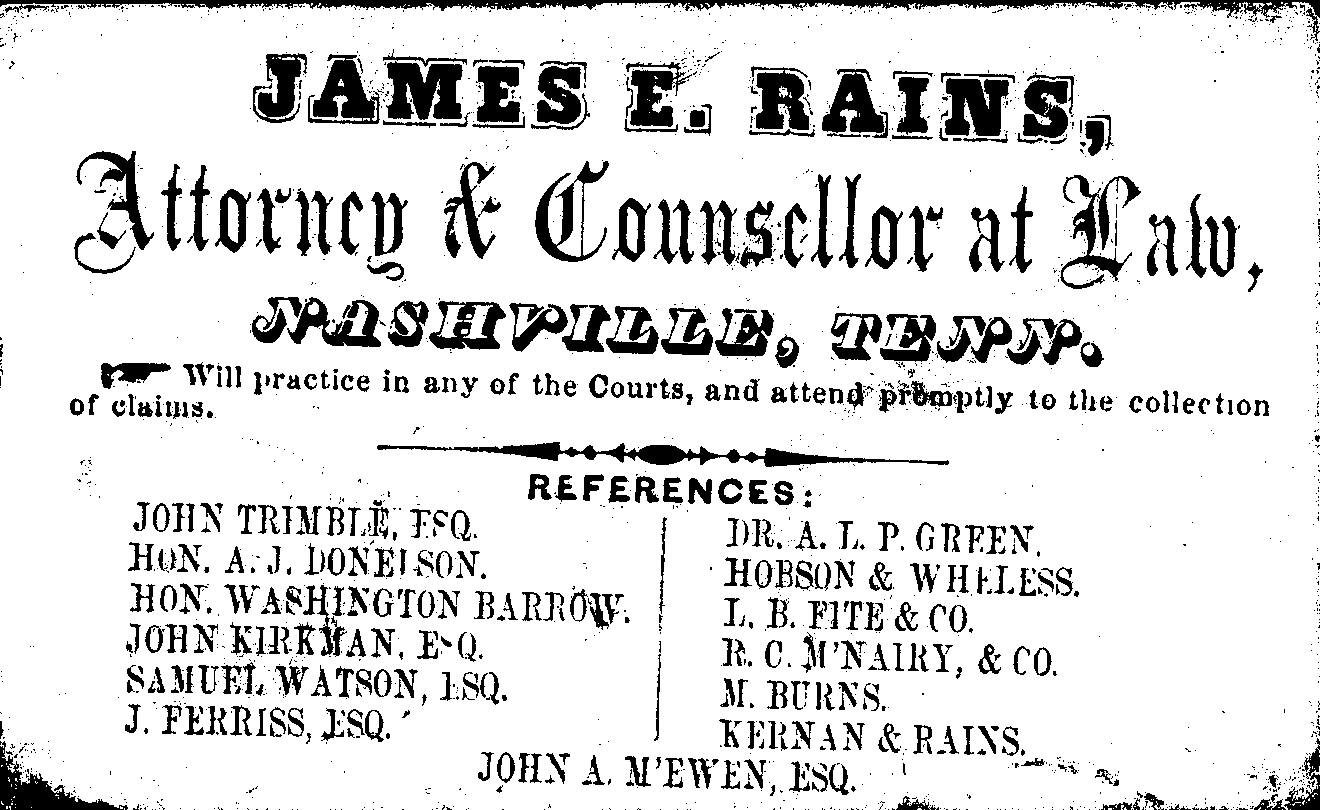
(Note, the above photo is a business card from lawyer James Rains, circa 1857. It says, “Will practice in any of the Courts, and attend promptly to the collection of claims.” It looks like he was a partner in the firm of “Kernan & Rains,” yet the card promotes Mr. Rains.)

Share

You wouldn’t be reading this if I didn’t have a blog

Share

I talk to a lot of lawyers who tell me they don’t have time for blogging or marketing on the Internet (or any marketing, for that matter). You’ve heard me say it before, marketing is the most important part of building a law practice.

I don’t care how good you are at practicing law, if you don’t have (enough) clients, you’re going to starve. And while your reputation and the natural referrals that flow to you as a result of doing a good job for your clients cannot be discounted, if you aren’t regularly engaging in marketing-related activities, you’re making a big mistake.

Marketing will bring you

  • More clients
  • Better clients
  • Better paying clients
  • More time (by hiring and/or outsourcing more lawyers and staff)
  • Writing and speaking assignments (that further build your reputation and bring you more clients, better clients, etc.)
  • Do I need to go on?

In the online world, you need (a) quality content, in (b) sufficient quantity, to attract (c) more traffic to your web site. People come, they see you as an authority who offers value (good content), and they (a) hire you, (b) refer clients, and/or (c) opt-in to your newsletter or other lists whereby you can stay in touch with them until they are ready to (a) hire you, or (b) refer clients.

But that’s just for starters. The traffic you generate to your blog who like what you have to say will tell others about you and your blog and those others will, in turn, (a) hire you, (b) refer clients to you, and (c) opt-in to your lists whereby you can stay in touch with them until they are ready. . .

And (and this is the big point) those visitors do the same. On the Internet, the growth of your web site and your practice is geometric, as this recent article explains. More begets more and if you’re not leveraging this opportunity for growth, you are missing out.

And so instead of saying, “I don’t have time. . .” you should be asking, “How can I find the time. . .”, because once you’ve made that transition, you will find the time. We all have 25 hours a day (God gave lawyers one extra hour) and we cannot manage time, all we can do is manage our priorities. When your priorities change, so will your schedule.

Share

How to get clients by email; the right and wrong approach

Share

I just got an email from a investment company representative that is a classic illustration of the WRONG way to use email to generate new business.

Hi David,

My group wanted to reach out to you to see if you have any interest in our services.

We are an independent, fee-only investment advisor with a proven track record and compelling value proposition. We have a sophisticated investment process that combines individual bonds and equities/ETFs to produce a tax sensitive, highly liquid, totally transparent, risk managed portfolio. Our philosophy is grounded in academically proven methodologies. We don’t do broker talk, just easy to understand investing.

Our CIO was formerly an executive corporate risk manager at BIG COMPANY, and a MAJOR UNIVERSITY grad and CFA. We have a solid understanding of not only equities and bonds but also foreign currency and interest rate risk management. We have retained over 95% of our clients over the last 5 years.

I wanted to see if you were open to exploring opportunities with us? Perhaps I can email you a 1 page breakdown about our firm, bio’s and performance?

Apologize for the email intrusion, however we believe it’s a less intrusive way of an introduction.

Best,

Name
Managing Director
Company Name

Okay, what do you think? Is this likely to bring in any business? What would you do differently?

I’m not concerned that it’s unsolicited. It’s okay to approach prospective clients or referral sources to introduce yourself in an unsolicited email. But you’ve got to do it right and the first thing that’s wrong with this email is it seeks to do much more than that and takes too much for granted about my interest in using this company’s services.

Too much, too soon.

Selling investment services is like selling legal services. It’s a process, over time. It’s based on a relationship between the professional and the prospective client or referral source and trust is integral to that relationship. Trust takes time and must be earned. (It can also be borrowed from a mutual contact who refers the parties).

Before marriage there is courtship and before courtship is the first date. You haven’t even asked me out but you want me to meet your family?

Too much, too soon.

So what’s a better offer? How about information that could help me save or make money, like a report or mp3 or newsletter with investing tips, strategies, or predictions? Or, how about an invitation to a free tele-seminar or web-inar? This would not only provide value it would also allow me to identify myself to you as a potential prospect for your services.

Offer something I want and I can have without a big commitment or a sales pitch. Make it easy for me to say yes.

(There’s another benefit (to you) of offering valuable information: it gives you an opportunity to demonstrate your expertise, which is much better than you simply proclaiming it.)

An offer must contain a benefit. What’s in it for me? What do I get out of it? Had this email offered valuable information I may have been interested in receiving it. The door to our relationship would have opened. You would have gotten my attention and eventually, over time, as trust is built, we might begin courting.

Another problem with this email is that it’s all about you–your firm, your experience, you, you, you. Talk to me about me–my concerns, my desires, my portfolio. I’m interested in my life, not yours.

Show me made an effort to learn something about me and what I do, perhaps a comment about my blog . I know it’s a form letter but if you had made any effort to personalize it, you’d have a much better chance of getting my attention.

Marketing is common sense. If we met in person, what would you say to get my attention? What would you offer that might make me interested in speaking further?

Emails like this make me think that common sense isn’t really that common.

Share