Search Results for: getting things done

Two questions to ask yourself every day

Share

Every day we accomplish things. Most of them are trivial. A few are important, advancing us towards our goals.

If you want to accomplish more of the important things, there are two questions to ask yourself every single day.

The first question should be asked the night before, about the following day: “What are my three ‘most important tasks’ for today?” I’ve talked about the concept of “MITs” before. They are a key to effectiveness, making sure you’re not just getting things done but that you are getting the right things done.

You may have ten things you need to do today. Only some of them move you forward and bring you closer to your goals. Those are your MITs.

Most people let their circumstances dictate their actions. They do whatever shows up for the day. Successful people, people who know what they want to be, do, or have in the future, let their vision of that future pull them forward. Your day may be busy, filled with many tasks, but “busy” isn’t the same thing as “effective”. If you want your day to be effective, you must do your MITs.

The second question to ask yourself each day is a reality check: “What did I do today that brought me closer to my goals?” Did you do your MITs? Did you start something and not finish it? Did you do other things that weren’t on your list of MITs but which advanced you towards your goals?

Being honest with yourself about what you did today will help you choose your MITs for tomorrow.

Ask and answer these two questions every day. They will help you create your own future.
Share

New eBook Shows Lawyers How to Use Evernote to Organize Everything

Share

If you’re a regular reader of this blog, you know how much I love Evernote. I use it for everything: notes, documents, writing, task management, you name it. Today, I’m proud to announce the release of a new eBook, “Evernote for Lawyers: A Guide to Getting Organized & Increasing Productivity“.

Lawyers manage an incredible amount of information and finding that information quickly is imperative. More and more attorneys use Evernote for capturing notes and web clips, and initially, that’s all I used it for. I’ve since discovered many other ways Evernote can be used to organize the information in my life, and that’s what this book reveals.

Topics include using Evernote for research and writing, time and billing support, marketing and career development, and managing client files and documents. Other chapters include, “going paperless,” “data security,” “working with email,” and “working with your calendar”.

Attorneys who use David Allen’s Getting Things Done® methodology (or want to), will want to read Chapter 4, which covers this subject at length. I’ve written before about my Evernote/GTD system. Evernote for Lawyers presents my latest thinking on this subject, as well as the latest updates to my gtd system and work flow.

Evernote currently has 20 million users world wide and was recently honored as Inc. Magazine’s 2011 Company of the Year.

Evernote is free and is available for Windows, Mac, on the web, and all major mobile platforms. A premium version with enhanced features is also available.

Evernote for Lawyers: A Guide to Getting Organized & Increasing Productivity is available for immediate download in pdf format at OrganizedLawyer.com

Share

The two elements of productivity (and why you need both)

Share

In his excellent article, “27 Productivity Killers: Why Nothing Ever Gets Done!” author Matt Tanguay presents a laundry list of reasons for failed productivity.

He begins with a “top level” view:

  • You have too much on your plate. Whether you don’t want to say no, you don’t know how or you can’t, you end up having too much to do.
  • The spirit is willing, but the flesh is weak. Your body has needs. You need to give it the proper food, exercise and time off to stay optimally healthy.
  • The flesh is willing, but the spirit is weak. Your attitude is greatly affected by external factors such as your relationships, your finances and the kind of work you’re doing.
  • There’s always tomorrow. Procrastination is caused by obstacles and friction. These tips will help you make sure you stop procrastinating altogether.
  • Stuff keeps coming up. Interruptions from email and phone calls, distractions from your personal life, as well as meeting overload can easily kill your productivity.
  • Doing the wrong things. Clarity is power. And once you’re clear about what you want, you need the right strategy and plan of action.

He then presents “productivity killers” in each of these areas.

But what is productivity? Is it

  • Getting things done?
  • Getting MORE things done?
  • Efficiency?
  • Effectiveness?

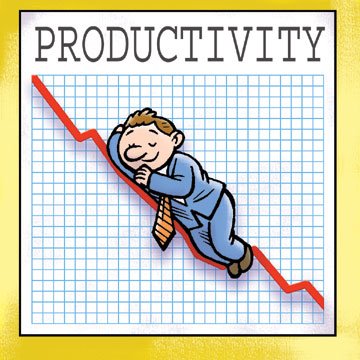
Productivity isn’t about getting things done, it’s about getting the right things done. Getting things done means you’re busy; getting the right things done means being effective.

But productivity is also about producing desired results efficiently, meaning as quickly and abundantly as you want.

You may be effective at bringing in clients but inefficient if this takes up too much of your time. You may be efficient at organizing your files but if this isn’t helping your practice grow (desired result), you’re not being effective.

Productivity requires effectiveness and efficiency.

By and large, Tanguay’s 27 “productivity killers” are really “efficiency killers”. They don’t necessarily stop you from producing desired results, but they could be slowing you down or making you pay too high a price for those results.

There are some good suggestions here. Just make sure you don’t use them to become efficient at the wrong things.

Share

“It’s the cases I don’t take that make me money”

Share

“Besides the noble art of getting things done, there is the noble art of leaving things undone. The wisdom of life consists in the elimination of nonessentials.” -Lin Yutang, writer and translator (1895-1976)

Last night, I spoke at an event. One of the topics I talked about was “The 80/20 principle,” aka, “The Pareto Principle,” the idea that a large percentage of our results come from a small percentage of our activities.

Afterwards, I was chatting with a man who works for a bankruptcy attorney. He liked my talk and was telling me about their practice and how busy they were. He quoted something his employer said, but I wasn’t sure I’d heard him correctly so I asked him to repeat it:

“It’s the cases I don’t take that make me money”.

He explained that the attorney was very selective about the cases he accepts. A lot of business comes knocking on his door, but he turns down a large percentage. He turns down the lower-end of the spectrum of clients, the ones who don’t have enough for a retainer, who need installments, price shoppers, etc., in favor of those who can pay his higher than average fees.

A lot of attorneys will take the lower-end clients, figuring that whatever they pay will contribute to overhead. But this attorney understands that those clients would actually cost him money, and not just in the literal sense of “not paying,” but because they would take up a disproportionate amount of time and energy.

And, he doesn’t have the extra overhead he would have if he accepted the lower end clients.

By eliminating as much as eighty percent of the possible client pool, he is able to run a lean and profitable practice. I’m sure he also makes it home for dinner.

Share

Evernote and my plan for achieving “Inbox Zero”

Share

I have tens of thousands of emails in my Gmail inbox. At last count, 16, 503 are unread. I have over 50 labels set up. I don’t use any of them. It’s a mess

When I first learned about Inbox Zero I swooned. The idea is intoxicating. When your inbox is empty, you are no longer overwhelmed by email. You are in control. You enjoy a Zen-like feeling of tranquility. You process your email inbox once or twice a day, keeping it at zero. You have a “mind like water”.

I loved the idea, but the thought of going through tens of thousands of emails was about as appealing as a state bar complaint.

Email has long been the final frontier in my productivity makeover. I’ve resisted changing for a long time. But now, I have a plan.

My plan involves my favorite productivity tool, Evernote, which I use for collecting information and managing my projects and tasks. I use it all day long, in every part of my work flow, as my tool for Getting Things Done. Read my previous posts on how I use Evernote for getting things done.

Right now, when I get an email that requires action of any kind (a reply, a call, review, read, etc.) or that is related to a project I’m working on, or is something I want to keep for reference purposes (receipts, newsletter ideas, research, documents, etc.), or something I am waiting for, I forward that email to Evernote. I then tag it and incorporate it into my gtd system.

If an email requires a reply that will take no more than two minutes, I do it. I may also send a bcc to Evernote.

Sometimes, I get emails requiring action that I don’t send to Evernote. An example is an email I got recently from someone I hadn’t spoken to in a long time. I didn’t want to dash off a quick reply, I wanted to give it some thought. In this case, I added a @Reply label and archived the email in Gmail. When I’m ready to reply, the label will help  me find it.

Yes, I could also send these to Evernote, but I like having the orignial email connected to my reply. And, if I do send it to Evernote, I want to do so after I’ve replied, so I have both the original email and my reply in one Evernote note.

So, here’s my plan for achieving email bliss using Evernote and Gmail:

First, when I have some quiet time, (this will probably require several sessions), I will go through my Gmail inbox, scanning (not reading) and quickly doing the following:

  1. Unsubscribing from newsletters I don’t read.
  2. Adding @Reply label to anything I need to reply to that will take more than two minutes but does not need to be tracked.
  3. Sending Action and Reference items to Evernote.
  4. Trashing or archiving everything else.

Once my email inbox is empty, as new emails come in, I will review and process them, as follows.

  • If it requires a response or action that will take two minutes or less, I will do it, then Archive it; if I want to, I can also send a bcc to my Evernote account.
  • If it will take more than two minutes but I don’t need to keep notes, add it to a project, or track it, I will label it @Reply and do it as soon as possible.
  • If I’m waiting for a reply or for something to occur, I will send it to Evernote (and add a @Waiting tag).
  • If it’s something I want to keep for reference, an important email, an exemple of a good sales letter, a receipt, or something I want to read later, I will send it to Evernote.
  • All other emails will go into Archive or get trashed. At day’s end, I will again have an empty Inbox and an empty mind.

The premise behind all of this is to identify emails that need action. That’s key. Everything else is reference and can be found through search.

Note, I will use just one label in Gmail, @Reply. I am open to adding others down the road, but only if they truly serve me. For example, I may find it easier to label emails @Read/Review in Gmail, rather than sending them to Evernote for that purpose. I may also add labels for specific projects, or use them temporarily (e.g., for promotions). But for now, one label will do.

Wish me luck. I’ll let you know how it goes.

Have you achieved “Inbox Zero”? What do you think of my plan?

Share

David Allen on how to handle distractions

Share

I thought you’d enjoy this short video by David Allen, the “Getting Things Done” guy himself.

[mc src=”http://www.youtube.com/watch?v=FTTQfeMGbd4&feature=player_embedded#!” type=”youtube”]David Allen on how to handle interruptions[/mc]

Share
Share

Attorney Marketing Center Products

All of my courses, books, and reports are all designed to help you get more clients and increase your income–to earn more and work less.

The Attorney Marketing Formula

The Attorney Marketing Formula: How to Earn More Than You Ever Thought Possible

Do you want to get more clients and increase your income? This 200-page course shows you how. You’ll get practical strategies you can use to increase your income without working harder or doing anything you don’t want to do. Learn more.

Buy Now


Make the Phone Ring: A Step-by-Step System for Attracting Good Clients

Make The Phone Ring: A Step-by-Step System for Attracting Good Clients

Most attorneys don’t have an effective website. This comprehensive course shows you what to do to get more clients online. Learn more.

Buy Now


The 30 Day Referral Blitz: How to Get More Referrals Without Asking for Referrals

The 30 Day Referral Blitz: How to QUICKLY Get More Referrals Without ASKING for Referrals

Attorneys love referrals, don’t we? We just don’t like asking for referrals. This report presents a simple step-by-step system for quickly getting referrals from clients and professional contacts without asking for referrals. Learn more.

Buy Now


Get the Check: Stress-Free Legal Billing and Collection

Get the Check: Stress-Free Legal Billing and Collection

This ebook presents stress-free legal billing and collection techniques that help attorneys get paid and keep their clients happy. Learn more.

Buy Now


Evernote for Lawyers: A Guide to Getting Organized & Increasing Productivity

Evernote for Lawyers: A Guide to Getting Organized & Increasing Productivity

Do you have too much information in your life? Do you spend too much time organizing to-do lists instead of getting things done? This ebook shows you how to use Evernote to get organized and increase your productivity. Learn more.

Buy Now

Share

https://www.attorneymarketing.com/products/

Overcoming marketing overwhelm

Share

You’ve read the books and blogs, watched videos about marketing professional services, attended seminars, listened to podcasts, and subscribed to more than a few newsletters about legal marketing. 

You have a long list of ideas, things to do to bring in more clients and better clients and increase your income. That’s the good news. Too often, it’s also the bad news because with so many ideas and options, with a long list of tasks on your marketing todo list, it’s easy to get overwhelmed and do nothing. 

Ask me how I know. 

You have clients and cases to work on. You don’t particularly enjoy most of the things we call marketing and often have to force yourself to do them. You don’t want to hire more people or spend more on advertising, but you know you need to do something to build your practice and you are willing to do it, you just don’t know what “it” is. 

I have a solution. A way for you to cut through the overwhelm and resistance and make progress. 

The first step is to gather up all of your ideas and notes and lists and put them in one place. Create a master list of things you could do, might do, want to do, and (you believe) will do (eventually).

Put everything in one big pile. Get everything out of your head, out of your drawers, off your desk, off your legal pads, out of your computer files. 

Go through that pile and make a master list of tasks and projects and ideas. Or get your favorite ai to do it for you. 

It’s still overwhelming, I know, but less so than when you had notes and notebooks and files everywhere. You’re making progress. 

Okay, you have a list. It’s messy and long and unorganized but it’s a list. 

What’s next? 

Next, read through your list and put a star or symbol or tag next to anything that stands out to you as urgent. 

If there is an upcoming event you need to prepare for, an inquiry to respond to, an email or phone call you need to do,  a bill to pay, a problem with your website, anything that shouldn’t wait, take care of them. Do it or delegate it. You’ll feel better.

But this is marketing, not legal work, so there’s probably not a lot that’s urgent.

What about everything else?

You might think I’m going to suggest prioritizing your remaining list in terms of importance, Eisenhower Matrix or Priority Matrix style. If you can, have at it. If it’s still overwhelming, you don’t know what’s truly important, or you just don’t feel like going through this process, there’s something else you can do. I think you’ll like it.

Read through your list, quickly, and choose five to ten things you would like to do this week. 

Not twenty, five or ten. Not things you think you should do, things you’d like to do.

Later, you’ll zero in on what’s important. For now, pick five to ten things you’d like to do–because they seem fun or easy or quick wins. Theis will help you get started, and getting started on something you resist doing (e.g., marketing) is key. 

Let’s recap. 

You’ve made a master list, taken care of urgent matters, and made a list of five to ten things you’d like to do this week. 

You’ve sorted out your week. The next step is to sort out your day. 

Go through your list for the week and choose one task for today. Just one. Okay, two if you must, but one is great. 

Do that one task today. Look at you, you’re marketing. 

If you finish that task, you can go back to your week’s list, or, if that’s complete, your master list, or your “inbox” and choose something else. 

I follow this process for all of my tasks, not just marketing. Each week, I choose six tasks I want to do for the week, one or two I want to do today. (These are my most important tasks. I have separate lists for routines, etc.)

This system works for me. I get a lot of important tasks done. Try it and see for yourself.

Overwhelm, marketing or otherwise, will be a thing of the past.

Get my best marketing and productivity ips and ideas in my free newsletter

Share

Why clients choose you

Share

Clients have options. Lots of them. So, why do they choose you?

You can learn how they found you by asking, “How did you find me?” You can also do intake and exit surveys, track your leads and advertising metrics, and you should.

Did they find you via search? What keywords do they use? Did they see your ad? Which publication, what day and at what time? Were they a referral? From which client or business professional, and what did they say about you?

The list goes on.

But while this is important information and you should continue doing what you do to get found by prospective clients, it doesn’t answer the bigger question: when they find you, why do they hire you instead of all the other attorneys they could choose?

Even the most unsophisticated client knows there are other attorneys who do what you do, and they know how to find them.

So, why you?

Sometimes, the answer is simply that you were the first one they looked at. They needed help and didn’t think they could wait. Or you looked like you could do what they needed or wanted done, and they didn’t want to spend time looking at other options.

But that’s not always the case. You should assume that a significant percentage of prospective clients do take the time to look at other options and that they compare them to you.

And so besides getting found, you need say and do things to stand out from other attorneys. You need to differentiate yourself so clients see choosing you as the best option.

The good news is that this isn’t as difficult as you might think. And, while other attorneys might be able to say the same things you could say, the fact is that many attorneys who could, don’t.

Many attorneys don’t say much of anything beyond name, rank, and serial number. Which makes your job much easier.

Okay. What could you say about your services or about yourself to make yourself stand out? That’s what you need to figure out. Here are some ideas to get your juices flowing:

You’re good. You have achieved millions or billions of dollars in verdicts or settlements for your clients, won awards, achieved records your competition haven’t.

** You’re trustworthy. You have many testimonials and endorsements, people who say good things about you, tell their stories and recommend you.

** You’re tough. You have a military or athletic background, or have taken on seemingly impossible cases or causes and beaten the odds.

** You’re smart. You have an academic background; you teach other lawyers (school, continuing education), you’ve been a judge, you do a lot of speaking, have written books, write a blog or newsletter, or served on committees.

** You’re well-known. You have been interviewed in prestigious publications, quoted by your peers, run for office, are the president of your local bar association,

** You’re focused. Clients prefer lawyers who specialize in their particular problem or type of case, or who focus in their niche or market.

** You’re like them. You grew up in their town; you had the same major in school; you read the same authors, or listen to the same kinds of music.

** You’re well-rounded. You have a good sense of humor, play guitar in a band, play sports, coach your kid’s soccer team, are active in charitable or humanitarian causes.

** You’re likable. You say things that make them smile, show them you truly care about your clients, tell stories that make them think.

** You explain things clearly. You thoroughly tell people about your work and how can help them. You spell out the steps, keep things simple, and don’t present too many options.

** You make it easy to hire you. You don’t bury them in details, fine print, disclaimers, and red flags. You spell out the next step and make it easy to take.

Figure out what makes you different and feature that in your marketing. It’s often the reason the people who find you hire you.

Subscribe to the Attorney Marketing Letter and get these posts in your inbox

Share

The probem with free consultations

Share

In the past year, my wife and I wanted to do some upgrades to our house and searched for contractors to get estimates. To my surprise, many contractors didn’t offer free estimates. They asked for a fee of $50 or $80 or more to provide an estimate, which they would credit back to us if we decided to hire them. 

On principle, we rejected these contractors and called others who did things the old-fashioned way, coming out to look at the job and giving us an estimate.   

I’m sure the “new age” contractors would say they no longer provide free estimates because of the expense of advertising and hiring salespeople and the like, and that statistically, since most customers who get bids don’t hire them, charging a small fee for an estimate helps defray some of their expenses. 

And weed out people who are “just looking” and not committed to getting the work done. 

A seemingly logical argument. But the reality is that we called (and hired) contractors who advertised free estimates. We didn’t call or hire ones who didn’t.  

I’m sure many customers would say the same thing. 

Now, attorneys. 

Some offer free consultations (and estimates) and some don’t. It depends on their practice area and market. And legal services have different metrics than contractors, so I’m not going to tell you to do one thing or the other. 

but I will tell you to think about it. 

Whatever you’ve always done, you might consider making some changes. After all, success in marketing boils down to having more conversations with more prospective clients and you might want to find ways to do more of that.

A different business model might might give you a competitive advantage. It might bring you more clients, decrease your overhead, and increase your (net) income. 

On the other hand, it might not. 

Attorneys argue that if they provide free consultations, they give prospective clients their legal opinion, and they are entitled to be paid for that. 

That’s true. But you know the answer to that. 

Give prospective clients enough information and advice to help them see that they have a problem and that you have the solution, but not so much information and advice that they don’t need to hire you. 

Share