[mc src=”http://www.youtube.com/watch?v=nGugj1ym594&feature=player_embedded” type=”youtube”]The Google+ song[/mc]
The Google+ song–listen and learn!
Social media marketing for a**holes and other lawyers
We often hear that the secret to success in marketing is to “be yourself”. But what if you’re a jerk?
Can you build a successful law practice if you’re not likable? Actually, I think you can. We all know lawyers who clearly haven’t read, “How to Win Friends and Influence People” but build successful practices anyway. Their strengths–drive, work ethic, skill set–allow them to overcome their interpersonal shortcomings.
What if the successful jerks of the world weren’t jerks–would their success have come any sooner or been any bigger? One could argue that it’s better to have people like you and want to be around you, that it’s better to be liked than respected. But that’s not true of sports coaches or military leaders. They don’t want friends, they want to win. In fact, in the sports and military realms, befriending your charges can be a liability.
Speaking for myself, yes, I do want to be respected and I also want to be liked. I feel good when people appreciate not only my work but me as a person. I like to be liked and I think you do, too, and while we may not need to be liked to be successful, for most of us, it does make it easier.
The article, “20 Reasons People Unfollow You on Twitter,” provides practical advice for building your social followers, (actually, for not losing your social followers), but also a paradigm for un-likeability in general. If you are an unrelenting self-promoter of your legal services, for example, a common failing of many attorneys in social media and in-person networking, you’re chasing people away. They don’t like you and they don’t have to listen to you–and they don’t.
In social media, likability has another meaning: “follow-worthy”. People may not like you personally but if you provide good content, they may “Like” you and follow you. Social media metrics don’t care if you’re nice or not, either your numbers are going up or they aren’t and if they aren’t, you can do something about it.
I just put, “Likeable Social Media: How to Delight Your Customers, Create an Irresistible Brand, and Be Generally Amazing on Facebook (& Other Social Networks).” on my reading list, after reading this review. I think I’m a likable guy but hey, who wouldn’t want to be “generally amazing on Facebook (& other social networks)”?
Lawyers: Facebook, Twitter or Google+?
Larry Bodine said goodbye to Facebook and Twitter; he’s now a “plusser”. Jennifer Golden is fed up with Google+ fanatics; she says Google+ doesn’t do anything you can’t already do on Facebook. And with the recent growth of Linked In, Steven Fairly notes the increased opportunities for lawyers to meet new referral sources.
So who’s right? Which social media is best for marketing legal services?
I think this is the wrong question.
If you’re going to incorporate social media into your marketing, why would you want to ignore Facebook, for example, with 750 million users, or Twitter, with it’s preponderance of influential Twitterati?
Social media marketing is time consuming. Checking in, following, commenting, posting, sharing, finds most people spending way too much time relative to the return on that time. And so most of us do have to pick and choose what we do with social media. But that does not mean we have to give up one platform in favor of another.
I am not a social media power user. I’m still trying to figure out Facebook fan pages, but I do have one. Twitter seems like the place to go if you like lots of noise, but I do regularly post. I have accounts with Linked In and Youtube. And I have a Google+ account which I haven’t spent much time on yet. So I am “connected” via social media, at least insofar as the biggies are concerned, and you should be, too.
But here’s the thing: I’m not connected via social media because I am “social,” I’m connected because that’s where the people are. I may not be very active on any one social media platform but many of the people who follow me are. When I share something they like, they share it with their followers. And that’s the point.
If you want to do ANYTHING with social media marketing, here’s what I recommend:
- You should have business accounts with Facebook, Twitter, LinkedIn, and, probably, Google+. Youtube is the only other option, if you produce videos. Don’t worry about the hundreds of other social media platforms, stick with these, that’s where the big numbers are. You will have to add/follow folks so that there is someone to talk to, but this can be done late at night, and will grow, over time. A few will lead to a few more and if you regularly post good content, this will occur (to some extent) naturally.
- Connect your social media accounts to your web site or blog. Encourage visitors to follow/friend you and to use the social media badges on your site to share your content with their friends and followers.
- Use software that allows you to post/update on all platforms simultaneously. If you have a blog, your RSS feed should post to your social media accounts; when you tweet on Twitter, your Facebook friends and fans should see the update.
- Share your good content or somebody else’s, once or twice a day. Check your emails and direct messages, reply if warranted (this is networking, after all), but unless you are very good at growing your social media network and it is resulting in clients, and thus, is a significant source of growth in your practice  (or you want it to be), you don’t need to spend more than 15 minutes a day on social media.
- As for your favorite platform, the one where you focus a bit more of your time and energy, just pick something. It doesn’t matter which one. As the social media world grows, Facebook may wane and Plus may wax and many things will change. Nobody knows where social media will be in five years, let alone five months, so don’t sweat it.
- Lastly, if you don’t understand social media (and don’t want to) or you don’t enjoy it, if you have more money than time, I give you permission to disengage from all social media and do something else to grow your practice. Life is supposed to be fun, and that includes business, and if it’s not, do something that is.
Is Twitter marketing for lawyers a waste of time?
A new study, reported by Mashable, finds that while nearly half of Americans use Facebook, only 7% use Twitter.  So, is it safe to ignore Twitter in marketing your law practice? The answer lies in an understanding of who uses Twitter.
According to the study, Twitter usage is dominated by “power users,” (approximately 22%) who are responsible for the majority of Tweets (approximately 90%). While these probably don’t reflect the target market of most lawyers, it’s logical to assume that this group of regular Tweeters is comprised of well-connected, avid communicators who could turn out to be a great source of referrals for lawyers.
I don’t think I’m going out on a limb here by suggesting that the frequent-tweeter club includes a lot of professionals, many of whom have followers in your target market. The numbers may be small but the influence is great. These are the folks you want to meet–and network with–and Twitter is a great way to find them.
Twitter is also continuing to grow and enter the mainstream. Those of us who have staked a small claim will benefit by that growth.
I don’t consider myself a power user of Twitter or any other social media tool. Far from it. But through Twitter, I’ve been able to meet some power users. And that’s the point. Networking is not about meeting everyone, it’s about meeting a few of the right people.
Social media is dangerous for lawyers with big mouths and thick heads
Kevin O’Keefe commented today about an article in the ABA Journal suggesting that social media for lawyers is dangerous. As proof, the article cites bone-headed lawyer moves such as blogging about a Judge and calling her “a witch,” “mentally unfit,” and “unfit for her position”; an assistant public defender revealing confidential information about cases she was working on online; and, ex parte communication via Facebook between a judge and an attorney appearing before him.
For attorneys like this, yes, social media is dangerous. But so is the Postal Service, fax machines, email, and courtroom hallways. Lawyers with poor ethical grounding or loose lips are a danger anywhere they are allowed to speak.
It’s true that social media gives lawyers even more ways to show their ignorance or lack of discretion. But that doesn’t mean we need new rules restricting its use. So says Mr. O’Keefe and I agree, as I’ve written before.
In fact, couldn’t we make the case that what’s really dangerous is the idea of restricting social media? Aside from it being an assault on freedom of speech, it would be an assault on the use of common sense. Putting extraordinary limits on attorneys’ use of social media might give readers a false sense of trust in what they read online. I don’t know about you but I don’t want to live in a world where people think, “I saw it on Facebook so it must be true.”
Are you branding your law firm? Here’s why you shouldn’t.
When one of your clients has a friend or business contact who needs a lawyer, they’ll hand their friend your business card (we hope) and say, “Here, call my lawyer”.
Notice they don’t say, “Here, call my law firm.”
Your clients have a relationship with you, not your firm. Even if you are a partner, your brand is “you” and “you” is what you should be promoting.
If permitted, you should have your own web site or blog, your own social media accounts, your own domain name, and your own email account (you@yourdomain.com).
If all you do is promote and brand your firm, what happens if you leave the firm or the firm disbands?
Your brand is valuable. It should be protected, nurtured, and grown.
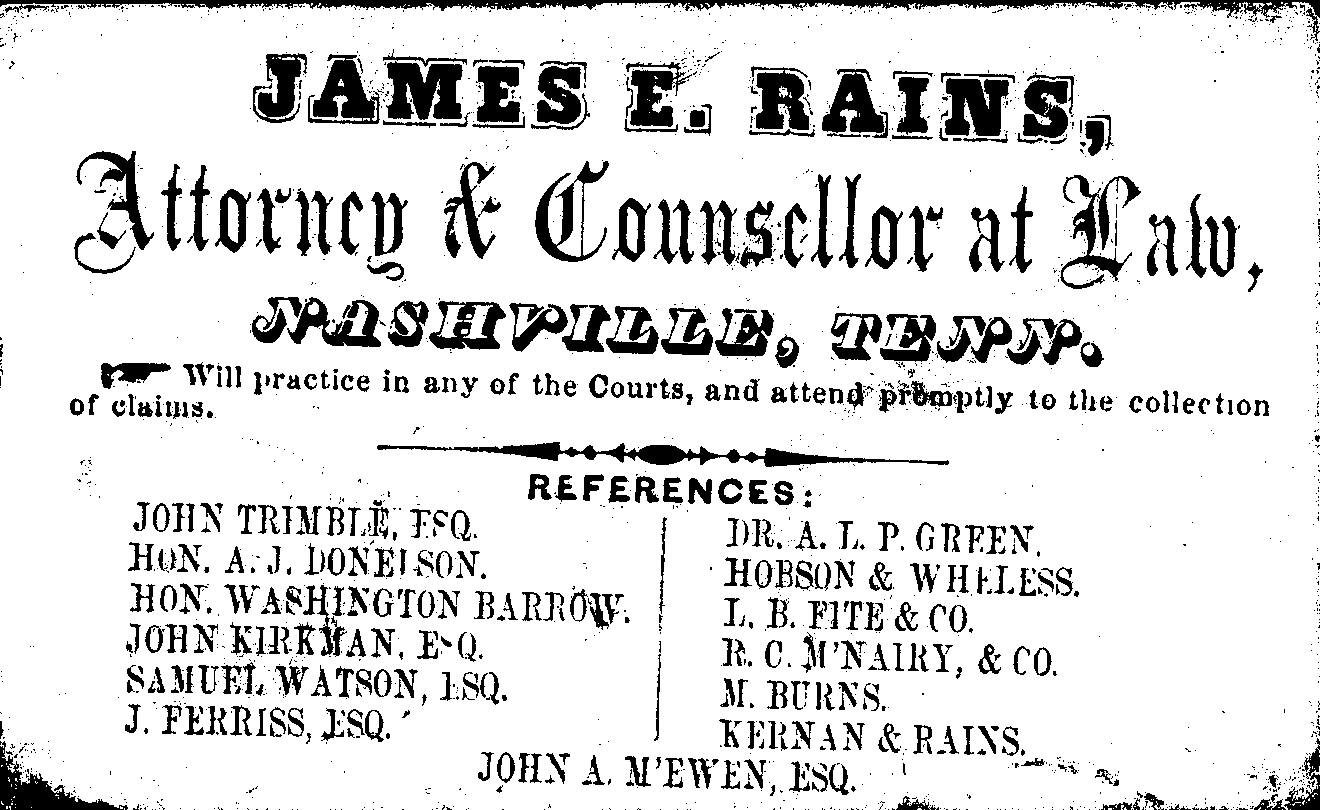
(Note, the above photo is a business card from lawyer James Rains, circa 1857. It says, “Will practice in any of the Courts, and attend promptly to the collection of claims.” It looks like he was a partner in the firm of “Kernan & Rains,” yet the card promotes Mr. Rains.)
What do SEO and client relations for lawyers have in common?
“I’m a busy lawyer. I don’t have a lot of time to write a newsletter or blog.”
Good. If you have time to write a lot, your clients and prospects might not read what you send them.
While frequency of contact is important, quality is far more important. Instead of writing low-quality weekly messages, you’ll do far more to strengthen your relationships and build your reputation by sending a high-quality missive once a month.
I am subscribed to hundreds of blogs and email newsletters. My email inbox and RSS feed reader are inundated. Several times a day I peruse these offerings. I spend most of that time skimming the headlines and deleting or archiving nearly every article. I may scroll through ten or twenty percent but I probably read no more than two percent. The ones I read (and, often save) are where the real value for me lies.
I stay subscribed to this multitude of newsletters and blogs because they give me a sense of what’s trending in my areas of interest. I also find articles I can share with my Twitter and Facebook companions. And, I do find articles worth reading. If I don’t have time to read them on the spot, I save them to read later. Many of the publications I follow publish several times per week; some of the bigger publications publish twenty or thirty articles per day.
I filter through a large quantity of articles looking for the few of high quality. Sometimes they come from the multitude. More often, they come from the handful of sources that consistently provide high quality material. They may not post frequently and not everything they post is golden, but the most useful material (for me) usually comes from the same sources. Those are the ones I look forward to and make sure I read.
So, if you write a newsletter or blog, you don’t have to write every day or three times a week or even weekly. Write when you can but make it worth reading. Your clients and prospects will appreciate it.
Apparently, uncle Google agrees. Carolyn Elefant writes that while in the past, quantity of keywords and links to a web site determined primacy in search engine ranking, Google has modified its algorithm to better reflect the quality of those keywords and links. You don’t need everyone linking to your site, so long as you have the right ones.
More ways to create a virtual business card or social media hub page
Attorneys carry business cards. Always have, always will. Today, attorneys also need a virtual business card, a web page displaying their basic contact information and links to their social media accounts.
I published a video about the virtual card I created, using a wordpress plug-in. But what do you do if you don’t have a wordpress.org-powered site? This article has some great alternatives.
I opened an account at card.ly. Unfortunately, as the article notes, the skin customization preview isn’t working.
I also downloaded The Digital WordPress Business Card Theme, to try out on my site. I’ll update this post if I wind up switching.
With the continued growth of Internet usage in general, and social media in particular, Â attorneys need to make it easy for people to find them. Virtual business cards and personal social media “hub pages” are a simple way to do that.
This is WHY the ABA wants new rules to regulate online lawyer marketing
Last week, I joined the chorus of attorneys who strongly object to the ABA’s proposal to promulgate new rules regulating what attorneys can do on the Internet to market their services.
This weekend, I saw a video of a TV commercial by Florida divorce attorney, Steven D. Miller and thought I might have been hasty. The video, which someone put on YouTube with the caption, “Tackiest Lawyer Ad. . .Ever,” is a prime example of why the ABA is considering new rules. Watch and you’ll see why.
[mc src=”http://www.youtube.com/watch?v=y1Qk6QPzuIc” type=”youtube”]Tackiest Lawyer Ad Ever[/mc]
Wait. It gets better.
The web site for Mr. Miller’s practice is. . . (are you sitting down?). . . “DivorceDeli.com“. Yep, you can look at their menu, call or click, and order your divorce. “Would you like pickles with your restraining order?”
I’m pretty open minded but let’s face it, this commercial and the entire “deli” concept is in very bad taste. It reflects poorly on all lawyers. One subscriber to this blog wrote to say he was against lawyer advertising of any kind because of the negative impression lawyers’ TV commercials have on juries and this has to be “Exhibit A”. But as ugly as this is, I still don’t want (or think we need) more rules.
I don’t want to legislate taste. I don’t want to outlaw embarrassing behavior. I don’t want to be told what I can and cannot do. And, unless it is the only way to prevent serious, irreparable harm, I don’t want to tell anyone else what to do.
Mr. Miller obviously does what he does because it’s working for him. God bless him. He’s serving a segment of society that might otherwise be denied access to the legal system because of their lack of funds (or good taste). I disagree with his approach but I must defend his right to do what he does without interference from the ABA or anyone else.
So, whether you laughed at this video and web site or recoiled in disgust, I hope you’re with me. If you agree that despite examples like these, we don’t need or want additional regulations, please tell the ABA.
Comments should be sent to: Natalia Vera, Senior Research Paralegal, Commission on Ethics 20/20 ABA Center for Professional Responsibility, 321 North Clark Street, 15th Floor, Chicago, IL 60654-7598. Phone: 312/988-5328, fax: 312/988-5280 and email:Â veran@staff.abanet.org. The comment period ends on December 15.


Do lawyers need a blog?
Sorry, but you didn’t miss much.
From a technological standpoint, not much has changed since I switched to the blog format. I’ve changed the color and layout and added some new plug-ins, mostly having to do with social media integration, but not much else.
My site has grown because I focused on creating content, not on the latest bells and whistles. Content creates value for visitors, allows you to demonstrate your expertise, and brings traffic from search engines and from word of mouth. And so the number of subscribers to my newsletter has grown and the number of blog subscribers has grown and I have continued to sell products and services.
Do you need a blog? If you want to get more clients online I think you do.
A blog has several advantages over a static web site. As you update your content, search engines are notified and they bring visitors. As those visitors see the solutions you provide, they may (a) take the next step toward hiring you, (b) connect with you by subscribing to your newsletter or your blog feed or commenting on your posts, or (c) tell others about you via social media.
Your blog allows prospects and referral sources to see you “in action”. Your content is not just puffery about how great you are it is an exemplar of your abilities. As visitors become familiar with your style and hear your “voice,” as they get to know and trust you, your preeminence grows, your traffic grows, and your client base grows.
You can set up a blog yourself  in about an hour. WordPress makes is easy. There are many free and inexpensive “getting stated” videos available and you can hire people inexpensively to do it for you. Contact me if you would like some referrals.
Once you have your own blog, you control it; you don’t have to wait for tech support to do updates for you, you can do them yourself. It’s as quick and simple as using a web browser. And, other than paying for hosting (under $10/month), it’s free.
What about content–do you have enough to say? Trust me, you have enough. There is an endless amount of material you can supply. Everything from posts about the law and procedure in your practice areas, success stories you helped created, general business (or consumer) advice, guest posts from experts (referral sources) in allied fields, and much more. A post can be as short as a few paragraphs and as simple as you commenting on something you found on another web site or blog or in the news. And you can outsource content creation, too.
A blog may seem to be a big commitment but think of it as the front door to your online office. You won’t be there 24/7 but your presence will be. If you write an offline newsletter, publish articles, or do any public speaking or networking, you are already doing the things that are done online through a blog.
If you have a web site, you have something you can point to and that’s good. But you have to do the pointing. If you want free traffic, you need a blog.