
The principle of accelerating acceleration

Share

In “The Slight Edge,” Jeff Olson talks about the power of doing “the little things” over and over again, consistently, over time, until the compounded effect of those small efforts produces dramatic change. Brian Tracy, in “Create Your Own Future: How to Master the 12 Critical Factors of Unlimited Success,” calls this same phenomenon, “the principle of accelerating acceleration.”

Tracy, who sees the principle as a corollary of “law of attraction, says, [page 48], “Whatever you are moving toward [i.e., a goal] begins moving toward you as well.” His characterization of how the principle operates should be given to every attorney who is about to start their own practice:

“When you first set a new, big goal and begin moving toward it, your progress will often be quite slow. You may be frustrated and think of giving up. The bigger your goal, the further away it will seem. You may have to work on it for a long time before you see any progress at all. But this is all part of the process of goal attainment.”

“The 20/80 rule helps to explain the principle. . . . For the first 80 percent of the time that you are working toward your goal, you will only cover about 20 percent of the distance. However, if you persist and refuse to give up, you will accomplish the final 80 percent of your goal in the last 20 percent of the time that you spend working on it.

“Many people work for weeks, months, and even years toward a big goal and see little progress. They often lose heart and give up. But what they didn’t realize is that they had laid all of the groundwork necessary and were almost at the take-off point. They were just about to start accelerating toward their goal, and their goal was about to start moving at a great speed toward them.

“This principle of accelerating acceleration seems to apply to almost every big goal that you set for yourself. You must therefore decide in advance that you will never give up.

So, as you contemplate how you might create your own future in the new year, start with your long-term, visionary goals. Decide now that they are worth the effort you are about to make. Get used to the idea that you probably won’t see most of the results you seek for a long time. And then, and only then, when you tell yourself (and anyone else who will listen) that you won’t give up until you get what you want, you might actually believe it.

Share

Social media marketing for attorneys

Share

This isn’t an attorney but he offers a cogent explanation of how social medial should fit into an attorney’s marketing mix. What’s that? You don’t have a mix? Oh my, you really should have a mix. . .

[mc src=”http://www.youtube.com/watch?v=zn1cspHx7DU” type=”youtube”/]

Share

What could you do if you didn’t know any better?

Share

This clip, from the movie, “Facing The Giants,” is a poignant reminder that we can do more than we think we can. It also shows you why you should never give up.

If you need a bit of inspiration, or a kick in the seat, watch this clip and ask yourself, “What could I do if I didn’t know I couldn’t?”

And go for it.

[mc src=”http://www.youtube.com/watch?v=-vB59PkB0eQ” type=”youtube”/]

Share

The ABA Journal wants to know what lawyers think about the economy. I don’t.

Share

How’s business? The ABA Journal wants to know. They are surveying lawyers on the job market and the state of the economy. They’ve asked me to mention this on my blog, so here it is:

http://www.surveymonkey.com/s.aspx?sm=9Dhw2g7bX_2bxfq4mW8eB1Cg_3d_3d

Surveys are interesting, but guess what? The job market and the state of the economy have no bearing on your life. Unless you believe it will.

If you believe the economy will materially affect your practice or job, it will. If you believe it won’t, it won’t.

Does that sound naive? Some kind of new age hooey? Well, if you believe that, then for you, that’s exactly what it is. But I have different beliefs. I believe we create our reality. I believe we can choose to be successful in the face of adversity or we can choose to capitulate, wring our hands, and suffer along with everyone else.

It’s our choice.

You can choose personal responsibility. You can choose to be optimistic. You can choose to see opportunity when others see Armageddon. In the Depression of the 1930’s, unemployment was twenty-five percent and millions suffered. But many made fortunes. I guess they understood that periods of great change create opportunities for the status quo to change. Of course that’s also why many previously wealthy people jumped out of windows.

Business philosopher, Jim Rohn, said, “It is the set of the sails, not the direction of the wind that determines which way we will go.” How are you choosing to set your sails?

——-

Update: In case you’re interested, here’s a link to the survey results: http://www.abajournal.com/magazine/14307_lawyers_predict_the_future

Share

Never, Never, Never, Never give up!

Share

Where would our world be if these people gave up? Think about these people the next time you’re thinking about quitting.

As a young man, Abraham Lincoln went to war a captain and returned a private. Afterward, he was a failure as a businessman. As a lawyer in Springfield, he was too impractical and temperamental to be a success. He turned to politics and was defeated in his first try for the legislature, again defeated in his first attempt to be nominated for congress, defeated in his application to be commissioner of the General Land Office, defeated in the senatorial election of 1854, defeated in his efforts for the vice-presidency in 1856, and defeated in the senatorial election of 1858. He later became the 16th President of the United States of America.

Winston Churchill failed sixth grade. He was subsequently defeated in every election for public office until he became Prime Minister at the age of 62. He later wrote, “Never give in, never give in, never, never, never, never – in nothing, great or small, large or petty – never give in except to convictions of honor and good sense. Never, Never, Never, Never give up.”

Sigmund Freud was booed from the podium when he first presented his ideas to the scientific community of Europe. He returned to his office and kept on writing.

Robert Sternberg received a C in his first college introductory-psychology class. His teacher commented that “there was a famous Sternberg in psychology and it was obvious there would not be another.” Three years later Sternberg graduated with honors from Stanford University with exceptional distinction in psychology, summa cum laude, and Phi Beta Kappa. In 2002, he became President of the American Psychological Association.

Charles Darwin gave up a medical career and was told by his father, “You care for nothing but shooting, dogs and rat catching.” In his autobiography, Darwin wrote, “I was considered by all my masters and my father, a very ordinary boy, rathe below the common standard of intellect.” Clearly, he evolved.

Thomas Edison’s teachers said he was “too stupid to learn anything.” He was fired from his first two jobs for being “non-productive.” As an inventor, Edison made 1,000 unsuccessful attempts at inventing the light bulb. When a reporter asked, “How did it feel to fail 1,000 times?” Edison replied, “I didn’t fail 1,000 times. The light bulb was an invention with 1,000 steps.”

Albert Einstein did not speak until he was 4-years-old and did not read until he was 7. His parents thought he was “sub-normal,” and one of his teachers described him as “mentally slow, unsociable, and adrift forever in foolish dreams.” He was expelled from school and was refused admittance to the Zurich Polytechnic School. He did eventually learn to speak and read. Even to do a little math.

Louis Pasteur was only a mediocre pupil in undergraduate studies and ranked 15th out of 22 students in chemistry.

Henry Ford failed and went broke five times before he succeeded.

R. H. Macy failed seven times before his store in New York City caught on.

F. W. Woolworth was not allowed to wait on customers when he worked in a dry goods store because, his boss said, “he didn’t have enough sense.”

When Bell Telephone was struggling to get started, its owners offered all their rights to Western Union for $100,000. The offer was disdainfully rejected with the pronouncement, “What use could this company make of an electrical toy.” How many of you have a telephone today?

Rocket scientist Robert Goddard found his ideas bitterly rejected by his scientific peers on the grounds that rocket propulsion would not work in the rarefied atmosphere of outer space.

An expert said of Vince Lombardi: “He possesses minimal football knowledge and lacks motivation.” Lombardi would later write, “It’s not whether you get knocked down; it’s whether you get back up.”

Babe Ruth is famous for his past home run record, but for decades he also held the record for strikeouts. He hit 714 home runs and struck out 1,330 times in his career (about which he said, “Every strike brings me closer to the next home run.”).

Hank Aaron went 0 for 5 his first time at bat with the Milwaukee Braves.

Stan Smith was rejected as a ball boy for a Davis Cup tennis match because he was “too awkward and clumsy.” He went on to clumsily win Wimbledon and the US Open…and eight Davis Cups.

Tom Landry, Chuck Noll, Bill Walsh, and Jimmy Johnson accounted for 11 of the 19 Super Bowl victories from 1974 to 1993. They also share the distinction of having the worst records of first-season head coaches in NFL history – they didn’t win a single game.

Johnny Unitas’s first pass in the NFL was intercepted and returned for a touchdown. Joe Montana’s first pass was also intercepted. And while we’re on quarterbacks, during his first season Troy Aikman threw twice as many interceptions (18) as touchdowns (9) . . . oh, and he didn’t win a single game. You think there’s a lesson here?

After Carl Lewis won the gold medal for the long jump in the 1996 Olympic games, he was asked to what he attributed his longevity, having competed for almost 20 years. He said, “Remembering that you have both wins and losses along the way. I don’t take either one too seriously.”

Walt Disney was fired by a newspaper editor because “he lacked imagination and had no good ideas.” He went bankrupt several times before he built Disneyland. In fact, the proposed park was rejected by the city of Anaheim on the grounds that it would only attract riffraff.

Charles Schultz had every cartoon he submitted rejected by his high school yearbook staff. Oh, and Walt Disney wouldn’t hire him.

After Fred Astaire’s first screen test, the memo from the testing director of MGM, dated 1933, read, “Can’t act. Can’t sing. Slightly bald. Can dance a little.” He kept that memo over the fire place in his Beverly Hills home.  Astaire once observed that “when you’re experimenting, you have to try so many things before you choose what you want, that you may go days getting nothing but exhaustion.” And here is the reward for perseverance: “The higher up you go, the more mistakes you are allowed. Right at the top, if you make enough of them, it’s considered to be your style.”

After his first audition, Sidney Poitier was told by the casting director, “Why don’t you stop wasting people’s time and go out and become a dishwasher or something?” It was at that moment, recalls Poitier, that he decided to devote his life to acting.

When Lucille Ball began studying to be actress in 1927, she was told by the head instructor of the John Murray Anderson Drama School, “Try any other profession.”

The first time Jerry Seinfeld walked on-stage at a comedy club as a professional comic, he looked out at the audience, froze, and forgot the English language. He stumbled through “a minute-and a half” of material and was jeered offstage. He returned the following night and closed his set to wild applause.

After Harrison Ford’s first performance as a hotel bellhop in the film Dead Heat on a Merry-Go-Round, the studio vice-president called him in to his office. “Sit down kid,” the studio head said, “I want to tell you a story. The first time Tony Curtis was ever in a movie he delivered a bag of groceries. We took one look at him and knew he was a movie star.” Ford replied, “I thought you were supposed to think that he was a grocery delivery boy.” The vice president dismissed Ford with “You ain’t got it kid, you ain’t got it… now get out of here.”

Michael Caine’s headmaster told him, “You will be a laborer all your life.”

Charlie Chaplin was initially rejected by Hollywood studio chiefs because his pantomime was considered “nonsense.”

Decca Records turned down a recording contract with The Beatles with the  evaluation, “We don’t like their sound. Groups of guitars are on their way out.” After Decca rejected the Beatles, Columbia records followed suit.

In 1954, Jimmy Denny, manager of the Grand Ole Opry, fired Elvis Presley after one performance. He told Presley, “You ain’t goin’ nowhere, son. You ought to go back to drivin’ a truck.”

Beethoven handled the violin awkwardly and preferred playing his own compositions instead of improving his technique. His teacher called him “hopeless as a composer.” And, of course, you know that he wrote five of his greatest symphonies while completely deaf.

Van Gogh sold only one painting during his life. And this, to the sister of one of his friends, for 400 francs (approximately $50). This didn’t stop him from completing over 800 paintings.

Leo Tolstoy flunked out of college. He was described as both “unable and unwilling to learn.” No doubt a slow developer.

Louisa May Alcott, author of Little Women, was encouraged to find work as a servant by her family.

Emily Dickinson had only seven poems published in her lifetime.

18 publishers turned down Richard Bach’s story about a “soaring eagle.” Macmillan finally published Jonathan Livingston Seagull in 1970. By 1975 it had sold more than 7 million copies in the U.S. alone.

21 publishers rejected Richard Hooker’s humorous war novel, M*A*S*H. He had worked on it for seven years.

27 publishers rejected Dr. Seuss’s first book, “To Think That I Saw It on Mulberry Street.”

Jack London received six hundred rejection slips before he sold his first story.

Let’s end with Woody Allen: “I don’t want to achieve immortality through my work. I want to achieve it through not dying. Eighty percent of success is showing up.”

The message? Don’t ever give up. Don’t let anyone stop you from achieving success. Keep going, don’t lose faith, and don’t ever quit.

Share

Lawyer marketing 101: The basics of niche marketing

Share

Q: I’m starting a solo practice. How do I compete with larger firms who use TV ads?

A: TV ads target everyone, and therefore, no one. The consumer markets are vast and expensive to reach, especially via TV. If you aren’t prepared to go head to head with big budget advertisers, I’d suggest that you concentrate your efforts in niche markets.

Niche markets are small, well-defined, sub-segments of the larger mass market. “Health care professionals,” “Chinese immigrants,” and “people who work for ABC Company” are examples of niche markets.

You can get more bang for your advertising buck in niche markets, and leverage your time by speaking, writing, and networking with centers of influence and/or prospective clients in those markets.

If you handle consumer-type practice areas (bankruptcy, PI, criminal defense, etc.) you’ll find clients and referral sources in just about any niche market. You don’t need to be especially selective about which niche to choose, just make sure it’s large enough to encompass enough people but not so large that you cannot effectively communicate with it. Look for markets with existing publications read by people in those markets, and local organizations where you can speak or network.

If you handle business matters, your choice of niche market(s) needs to be made a bit more carefully. Some business niches are more likely to need your services than others and some markets may already be dominated by a handful of existing law firms. The advantage in business markets is a more established infrastructure of publications, organizations, and centers of influence, ready for you to plug into.

The bottom line is that by focusing on smaller markets, you can dominate them. You’ll get the lion’s share of the business in those markets and never have to worry about someone outspending you on TV ads.

Why compete when you don’t have to?

Share

Lawyer marketing 101: The basics of networking

Share

Experts tell us that 85 percent of success in the business and professional worlds is accomplished through personal contacts and word of mouth. The more people you know, then, the more chances you have of meeting people who can and will further your career.

One of the best ways to develop more personal contacts is by networking within organizations. Bar associations, community and charitable groups, and organizations in your target markets provide opportunities to meet prospective referral sources and clients, as well as others who can provide introductions, information, and advice.

Begin by selecting one or two candidate groups that contain people it would be helpful for you to know in the years ahead. Attend a meeting or two, introduce yourself, and decide if it would be useful for you to join. If you decide to join, attend every meeting and
begin the process of making yourself known.

One of the best ways to do that is to volunteer to work on an important committee within the organization. Choose one that has members on it that you would like to get to know or that is engaged in activities that will bring you into contact with key people both inside and outside the organization.

Your work on committees will require time and effort, but over the long term, the relationships you develop can provide everything you need to ensure a lifetime of success.

Today, networking online has become popular. I’ll address that in a future post.

Share

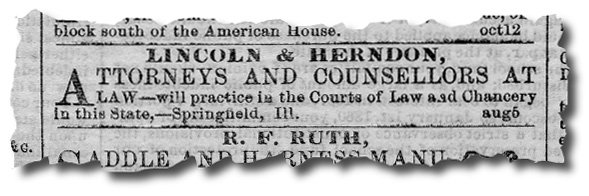
Abraham Lincoln advertised his law practice; why don’t you?

Share

Okay, I’m not going to get into a rant on why lawyers who don’t advertise shouldn’t denigrate lawyers who do. I’m just going to present this ad by one Linclon & Herndon, Attorneys and Counsellors At Law in Springfield, Illinois, who advertised their availability for hire in what appears to be a newspaper of general circulation.

 lincoln.jpeg

Share

Lawyer marketing 101: the basics of getting articles published

Share

Getting exposure via published articles has long been a marketing mainstay for lawyers. In the age of the Internet, there are even more opportunities than ever as the need for quality content has multiplied.

Many books have been written on writing and publishing articles. If you are serious about promoting your practice this way, I recommend reading a few books and learning to do it right.

The basics of getting published never change. The first step is to identify those publications that are a suitable outlet for your articles. Offline, the venerable “Writers Market” (from Writer’s Digest) lists thousands of magazines and newspapers that accept outside submissions.

Online, numerous directories list electronic newsletters and web sites that accept articles. Go to any search engine and type in and you’ll find thousands of ezines and the directories that list them.

Once you have determined which publications you are interested in, the next step is to obtain their “writers’ guidelines”. This is a description of the kinds of articles they want, how many words, the rights they purchase (i.e., “first publication”), and the procedure for submitting the article for consideration.

You’ll probably find writers’ guidelines on the publication’s web site. If not, contact the editor and ask if they accept articles and if so, what they are looking for.

Once you know the guidelines, the next step is the “query”. Some publications want you to submit your article idea in outline form, along with a sample of your other writing, some publications want to see the whole article first. Whatever the guidelines, your query needs to sell the editor on three things:

  1. Why their readers would want to read your article
  2. Your credentials for writing it
  3. Your ability to write it

Your query letter should be well written and to the point. It should demonstrate that the article you propose will be relevant to their readership and interesting to read. Editors read hundreds of queries and sort through them quickly; if you want to be considered, you need to get their attention and immediately make them see the value in your article.

Getting the first article accepted is the hardest. Once you have built up a list of publications that have accepted your work, you should find yourself getting published more frequently. Until then, don’t assume that being a lawyer is enough of a pedigree to be accepted for publication. Actually, being a lawyer could work against you. If an editor assumes you “write like a lawyer,” you’ll have to work harder to show them that you can write something real people would want to read.

Don’t hesitate to start with small publications. It will give you experience in writing and submitting articles. You’ll also get a list of publishing credits and that will make it easier to get other editors to give you the go ahead.

Don’t be concerned about payment for your articles; most publications pay little or nothing anyway. But do negotiate a listing of your web site or other contact information at the end of the article. You want readers to be able to reach you.

Be patient; it will be worth the effort. Even if they don’t allow you to list your contact information in the article, just being able to say you have been published carries weight. Reprints of your articles make excellent marketing hand outs that can be used for years. And you can re-cycle your material (make sure you retained the right to do so) in other articles, speaking engagements, web/ezine articles, blog posts, reports, and so forth. Also, having been published can lead to interviews and speaking engagements and could also provide material for press releases. For example, your published article might be referenced in a press release where you offer a free report that amplifies the subject matter of the article.

Writing for publication will give you exposure and credibility as an expert in your field. It can also lead to even more exposure in the form of inquiries from other publications, joint venture partners, meeting holders, teleseminar promoters, and the like. Getting published will help you grow your mailing list, develop new referral sources, and create more clients.  It will also make your mother proud.

Share

Attorneys can benefit from a unique selling proposition

Share

A few years ago, Progressive Insurance ran TV commercials touting that they assign a dedicated claims specialist claimants their policyholders can count on for the life of their claim. The benefit is that you can always call "your" representative and never have to worry about what’s going on with your claim. Policyholders want to be able to talk to the same person each time they call, someone who understands their claim and is staying on top of it "for them".

Now, most other insurance companies probably do the same thing. But because those companies aren’t saying they do it, when Progressive says it, they virtually OWN that benefit.

You can do the same thing. You can promise prospective clients that they will have a dedicated member of your firm assigned to their claim, so that they don’t have to worry about who to ask for when they call. They’ll feel better just knowing that someone is assigned to their case and that it’s not lost in the shuffle.

The fact that most lawyers do the same thing is not important. If you say it and they don’t, or you say it FIRST, you can effectively "own" that benefit and preempt other lawyers in your market from using it. It can become your "Unique Selling Proposition" (USP), the competitive advantage that sets you apart from other lawyers in the minds of clients and prospects.

In marketing, perception is everything. If you appear to offer a unique advantage, people will see a benefit to hiring you instead of your competition.

Your USP can be about any meaningful benefit you offer. What do you do faster, better, or more thoroughly? What do you do that you know clients like?

A great way to find a powerful USP is to learn what your clients DON’T like about lawyers in your field, and promise them the opposite. If clients consistently complain that lawyers who do what you do take to long to do it, for example, your promise to do it quickly would likely be seen as valuable and desirable to those who can hire you.

The number one complaint received by state bar associations is lack of communication by their lawyer. Many lawyers have difficulty, it seems, keeping their clients informed about the progress of their legal matter. Even worse, many complaints involve lawyers who don’t return phone calls. Something this common, and this easy to fix, would seem to be a great USP for lawyers in many practice areas.

If you’re bad at keeping clients informed (or returning calls), resolve to get better. In fact, I’d suggest a goal to become not just better but the best. Make a promise to yourself to return calls within 24 hours, for example. Raise the bar. It’s so easy to do and it will have a profound impact on your practice. Fewer unhappy clients, more repeat clients and referrals.

Then, proclaim it to your clients and everyone else. Let them know of your commitment. Make it your unique selling proposition.

If you’re already good at keeping clients informed and returning calls, the odds are you don’t tell people this, or you don’t tell them enough. Consider doing so before some other attorney decides to make it her unique selling proposition.

Share





