
10 signs you are a successful lawyer (marketing edition)

Share

How do you know you are a successful lawyer? Some measure success in terms of money. Others use milestones like number of clients, courtroom win/loss ratio, or receiving a prestigious award. I knew I was successful when clients sent me thank you notes and gave me hugs.

Today, I want to give you 10 signs of success from a marketing point of view. I got the idea by reading a similar article for small business owners.

  1. Clients send you referrals. The sine qua non of success. Nothing says you are doing things right better than getting most of your clients via referrals from happy clients.
  2. Other lawyers send you referrals. Successful lawyers get referrals from lawyers in other practice areas. The best lawyers get referrals from lawyers in the same practice area.
  3. Non-lawyers send you referrals. Influential people in your community or niche market should have you on their radar and be sending you business.
  4. Clients find you (via search, social, publicity, articles, etc.) You should be getting clients who find your web site through various means and are impressed with your knowledge and experience. The web site should sell them on hiring you or taking the next step.
  5. The media seeks you out (interviews, quotes, profiles). This usually occurs because of a prominent case or client or because a writer or publisher finds your web site and is convinced you are THE subject matter expert for the story they are working on.
  6. You have a list and you stay in touch. Most people who find you don’t hire you immediately. You need to collect their contact information and stay in touch with them. You also need to stay in touch with your clients because they are your best source of new business.
  7. You use strategic marketing alliances. Your client list is paramount. Next best are the client lists of other professionals and business owners. By leveraging the trust they have with their lists, you get exposed to, and endorsed by, those professionals, which should bring you a steady stream of pre-sold prospective clients.
  8. You fire clients. Successful marketing means you have the ability to continually upgrade your client list. You make room for better clients by purging the lowest segments of your client list (lowest paying, least amount of work, slow paying, complainers, etc.)
  9. A publisher asks you to write a book. If your web site (podcast, video channel), has lots of good content, and it looks like you have a good following, a publisher may contact you to see if you want to write a book. They know that book has a built in audience of potential buyers.
  10. Other lawyers ask how you do it. If you are successful in bringing in lots of good clients, other lawyers will ask you to share your secrets.

So, how did you score? Do you some opportunities for improvement?

You may be a good lawyer but are you good at marketing? Here’s what to do.
Share

How to find ideas for blog posts

Share

If you would like to know how to find ideas for blog posts, I’ve got an easy one for you.

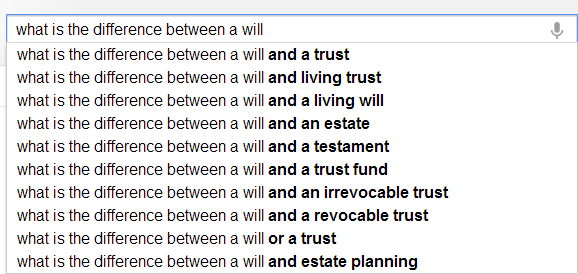
Go to Google and type in a question related to your legal services. Before you complete the sentence, Google’s autocomplete mechanism (assuming you have it enabled) will provide you with a list of possible searches based on what you have written so far.

I did just that by entering in, “What is the difference between a will” and as you can see in the graphic below, Google gave me several options for completing my search request, to wit, “What is the difference between a will and a trust,” “What is the difference between a will and a living will,” “What is the difference between a will and estate planning,” and so on, based on what other people have searched for in the past.

How to find ideas for blog posts

Armed with this information, you can write a blog post that answers the very questions your prospective clients are searching for. Use one of these search phrases as the title of your article and you will increase your chances of being found in subsequent searches.

You can use the other search queries as key word phrases in your post, or write other articles with these titles.

This can help you find “long tail” search terms, meaning longer, more specific search phrases you can use instead of the more common, shorter and highly competitive phrases.

For example, you would have a hard time getting found by targeting the search term, “slip and fall.” There are too many lawyers competing for that phrase, in both generic search and in Adwords. But type in “slip and fall” into Google and you will find another suggestion: “slip and fall statute of limitations california”. Make that the title of your article (or bid on this term in Adwords) and you should have very little competition.

I used Google to generate the title of this post. I typed in, “How to find ideas for” and it suggested, “How to find ideas for blog posts,” and not “newsletter,” “ezine,” or “articles.”

Prospective clients are looking for information. Now you know an easy way to find out what they want to know so you can give it to them.

The law is complicated. Marketing is simple.

Share

Lawdingo.com: how NOT to build your law practice

Share

Cue Rod Serling:

“Meet Jerry Finster, picture of a desperate lawyer. Don’t let his smile fool you. It is nothing but paint and plastic, a mask he wears to hide his pain. Like other lawyers, Jerry once had big plans for his career. But Jerry listened to some bad advice and now, he sells his soul in five minute increments to anyone with a question and a sawbuck. You’ll find Jerry in his booth at a place called lawdingo.com, where other desperate lawyers have set up shop. The sign over his booth says you can talk to him at 10, 12, 2, or 4. The truth is you can talk to Jerry at any time. He’s waiting for you now. If you want some cheap advice, go see Jerry. But don’t go looking for him on the World Wide Web. You can only find him in a place called The Twilight Zone.”

Perception is everything. If you look desperate (or even just hungry), in the eyes of the world, that’s what you are. There are, I am sure, many fine lawyers answering questions on sites like lawdingo.com, and I’m sure they are getting some clients. But is it worth it? I say no. You may get clients but you won’t build a practice, at least not one you want.

When I first started practicing, I volunteered one day a week at a legal clinic. I got a few clients out it (and a lot of real world experience). The people who visited the clinic didn’t have much money. When they hired me, they paid maybe twenty cents on the dollar. They needed help, I needed the money.

But I was careful. I never told my “real clients” about what I was doing at the legal clinic. They needed to see me as successful. I could look the part and build my practice on Wilshire Boulevard in Bevery Hills and nobody knew I was bringing in rent money from the legal clinic on Pico.

You can’t do that today. The Internet won’t allow it.

I could be wrong. (I’m not, but I guess I should say it.) See for yourself. Pretend you are a client looking for a lawyer. Browse through the listings of the lawyers on lawdingo.com and see what you think. (Could they have come up with a worse name?)

Click on the button to sign up as a lawyer. But before you fill out the form, imagine that your “real clients” find you on this site. What do you suppose they would think?

If you’re not desperate, the last thing you want to do is look like you are. If you are desperate, the last thing you want to do is look like you are.

There are better ways to build your practice. You’ll find them here.

Share

Do prospective clients read lawyers’ blogs?

Share

Of course they do.

They may not know that your web site is a blog or that what you wrote is a blog post. They may not know what RSS is or care about Google Reader’s impending demise. But when they have questions, they go searching for answers and when they find your blog post via Uncle Google or Auntie Facebook, they read it. If you answer their question, they’ll go read more of your content and about what you have to offer.

When they’re ready, they’ll call.

Prospective clients have questions. About their rights, about the law, about their options. They know how to use a search engine to find restaurant reviews and oil change coupons and movie times and they know how to use it to find answers to legal questions.

Give them something to find.

Answer their questions. Tell them about the law and their options. Tell them about other people like them who had the same problem and how it got resolved. You know what they want to know. What do prospects and new clients ask you when you speak to them? Write about that.

It’s true, they may never before had any interest in reading anything you wrote, and they may never again. But when they have a legal problem and they want a solution, they will read everything you have to say on the subject.

So yes, prospective clients read blogs. So do your existing clients, former clients, and others who may not need your services but know people who do. So if you don’t have a blog, now you know why you need one. And if you do, you know why you need to keep writing.

Marketing for attorneys made simple: Click here.

Share

Google Adwords for attorneys? Read this first.

Share

An attorney who reads this blog asked me what I thought about attorneys using Google Adwords to get clients for a law practice.

I’ve done a lot of advertising over the years, including Adwords, both as an attorney and in my attorney marketing business, and overall, I’ve had positive results. But I don’t recommend Google Adwords for most lawyers, at least not until they have many other ducks in a row.

Here’s what I mean.

If you don’t know what you’re doing, advertising of any kind can be a huge financial sinkhole. There are lots of things you have to get right and if you don’t, you’ll get poor results or spend way too much money for the results you do get. True, with Adwords you can get started with a small investment (e.g., $50 or $100) and you aren’t locked into a long term contract. But it’s far too easy to get caught up in the game of trying to make make your ads work, and that can be a very expensive game to play, especially for attorneys who might pay up to $50 per click.

If you don’t have the budget and the stomach to play that game, you should probably stay on the sidelines, at least for now.

In other words, don’t start with Adwords (or any advertising), to get traffic to your law firm’s web site. Start by building organic traffic by posting high quality content. Use referral marketing, social media, speaking, writing, networking, and other means to build your practice, before you even think about advertising. Once you have a sold base of clients and lots of disposable income to invest in further expansion, then you can consider advertising to provide an incremental increase in that income.

You might use Adwords short term, to test headlines and offers, however. Invest a couple hundred dollars to test several different report titles, for example, and see which one gets the highest response. When you know which one pulled best, you’ll know which one to use for your report.

Advertising is only part of the challenge. You may have great ads that pull lots of traffic, but is it targeted traffic, appropriate for your practice? Are they looking for a lawyer or just free information? At $50 a click, you need to make sure.

In addition, you must have effective landing pages. You may be getting lots of the right traffic but if they don’t opt-in or call you when they get to your site, it is all for naught.

You also need to be able to handle those leads and convert them into appointments. Someone needs to be available when they call and that could be long after business hours. And whoever takes the calls must be good at closing the appointment. The goal isn’t traffic and clicks, it’s appointments and clients.

If you do want to try Google Adwords (or Facebook ads or any other kind of Pay-Per-Click or Pay-Per-Action advertising), here’s what I recommend:

  • Make sure Adwords is right for a practice like yours. Do your ideal clients use search engines to find lawyers? Do they click on paid ads? Do you have high enough margins to justify the per client acquisition cost of advertising and associated overhead?
  • Learn all you can about Adwords. Start with the Google Adwords help center. Read books and blogs and take courses.
  • Start small. Open an account with no more a few hundred dollars and be prepared to lose it all. Take a break and evaluate your results.
  • Start with bids on low volume key words: “brain trauma law south bay” should cost a fraction of what you’ll pay for “Los Angeles personal injury attorney”.
  • Be prepared to roll out your winners and pull the plug on your losers. You must spend enough on your ads, however, to get enough clicks so you can quantify the difference.
  • Be prepared for constant monitoring, testing, and tweaking. You will need to know which headline, displayed in response to which key words, and sent to which landing page, is producing traffic that opts-in or calls. Then, you have to compare those results to other combinations, so you can maximize results and minimize costs.
  • Don’t expect that what works today will work tomorrow. Or vice versa. Advertising is never “set it and forget it”. You can never stop testing and making changes.
  • Get help. Hire consultants to design and track your campaign, and write your ads and landing pages. Let them do what they do best so you can do what you do best.

I’ve spent millions of dollars in advertising over the years and I love what it can do. If you get the pieces right, there is no faster way to bring traffic to a web site (aside from having something go viral, and that’s something you can’t control.) And yet. . . I’m not doing any advertising right now. I don’t want to work that hard.

What are your experiences with Google Adwords? Please share in the comments.

If you want to get more clients without advertising, you need The Attorney Marketing Formula.

Share

How clients find lawyers

Share

My wife needed dental work. After she was seen by her dentist and the work was scheduled, she saw an article in one of the newsletters she reads about a new and “better” procedure. After reading more about the new procedure, she was convinced that this is what she wanted to do and started looking for a dentist who offered it. She found one close by, had her first visit, and booked an appointment to have the work done.

She found “candidates” through a search engine. She choose the dentist she did because

  • They have a great web site. It has lots of information about the dentist and their office, and about the technology and procedures they use. There are also lots of testimonials on the site.
  • They have over 200 five star reviews on Yelp
  • They were friendly and helpful on the phone and when she went in for her first visit. They made her feel like she could trust them and that they cared about her.

By contrast, aside from not offering this new procedure, her now former dentist

  • Doesn’t have a web site
  • Doesn’t have any reviews on Yelp, or anywhere else she could find
  • Didn’t make her feel like he cared

Oh yeah, the new dentist is actually less expensive than the former dentist. Not critical, but nice.

People find lawyers like they find dentists. I’m just saying.

Marketing is easy. But you have do it. Here’s how.

Share

Is your web site boring? Try these quick fixes

Share

Many competent and successful attorneys are, frankly, a bit dull. They live in a world of dry facts and esoteric knowledge and in that world they may be brilliant, but clients don’t usually live in that world.

The truth is, if your web site is boring people won’t read your content. If they don’t read it, they won’t know what you can do to help them. And trust me, they won’t call to find out.

How can you improve your writing? One of the best ways is to study good writing.

Think about your favorite web sites, the ones that aren’t boring. The next time you visit, save some of their articles and study them. Read them several times, slowly. Read them out loud. Copy them, by hand. Then, create an outline of the article and use it as a template for your own.

Now, what can you do right now to improve your web site’s content? Here are three quick fixes:

  1. Don’t write, speak. Dictate and record your thoughts and transcribe them. You’ll have a more natural, conversational first draft. You’ll be more likely to say what you want to say and leave out the boring bits. You could also record your content on audio or video and post that on your web site, along with a transcript.
  2. Put people in your posts. Stories breathe life into writing because they engage human emotions. Readers relate to the people in stories and keep reading to “find out what happened.” I’d much rather read about your client and what happened when he didn’t follow your advice than to only your advice.
  3. Make it visually appealing. Many people don’t read anymore, they scan, so give them something scanable. Use more white space and photos. Shorter articles, shorter paragraphs, and shorter sentences. Use bold headlines, sub-heads, and bullet points. By scanning, they’ll get the gist of what you’re saying and for now, that might be enough.

Don’t stop with quick fixes, though. Writing is one of the most valuable skills any attorney can have and worth the time and effort to improve. Read books or take courses on writing, copy writing, and sales. Make writing a daily habit. The more you practice, the better you will get. And, if you have more money than time, hire an editor or writing coach. Their feedback will help you get better.

You may be boring but your writing doesn’t have to be.

If you aren’t open minded, don’t buy this course.

Share

How to get targeted traffic to your web site by commenting on others’ blogs

Share

As a group, attorneys don’t seem to post a lot of comments on blogs. It’s not that we don’t have anything to say. We’re friggin blabbermouths when we’re getting paid for it.

Guess what? If you do it right, you CAN get paid for posting comments. You’re paid in the form of traffic back to your web site from people who read your comments and think you have something intelligent to say.

If your web site is doing it’s job, those people see something they like on your site, opt into your list, and let you court them. Eventually, they hire you.

The key to getting targeted traffic is to choose the right blogs to add comments. You might have an opinion about the legality of claiming a fake girlfriend, but unless you market to a sports niche, your comment on ESPN.com isn’t going to do you much good.

To get started, here’s all you have to do:

  1. Make a list of blogs in your target market. If you target Enterprise software developers, American couples seeking to adopt Russian babies, or diamond brokers in New York City, Uncle Google will help you find the blogs they read.
  2. Note the blogs that accept comments and a link back to the poster’s web site. Not all do. The ones that don’t accept comments might prove useful, however, if they accept guest posts, that’s another way to get targeted traffic.
  3. Subscribe to the RSS and comment feeds. Learn what you can about the kinds of articles posted and the frequency and nature of their comments. A blog with lots of comments is probably going to have more people reading your comments. Also pay attention to the style of the comments and the sophistication of their readers.
  4. When you read a post that is worthy of your two cents, add a comment. Reference the post, tell why you agree or disagree, and offer something of value to the discussion. Tell readers about resources you have found on other sites. Demonstrate your expertise, knowledge, and especially, your experience in the particular niche. When you say, “I represent several diamond brokers. . .” within your comment on a blog for diamond brokers, you will get noticed.
  5. The best way to link back to your site is to link to an article you wrote on the subject being discussed or something related. Tell readers why they should click through to read your post, e.g., “I just posted an article with 27 do’s and don’ts for adopting Russian babies.” If nothing else, your web site link appear when readers hover over your name above your comment.

Post a comment a few times a day or a few times a week and you should see traffic coming to your site from these blogs. And because it is targeted traffic, it doesn’t have to be a swarm to be profitable.

Marketing is easy. Clients are waiting. Start here.

Share

Get more clients by being yourself (even if you’re nothing special)

Share

An unremarkable undergrad at an unremarkable college is in talks with a prestigious Wall Street investment firm for a coveted internship, on the strength of the cover letter he sent with his resume. The letter has been called the ‘best cover letter ever’ and has gone viral throughout the investment world and on the Internet.

The article reporting the story put it this way:

“Rather than inflating his qualifications and bragging about his grades or past job experiences, the humble applicant simply stated his case and matter-of-factly asked for an internship–even if it meant shining shoes.”

He added: “I have no unbelievably special skills or genius eccentricities.”

You can read the letter and the rest of the story here.

So, great story, huh? Boy meets (investment) world. Boy lands big internship. Boy makes his mom proud.

Nice. But what does it have to do with marketing legal services?

Here’s what:

It deftly illustrates a timeless direct marketing principle–the supremacy of the sales letter. It wasn’t this young man’s resume that got the job. It was the letter. Similarly, your CV or list of accomplishments won’t get clients to hire you. Not by itself. You need a sales letter.

Let me show you what I mean by taking you on a stroll down memory lane.

Remember back before email when we all got a lot of direct mail solicitations in our mailboxes? For various goods and services, magazines, record clubs, insurance, and such? The mailing has several components and each plays a role in getting the sale.

First, the envelope.

Oh yes, the envelope is a sales tool. Direct mail experts consider (and test) the size and shape of the envelope, the color, the stamp, the address (label, print, or hand written), and the copy–the words printed on the outside of the envelope. It is those words that get the recipient to open the envelope (or not). Envelope copy grabs you (or doesn’t) and that determines whether or not you open the dang thing. Just like the “subject” line in an email today.

Inside the envelope is the sales letter and other documents. These may include a brochure or leaflet, a booklet of testimonials, a guarantee, an order form, a return envelope, and perhaps various “involvement devices” like stamps or tokens you’re supposed to affix to a the order form to indicate your preference.

Let’s compare that package to your web site.

You get people to “open” your web site with your “envelope copy”–the title and description of your site in search engines or in an ad, for example. Your description or ad piques their interest and they click through to your site.

In a mailing, the brochure and other components provide supporting materials: facts, details, proof. People buy for emotional reasons and justify their decision with logic and facts. The brochure supplies the latter.

On your web site, your brochure takes form in articles, FAQs, and a list of accomplishments. This is the supporting data that helps people justify their decision to take the next step towards hiring you.

Other content that supports this might be a page that offers a pledge or guarantee, involvement devices like polls (or results), videos, checklists, forms, and the like. These get people to spend more time on your site.

All of this content helps. But it is the sales letter that gets them to act.

On your web site, your sales letter might be on a welcome page or your “About” page. It might be a video. You greet the visitor and tell them what you can do for them. You tell them about yourself and do your best to connect with them. You want them to feel good about you and trust you. If they do, they’ll read some of your other content to learn the details.

The sales letter is the most important part of the mail package and your web site. It has to connect with the reader and do a complete sales job. There’s no sales person sitting with them or on the phone so the letter has to do all the talking. It has to tell the story, answer questions, overcome objections, and close the deal. In a mailing package, it has to get the order. On your web site, your sales letter has to get the visitor to call, fill out a form, or opt into your email list.

Now, how did this young college student with ostensibly no sales or marketing experience write such an effective sales letter? How did he stand out in a sea of competition?

He did it by ignoring what everyone else does and what conventional wisdom says he should do.

He wrote from the heart. Straight talk. No hype, no pretense. “Here I am, nothing special. I’m reasonably intelligent and I’ll work hard. Give me any job, I want to learn.”

He told the “buyer” what they wanted wanted to hear. Not because he knew what they wanted to hear, but because he didn’t know what else to say except the unvarnished truth.

It worked because he was refreshingly honest.

People don’t want “canned” and “commercial”. They want “real” and “believable.” If you can deliver that, they’ll pay attention, and if they want what you offer, they’ll buy.

The most critical job of the sales letter is getting the reader to pay attention. Employers sort resumes with a bias towards trashing them. They read only a handful that have a cover letter that catches their attention.

Web visitors do the same thing. When they arrive at a web site, they look for reasons to click away. Your “sales letter” has to get them to stay.

When you write your sales letter, you should do what this young man did. Be yourself. Tell your story, warts and all. Okay, maybe you can hide some of the warts, but keep it real and talk to them from the page like you would if you were talking face to face.

Don’t give them the packaged and polished (and boring) stuff you see coming from most attorneys. If you don’t grab them, you’ve lost them. If you don’t get their attention, it won’t matter how impressive your accomplishments might be, nobody will see them.

So here’s what I want you to do. Write a letter to a prospective client. Tell him why he should hire you. Tell him what you can do for him or his company and how you’ll work hard to do it. Imagine you’re sitting with him in a coffee shop, just the two of you. What would you say to get his attention and make your case?

Write that down.

I’m not suggesting that you’ll write something brilliant that will go viral on the Internet and be called the “greatest lawyer letter ever”. In fact, nobody will see this letter because you’re not going to send it to anyone.

But you might just get some ideas you can use on your web site or the next time you write an email or a blog post. You might just write something that reaches out and touches someone and makes them want to hear more.

Human beings are starved for real communication. A lot of people don’t even talk on the phone anymore, they “talk” with their thumbs. So when they hear a real person who speaks plainly and openly, without pretense or affectation, they listen.

To college students, and even to lawyers.

Learn more. Earn more. Get the Attorney Marketing Formula.

Share

The only metric that matters

Share

Wow, you’ve got a LOT of Facebook friends. And your mailing list is fatter than Santa. Traffic? Your web site is busier than So Cal freeways. And, oh-my-goodness, look at all those Likes and Retweets!

Very impressive.

Big numbers. Big list. Big stats.

But, um, question for you. How many clients did you sign up last month?

No, really, I know you’ve got all this traffic and stuff, but how many clients came in through the Internet?

See, there’s really only one metric that matters. The rest is one big distraction. Fools gold. Rope-a-dope.

Don’t kid yourself. Your time and effort (and money) spent online is either working or its not.

What’s that? More traffic and more subscribers does lead to more sales? Sometimes it does. But I’d rather have a site with 100 visitors a month and five clients signing up than a site with 10,000 visitors and only one new client.

Bottom line, baby.

Traffic and subscribers are factors, but not the most important ones. Not by a long shot. Your offer is way more important. So is your content. And how often you stay in touch with the people who visit your site. And what you say to them.

So, if your web site has itsy-bitsy traffic but you’re signing up boat loads of clients, rejoice! You’re an Internet marketing goo roo. If you have tons of traffic but nobody signs up, hey, that’s okay. Everyone needs a hobby.

Get more clients online, and off. Get The Attorney Marketing Formula.

Share






