Networking when you don’t have time for networking

Share

networking for attorneysWell, my wife struck again.

Yesterday’s post was about my wife’s experience at her dentist and an important marketing (billing) lesson for attorneys.

Today, she got her oil changed. She was very impressed with her experience (great customer service, low prices) and she told the owner how she felt. She asked him for some of his business cards because when my wife finds something she likes, she will go out of her way to tell people about it.

During her conversation with the owner, she happened to mention a service her business offers (she and I own a service-related business). He was busy, of course, but he was interested in hearing more, so she gave him a brochure.

Guess what? He thought his customers would also be interested in our service and asked for more brochures to display on his counter.

Networking doesn’t have to be complicated or overly time consuming. It can be as simple as making new contacts while you’re busy running errands or otherwise going about your daily business. When you find a product or service you like, ask for some cards or literature. Tell your friends and clients about it.  Tweet about it. Promote it.

Do this because you like the products or services and without any expectation that the owner or manager will do the same for you. If that happens, consider it a bonus.

When you approach networking like this, without an agenda, without demanding reciprocity, you will enjoy the process and do it naturally. Your friends and clients will get the benefit of your recommendations and be grateful to you. “Wow, my lawyer always has these great tips. . .”.  They might even start reading your newsletter or Liking your Facebook fan page.

And. . . something else will happen.

What do you think the owner of the business you are promoting will do when three new customers come into his place of business this week and mention they were referred by you?

If you want to build your business, go promote someone else’s.

Share

How to make your clients appreciate you more than they already do

Share

free and discount services for lawyersLast week my wife went to her dentist for a cleaning. The bill arrived with a charge of $84 for the cleaning and $45 for the exam. Then, the bill showed a $45 credit for the exam. In other words, the exam was free.

Why? I don’t know. Maybe because it was a brief exam or maybe he never charges for an exam that follows a cleaning. Whatever the reason, my wife and I were pleased. We like our dentist even more than we already did.

Now, what if he simply omitted the charge for the exam? Would that have had the same effect? I don’t think so. We wouldn’t know that he was “comping” the exam. If we had thought about it at all, we would have assumed the exam was included in the cleaning and not given it another thought.

When you do something nice for your clients, whether giving them a free service, a discount, or something extra, make sure they know about it. Put the charge on the statement and then show a credit for that charge, so the client can see the value of the service they received.

Do this for free consultations, too. Send a bill for the consultation, show a 100% credit, and a zero balance due.

Do you think your would-be clients will better appreciate the value of what you do if they see that the consultation they got free is worth $400?

You bet they will.

Something else. If you don’t have free or discounted services you occasionally give to clients and prospects, it’s time to start. One way to do that is to take something you regularly include as part of your services and “break it off” as a separate item.

For example, if you charge $1500 to prepare a living trust and this includes a pour over will, power of attorney, and living will at no charge, simply send an invoice that shows the ordinary charges for those additional documents and 100% credit.

If you want clients and prospects to appreciate you more, when you do something nice for them, make sure they know about it.

Share

Attorney Marketing 101: How to Improve Your Social Media Profile

Share

Marketing legal services on Facebook, Twitter, LinkedIn, or any other social media platform, begins with your profile. This is the first thing prospective clients and referral sources see.

Here are five tips for making a good first impression:

  1. Your account name. Ideally, this should be your name, not your firm or practice. Social media is about people engaging with other people. You may “like” or “follow” a company or product page but you can’t talk to that product, only to the people behind it. The ultimate purpose of social media marketing is to expand your “warm market,” i.e., the number of people who know, like, and trust you. YOU, not your firm. Brand yourself, not your firm. Your firm can also have a page or profile, but this is not a substitute for your own personal profile.
  2. Your profile photo. This should be a photo of you. Not your firm logo, not a group shot, not a sunset, not your dog. People want to see who are they are friending/following/engaging with/thinking about hiring. Anything other than your photo puts distance between you and them. Use a professional looking head shot. It doesn’t have to be a professional photo, but you must look “professional”. No mugging. Clients don’t hire clowns.
  3. Your bio. Don’t make it all about your work, include personal references. This invites conversation. The first step in any networking conversation is the “search for commonalities,” so if you like to play chess, as I do, include it in your bio. Also, your bio is not a resume. (If you’re looking for a job, include a link to your resume or linkedin profile). Therefore, don’t make your bio about your work history. Nor should it be an ad for your services. Talk about how you have helped clients in the past, so that prospective clients can see what you can do for them. One more thing: include your location. People hire local attorneys.
  4. Link to your web site and other social media accounts. Don’t rely on one account, give people as many ways to read about you and engage with you as possible. Someone may find you on LinkedIn, for example, but converse with you via Twitter. Also, I just updated my Twitter profile to include a link to my web site, even though I already had it in the box Twitter provides for that purpose. The reason: when you first look at a Twitter profile you don’t see the web site link until you click through to the actual profile. This post says that making this change increased the number of clicks from Twitter to her web site. Make sure to include “http://” to make the link clickable.
  5. Include keywords. Social media profiles show up in search results on the site itself and via search engines. Include your key words throughout your profile, so someone looking for an estate planning attorney in Tampa can find you.

Go take a look at your social media profiles. Can people find you? Are you making a good first impression?

Share

Attorney Marketing 101: Networking with the Right People

Share

For many lawyers, networking is a great source of new business. Referrals are given, ideas are exchanged, doors are opened.

Most attorneys network by default. The local Chamber of Commerce advertises a mixer, a friend invites them to a Rotary breakfast or their local bar association announces their annual meeting, and that’s where they go. But these groups may not be the best choice.

When they don’t get a lot of business from one networking group many attorneys join a second group. Before you know it, some attorneys attend so many networking events each month they have no time for anything else. And because they aren’t networking with the right people, they still aren’t getting good results.

The right people, the ones you want to meet and network with, are those who are likely to know and influence a significant number of your ideal clients. No matter what your networking skills might be, your odds of success are much better when you network with groups comprised of a high concentration of these individuals.

Where do you find these groups? First, define your “ideal referral source”.

Start by looking at the referrals you received over the last twelve months. Who sent those referrals? What is their profession or background? What industry are they in? What other demographic factors stand out?

Look for patterns. If you see you got twenty-six referrals from real estate brokers last year, it probably makes sense to put real estate brokers on your list.

Then, put on your thinking cap and brainstorm other categories of prospective referral sources. Who sells to or advises your ideal clients? Who might have a big list of your ideal clients or influence in your target market?

Make a list of five to ten categories of promising referral sources. Depending on your practice area and local market, two or three categories may be enough (and all you can handle).

If you’re a plaintiff’s personal injury attorney, your list of categories may include obvious choices like insurance agents and brokers and physicians. It may include some less obvious choices, however, such as high school principals or pastors.

If you’re a consumer bankruptcy attorney, obvious choices might be real estate and mortgage brokers, accountants, and hairdressers.

Consider also including categories of people who influence your ideal referral sources. For example, if you want to network with financial planners, networking with accountants or non-competitive attorneys who represent financial planners would make sense.

Once you have defined your ideal referral sources, the next step is to find out where they congregate.

There are directories and web sites that list countless associations, networking groups, and referral groups (groups that meet specifically for the purpose of exchanging referrals). An hour or two will allow you to make a list of “candidate” groups. Note where they meet and when, and other pertinent information, e.g., how many members, requirements to join, do they allow outside speakers, etc.

A simpler way is to ask your existing referral sources what groups they belong to. Not only can this shortcut your research time, your contact will probably invite you to attend a meeting as his or her guest.

Having a friend on the inside, someone who can introduce you to the right people and provide information about committees, speakers, and group dynamics is invaluable.

If you don’t know people in the right categories, or the people you know don’t do any networking, you can ask people you know for a referral to someone who does. Call and introduce yourself, mention your mutual friend, and tell them you’re looking for a networking group you could attend. I’m sure they will have recommendations.

You’ll still need to attend a few meetings to see if a group is a good fit. The good news is that once you find a group that is, you may not need to find a second.

When it comes to networking, most attorneys are “a mile wide and an inch deep”. The most successful networkers focus their time and effort in a limited number of groups of “the right people”.

Share

Attorney Marketing 101: The psychology of referrals

Share

The psychology of referrals--lawyer marketingThere are two kinds of referral sources: those who can refer and those who will.

If you’ve done a good job for your clients, most are probably willing to give you referrals. That doesn’t mean they will. If they don’t know people who need your services, they can’t refer them.

Others — professionals, business owners, centers of influence — who are able to refer you a lot of business, often don’t.

Understanding why people do or do not give referrals can help you get more of them.

So why do people provide referrals? Your clients are willing to send referrals for several reasons:

First, your clients want to help their friends and colleagues to the benefit of your services. They can save their friends the time they might have spent looking for an attorney, and help them avoid the risk of getting an incompetent one or getting overcharged. Their friends appreciate this help; your client’s status is elevated. Being able to help their friends makes them feel important.

Second, when their friend retains you and is also satisfied with your work, it validates your referring client’s decision to hire you in the first place. Any doubts they may have had about their experience with you are removed.

The third reason your clients are willing to give you referrals is that they want to help you. However, clients don’t always know that you want their referrals. You need to tell them. Or, they understand that you want referrals but they just don’t think about it. You need to remind them.

If you’re not getting referrals from your clients, or you’re not getting as many as you would like, there are only two reasons: either you don’t deserve them or you’re not asking for them.

Now, how about non-clients, professionals, business owners, centers of influence–why might they give you referrals?

For some, it is the expectation of quid pro quo. They give you referrals and you give them referrals, or so they hope.

Others will refer their clients and contacts to you for the same reason your clients do: to help their clients avoid the risk and effort of finding an attorney on their own. In helping their clients this way, they add value to their relationships and their status is also elevated. And yes, some also feel good about helping you, too.

When a professional is able to refer business but is unwilling to do so, it may be because they don’t yet know, like, and trust you. It takes time for your relationship to develop. Eventually, they may turn out to be a big source of new business.

Many prospective referral sources don’t send you business because they don’t have it to give. They have a relationship with another attorney to whom they refer and they don’t have enough referrals for both of you. Unless their regular attorney has a conflict of interest, is unavailable, or doesn’t handle a given matter, your prospective referral source may be willing to refer, but not able.

In time, that may change. When the other attorney retires, dies or screws up, you could be next in line.

If you’re dealing with a prospective referral source who cannot reciprocate, there are other ways they can help you. By the same token, there are other ways you can help them when you can’t reciprocate.

Some people who can give referrals simply won’t. They may see it as risky–what if you screw up and make them look bad? Others just can’t be bothered.

Don’t dwell on the reasons why people won’t refer. If some clients won’t do it, it doesn’t matter; most will. With non-client referral sources, the numbers are reversed. Most won’t refer and this doesn’t matter. You only need a few who do.

Share

How often do you need to update your blog?

Share

When I converted this website from a static site to a blog in 2007, I didn’t want my “new house” to look unfurnished so for the first month or so I added posts and articles almost every day.

It was a very good thing that I did.

I saw an immediate upsurge in traffic to my site, I received many emails thanking me for the content, and I got a lot of new leads for my products and services.

I was new to blogging, but I was very glad I made the leap. Today, I post every day, Monday through Friday, and I am again seeing an increase in traffic and engagement like I experienced in the early days.

Wait. I know what you’re thinking. You’re too busy for blogging.

But hold on. Hear me out.

Many lawyers would like to have a blog. They see other lawyers building their practices online and they want to do the same. But they “just don’t have the time.”

Some argue that quality is more important than quantity, that frequency of posting isn’t a critical factor. But frequency does matter.

It seems that most people who read blogs do so by visiting the blog itself (instead of reading posts in a “feed reader”) and their visits to that blog become a habit. They visit the site to see the latest post and if there isn’t an update today, and there isn’t one tomorrow, they fall out of the habit of visiting. Soon, they don’t visit at all.

Posting once a week is considered the minimum for keeping a blog alive. (If you do post once a week, do it on the same day.) But if you can’t blog daily or weekly, if the best you can do is post content once or twice a month or once in awhile, does this mean you shouldn’t bother?

No. Not at all.

You may not get as much traffic to your blog if you don’t post frequently but if you post anything of decent quality, the traffic you do get will see you as an expert who can deliver the benefits they seek. A blog is just a web site that is updated more than once in a blue moon. It’s a great idea, even if you don’t update it all that often.

Besides, frequency of posting is only one way to get traffic. You may not get a lot of search engine traffic if you post infrequently, but you can send traffic to your site in other ways: offline, via networking, advertising, public speaking, and writing, for example, and online, via social media, your email signature, and dozens of other ways.

And, while infrequent updates won’t get your visitors into the habit of regularly returning to your site, if your site has an opt-in list (and it should), you can capture visitor emails and notify them when you do have updates or something else to offer.

If you want to start a blog but think you don’t have the time, you do. If you have a blog but it’s not being updated very often, don’t worry about it.

Think of a blog as a place to showcase your problem-solving abilities, if nothing else. Prospects may or may not find your blog when they search for “your key words” but when they hear about you from a friend and search for you by name, they will find your blog and your content will convince them to call for an appointment.

Share

What do your clients really want?

Share

Your clients hire you to obtain results. They want a certain outcome, a verdict or settlement, a deliverable. This post points out that results usually come at the end of the engagement and says that, “. . .clients don’t care about results most of the time, they care about the experience they’re having with you right now.”

Clients obviously do care about how they are treated by you and your staff; their experience with you is important to them. But I don’t think you can say they don’t care about results most of the time. They certainly do.

But, next to getting those results, there’s something else they care about.

They want to see that you made the effort.

Clients want to see that you tried. You fought for them. You did the work. If the hoped for results don’t come, most clients will accept this, but only if they know you did your best.

Your clients expect you to treat them politely and keep them informed. They expect you to be fair in your billing. Being treated well is part of the deal, part of what they get when they hire you. But being treated well will never excuse a lack of effort.

There’s two parts to this:

  1. You have to make the effort, and
  2. Your clients need to know you did.

Make sure your clients see your work product and understand everything you do. Paper them, inform them, explain to them. Show them you did everything you could to obtain the results they want. That’s what they’re paying you for.

Share

Is this the real reason you’re always tired?

Share

So you work long hours. And too many days without a day off. You’re on the go all day long, putting out fires, racing to the next one. Who wouldn’t be tired with your schedule?

But near exhaustion is not a natural state of being and it’s certainly not a recipe for good health or long life.

If you’re not getting enough sleep because of your schedule, if there simply isn’t enough time for sleep, you need to fix that. Fortunately, there are many ways you can cut your work hours without cutting your income. In fact, working less can actually increase your income, as it did mine.

If you are self-employed, you can delegate more of your work, you can increase your billable rate, and you can target better clients e.g., those willing to pay more for better service and influential clients who can refer others like themselves. If you’re not self-employed, you need to have a talk with your employer about your fast track to burnout, or find a new employer.

If you have enough time for sleep but you’re still not getting enough, if you have some form of insomnia and there’s no medical reason for it, there are also many things you can do. Taking naps, exercising, cutting down on caffeine, listening to “white noise,” improving your diet, and avoiding TV before bed, are a few common techniques for improving your ability to get a good night’s sleep.

But instead of looking for techniques to cure insomnia, why not find the cause and eliminate it?

If you’ve tried everything you can think of to get a good night’s sleep but you’re still always tired, my guess is that you’ve got too much stress in your life. It might not be caused by something obvious like job loss, marriage issues, or a medical crisis. It can be something much more subtle.

Let me ask you a question. Be honest, you’re the only one who will hear the answer.

Are you happy?

Are you doing what you want to be doing professionally? Is your career going the direction you want it to go? How about your personal life, are things running smoothly there?

Life is supposed to be easy. And fun. If it is not, if it is a struggle, if you’re always doing things you don’t want to do and pushing to get to the next level, you need to know that this is not the natural order of things.

I don’t believe we were put here to struggle. I believe we were put here to explore, to build, and to experience joy. I also believe we were given instincts and emotions to guide us. If most of the time we feel good about what we’re doing, it means we’re doing the right things and moving in the right direction. If we feel bad, it means we are not. When we feel bad most of the time, we experience stress, insomnia, and burn out. A one way ticket to unhappiness.

In his post, The Power of Effortless Living, the author uses the metaphor of a meandering river to make the case for following the path of least resistance. “To resist the natural course – to row against the tide – is exhausting and pointless; those who try only wear themselves out getting nowhere.”

Our futures are uncertain, he says. We cannot know where the river will take us. “All we can do is keep a vigilant eye for opportunity, relax and enjoy the journey”.

Share

Save time by not filing email; study proves search is quicker

Share

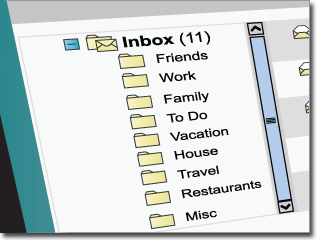
Filing emails in folders, or adding labels to them, doesn’t make them quicker to find. According to a study by IBM Research, it’s quicker to find them by searches.

“Finding emails by searches took on average 17 seconds, versus 58 seconds finding the emails by folder,” the researchers concluded. “The likelihood of success – that is, finding the intended email – was no greater when it had been filed in a folder.”

The time spent filing email, in addition to the added time spent retrieving it, can add 20 minutes a day to your workload, the study concluded. A comment to the article questions whether this is true under real world conditions:

In the majority of scenarios, searching is more efficient, however if you forget. . . the metadata [key words]. . . related to the email, then your search efforts are going to be quite difficult. On the other hand, if you remember that you simply filed the email under the “important” folder, then odds are you may only be a few clicks away. In a black and white world, yes searching is more efficient, however there are still valid purposes to using folders.

My plan to achieve email inbox zero calls for me to get rid of all but one label and rely on Gmail’s search capability. I’m pretty sure I won’t miss having more labels since I don’t use the 50 I currently have. But my view is colored by my use of Evernote to file important emails and to manage tasks and projects.

In Evernote, I tag everything (and sometimes also add key words to the body of the note). The difference though is that I don’t “file” all my email this way, just the actionable or otherwise important ones which constitute less than 5%.

I found most interesting the researchers conclusion that most people don’t file emails in folders to make it easier to find them so much as to remove from view the overwhelming volume of email. They pare down the inbox so that they can use it for task management, which the study implied was not efficient.

If they used Evernote like I do, they wouldn’t have to spend as much time filing all of their email in the right folders, they could simply send the important ones to Evernote and archive the rest.

Share

Making Money in the Current Economy: Advice for the Nervous

Share

A friend emailed me recently, seeking financial advice. He’d just watched a video on our current economic woes and the bleak forecast for the future.

He’s in his late 20’s, a creative type (graphic arts, web design, dance, music), and intelligent, but not savvy about business or finances. He currently works part time and does some freelancing, and he is nervous about his future.

He asked for books I might recommend, so he can educate himself, and for advice. I thought I’d share with you the advice I gave him, edited and with a comment or two for attorneys.

Here is what I told my young friend:

  • The best thing you can do is to own your own business. Don’t rely on a job, hire yourself. Yes, that’s risky and frightening, but so is being dependent on someone else.
  • Do something that excites you, even if you don’t know how you can make money at it. If you’re passionate about what you do, you’ll do it long enough to get good at it and the money will find you.
  • Focus. Put all your eggs in one basket. You can have more than one business [he has several interests], but only if they are related, or you start one after the first is successful.
  • Employ leverage. Find ways to use OPM and OPE (other people’s money and other people’s efforts). If your income depends solely on what you do, you’ll never grow as big as you could and vacations and retirement will be problematic.
  • Work at your business every day. Most people give up; you can stand out by consistently showing up.
  • Give more than is expected of you. The more value you deliver, the more your business and life will be enriched.
  • Go global. Use the Internet to offer your products or services worldwide. [Attorneys, if possible, don’t depend on just your local market. Can you get licensed in other jurisdictions? Can you create a law-related product (book, course, etc.) that can be sold to people outside your local market?]
  • Don’t fear competition, embrace it. Your voice and style makes you unique. You can earn more by working with your competition than you could trying to beat them. [Attorneys, you don’t sell your services so much as you sell yourself. You are your brand and your brand is valuable.]
  • Surround yourself with good people. You only need a few but choose them carefully.
  • Don’t worry about whether or not you’re good enough right now. Study your craft, do it every day, and you will soon be good enough. Just get started. Teddy Roosevelt said, “Do what you can, with what you have, where you are.”
  • Don’t worry about the economy or fixate on politics. Don’t put your head in the sand but realize you can’t do much about it. I agree with Barbara Bush who said, “What happens in your house is far more important than what happens in the White House”.
  • Think about what you want, not what you don’t want. You will attract what you think about.

A law practice is an extension of you. You are worth far more than you know.

Marianne Williamson said it beautifully:

Our deepest fear is not that we are inadequate. Our deepest fear is that we are powerful beyond measure. It is our light, not our darkness that most frightens us. We ask ourselves, Who am I to be brilliant, gorgeous, talented, fabulous? Actually, who are you not to be? You are a child of God. Your playing small does not serve the world. There is nothing enlightened about shrinking so that other people won’t feel insecure around you. We are all meant to shine, as children do. We were born to make manifest the glory of God that is within us. It’s not just in some of us; it’s in everyone. And as we let our own light shine, we unconsciously give other people permission to do the same. As we are liberated from our own fear, our presence automatically liberates others.

Share