Search Results for: getting things done

How to get good at marketing legal services

Share

Getting good at any skill, including marketing, is by and large a process of learning and doing. The more you learn, the more knowledge you can call upon. The more you do, the more your decisions will be informed by your experiences and the more agile you will be in performing the activities.

You’ll get faster, make fewer mistakes, achieve better results, and eventually earn your boy scout badge.

But it’s not a matter of learning it once and then doing it. Once you do the activities and observe the results, you go back to learning.

You re-read what you read before, but get more out of it because of the context of having done the activities. You read (watch, listen to, etc.) more advanced materials and pick up nuances that would previously been over your head. You talk to experts and learn new systems and methods you can incorporate into your mix.

And then you go back to doing.

Back and forth, learning and doing, learning and doing. Until you are good enough that others look to you as someone who knows what they’re doing.

And that’s where something else comes into play: teaching. When you are able to take your new skill and and help others develop that skill, that’s when you will learn the most.

And you can start doing that sooner than you think.

You may not know everything there is to know but you know more than others. If you want to get really good at marketing legal services, for example, find some lawyers and teach them what you know. Start a newsletter, blog, or Facebook group and invite them to join you.

Then, watch how much better you get at the skills you’re teaching, because the teacher always learns the most.

If you are go through one of my courses tonight to learn it so you can use it in your practice, you may miss things, at least the first time through. If you know you have to teach that course to other lawyers tomorrow, however, you’ll read more intently, take better notes, internalize the information, and be a step closer to mastery.

If you want to get good at any subject, learn it and do it and keep at it until you can teach it.

Start learning about marketing legal services with this
Share

Do you have five minutes? Great, then you can market your law practice

Share

Like a broken record, I promote the idea that you can market your law practice in only 15 minutes a day. You repeatedly hear me say, “Put 15 minutes on your calendar and make it an appointment with yourself.”

But I know that many lawyers don’t do it.

Is that you? If 15 minutes a day is too much, how about 5 minutes?

The beauty of five-minute marketing is that it can be done on the spur of the moment. You don’t have to schedule anything. When you’re waiting for your next client, when you’re eating lunch, when you’re driving, you can make calls, dictate emails, or brainstorm ideas.

You can even write the first draft of a blog post or article. Yes, in five minutes.

The trick to writing an article in five minutes is to separate the idea-getting from the writing. Set up a notebook dedicated to ideas for articles or posts. When you have five minutes, add a few bullet points, examples, or sub-topics to each idea.

When you have another five minutes, you’ll be ready to crank out the first draft of an article.

Assuming you’re writing about something you know, with notes in hand, in five minutes you should be able to write 200 to 400 words. More if you dictate them.

Whether you type or dictate, the trick is to write for five minutes without stopping to edit or even to think. Remember, you know this subject and you know what you want to say about it. That’s enough for a first draft.

That draft will be rough and better for it because it will sound conversational. At least it should.

Put the first draft aside and come back to it when you have another five minutes. Re-write, add links or cites or quotes, edit and polish.

As proof, I wrote the first draft of the foregoing in about five minutes. I’m taking another ten minutes or so to make it pretty for you.

Whether it’s writing articles or emails, calling former clients to say hello, or calling other lawyers to talk about how you might work together for your mutual marketing benefit, you can do a lot in five minutes.

If you’re not willing to commit 15 minutes a day to marketing, make a list of things you can do in five minutes and keep it handy. If you are willing to commit 15 minutes a day to marketing, during those 15 minutes you can do three of them.

How to talk to lawyers about referrals

Share

What should I have my virtual assistant do for me?

Share

I got an e-mail from attorney who uses a virtual assistant “to write and edit letters to prospective clients”. He asked me what else he could have her do.

Great question.

To answer it, I’ll share a (slightly edited) email I received in response to a post I did about justifying the cost of hiring outside assistants:

I have a full-time VA in the Philippines. She costs me about $75 per WEEK (full time). I gladly pay this even though I often don’t have 40 hours’ worth of stuff for her to do. I don’t let her handle much for my law practice. Her English grammar is a bit off sometimes, but she updates websites, edits video, does show notes for my podcast, handles blog posting, social media promotion of my stuff, etc. She’s been invaluable in getting my courses and info products created and published. This frees up some time for marketing, client service, and for ME… I get to have dinner with my kids almost every night.

Letting go of control is my big challenge, but I’m working on it, and Managing a VA is a skill set that needs to be developed, too… the time/distance and cultural differences require some finesse… But I’m glad to have Joanna on my team. I encourage everyone to find a VA to help out with things.

So, here’s what I would do.

Make a list of every task that is performed in your practice, by you or anyone on your behalf. Write down everything, from opening the mail, opening and closing files, meeting with clients, writing articles, and everything in between.

Then, look at that list and put a check mark next to every task that can only be done by YOU.

You probably do a lot of things that someone else could do. They may not do it as well, but as long as they can do it at an acceptable level, you should let them do it.

Make sure break down the tasks that only you can do into sub-tasks that others can do.  You may be the one who conducts the trial, but you can have others assemble documents and write (the first draft) of motions.

Now, what about the tasks that nobody is doing? What could you have a VA or employee do to help you with marketing, for example? That depends on your objectives and what you’re willing to do to accomplish them.

If you want to do Facebook advertising, you can have an assistant find keywords, create the ad graphics and copy (or co-ordinate with freelancers), and manage the campaigns.

If you have my new course on getting referrals from lawyers, you would have your assistant find other lawyers that you can contact to discuss referrals and joint ventures. The VA can compile details about what they do, make the initial contact on your behalf, and follow-up with those who respond affirmatively.

Do only those things that only you can do and delegate everything else. But first you have to figure out what needs to be done.

Get more referrals from other lawyers: click here

Share

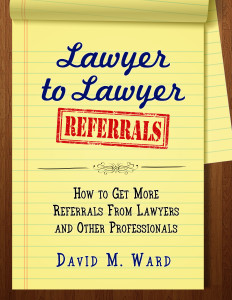
Lawyer to Lawyer Referrals–Get More Referrals From Lawyers and Other Professionals

Share

Lawyer to Lawyer Referrals: How to Get More Referrals From Lawyers and Other ProfessionalsDo you remember the last time a lawyer sent you a referral? How would you like to have that happen every day?

Lawyer to Lawyer Referrals: How to Get More Referrals From Lawyers and Other Professionals shows you how to get more referrals from the lawyers you know, and how to get more lawyers to become a new referral source for you.

Of course, lawyers are potentially one of your best sources of referrals.

Sure, your clients may be willing to send you referrals. If they don’t know anyone who needs your services right now, however, there’s not much they can do. But lawyers talk to people with legal issues every day of the week. Unless those lawyers handle “everything,” they can’t help everyone.

They can either turn those people away or refer them to other lawyers. Like you.

In fact, many lawyers have the ability to send you a steady stream of referrals, month after month, year after year. If you have a systematic method of showing them how you can help their clients and prospects and business contacts. . .

YOU WILL GET MORE REFERRALS

But it gets better. Not only will you get more referrals from other lawyers, the clients they send you are often better clients than you typically get through other means such as the Internet or advertising.

They’re better because they are pre-screened by the referring lawyer. The lawyer knows if the client is a good match for you and if they can afford to hire you. They can also “sell” the client on you and your abilities, making it less likely that the client will “shop around” and more likely that they will hire you.

The referring lawyer can also provide you with pertinent information about the client and their situation, making it easier for you to relate to those clients and do a better job of showing them how you can help them. As a result, referred clients tend to sign up more quickly and with less effort on your part.

And referred clients are themselves more likely to provide referrals.

Lawyers get referrals from a lot of sources—clients, prospective clients, business contacts, friends, business owners, and other professionals—but one of the best sources of high-quality cases or clients are referrals from other lawyers.

In Lawyer to Lawyer Referrals, you’ll learn

  • Why some lawyers almost always get more referrals—and how to become one of them
  • The SIMPLEST way to get more referrals from other lawyers (without asking for referrals)
  • A proven system for increasing referrals by up to 1,000%
  • What to say to lawyers who “owe” you referrals
  • How to get referrals from your competition
  • How to use incentives and “referral devices” to get even more referrals
  • How to set up simple joint ventures with other lawyers. Don’t wait for referrals to happen, MAKE them happen
  • What to do about referral fees
  • The ultimate, long-term, best way to get other lawyers to send you MOST or ALL of their referrals
  • What to do when you don’t have referrals to send them (i.e., when you can’t reciprocate)
  • How to get referrals as a new lawyer or when starting a new practice
  • A 7-step process for getting all the new referral sources you could ever want

One of the best things about this course is that it allows you to “automate” your referral program with a “referral letter” that does most of the work for you. It’s not as simple as mass mailing letters to other lawyers, but it’s close.

Have you ever had a lawyer tell you they sent you a referral, but you don’t know what he’s talking about because you never heard from the client? Your referral letter will make sure that doesn’t happen.

Lawyer to Lawyer Referrals is the ultimate referral-getting system for any lawyer. It comes with scripts and step-by-step instructions and everything else you need to start getting more referrals immediately.

GET MORE REFERRALS IN 15 MINUTES A DAY

You may be wondering if this system will take up a lot of your time.

Nope.

You can get everything set up in a few hours, and then spend as little as 15 minutes a day “working” the system. And you can delegate some or all of the daily activities if you want.

The course comes with a Bonus Quick Start Guide to help you get your referral program set up and working. Then, you can use the system over and over again, to get more referrals from the lawyers you know and to get more lawyers and other professionals on your “team”.

No matter how many referrals you now get in your practice, you are about to learn how to get more. Lawyer to Lawyer Referrals comes in pdf format and is available for immediate download. You can use PayPal or a credit card.

Lawyer to Lawyer Referrals is only $97 for a limited time.

Order Now

 Recommendations

Here’s what attorneys say about my programs:

As an update about the success I have had with [this technique], the 2nd client (and the one I thought would not use that approach) agreed to the plan. As a result of using this approach, I deposited over $60,000.00 since purchasing the cash flow for attorneys program. Wow!!”

A few days later: “Went 3 for 3. Last one agreed today and paid me. I put $75,000.00 in the bank in 2 weeks. I love it!” —Jack Robinson, Texas

“I think your materials are great. I got a lot out of them. I started using one of your techniques but I got so many responses, my secretary was going crazy and made me stop! I’m going to hire a young lawyer to handle the extra work, so I can spend more time marketing.” –Bernard H., MA

“I am one of your original subscribers. Last year was my biggest year ever. I moved about $2 million in PI cases across my desk. Most of those clients were retained using techniques you taught me. Not bad for a sole practitioner.

Your internet advice over the phone already saved me the price of your course and will make me a fortune in the future. As you know, there is a gold rush going on in the internet. Lawyers who hesitate will be left behind and broke. —John J. Schalter, MI

David, you were kind enough to offer a detailed, five-page critique of the networks I had been forming among other lawyers. You had asked me to keep you informed of my progress. I am happy to report that my first case resulted in a $10,000 fee within the first month! Much of what you said in your five-page letter proved prophetic. So far I have received 6 cases that I would not have otherwise had.–David Wright

I’m finding your program extremely helpful. In the first week of business on a part time basis, I have 3 new clients. –Jane K., LA

Order Now

More recommendations

Your materials are unbelievably good! I should know. I used to be the marketing director of a 100,000 member association headquartered in Kansas City. We had a large marketing department and did all of our own creative, production, copywriting  etc. I ran the whole show so my expertise has been in the marketing arena.

Having said that, let me tell you, your course taught me more about marketing legal services than the entire sum total of all the marketing research and reading I’ve done over the last decade. There’s something there for every attorney.

I project that your guidance will add an additional 2 to 3 clients a week. . . and at an average of fee of $1500 per client. . . well you do the math.

I thank you. . . my wife thanks you and my kids thank you. Oh yeah, like the commercial says. . . we’re going to Disneyworld. . .thanks to you.” —Bill H., KS

I have never seen such a collection of relevant secrets and pragmatic ideas on how to build a law practice. I had always assumed that successful lawyers either: (1) never gave away their secrets; or (2) did something unethical to obtain their clients. The fact that you would even consider sharing the secrets of your success says a lot about your character.

[T]here are a lot of struggling lawyers that I have attempted to help over the years. So many drop out of the profession and change careers because they can’t make a living practicing law. You may never hear about all the careers you have saved. You will never know all the good you have done.” –David W.,TX

“[My three partners and I] were very happy with what we received. A lot of thought and energy appears to have gone into the program. It was good to see more subtle approaches that appear to fit our firm’s nature. We expect to quadruple our income by the end of the year! Seriously, we are quite busy and have for the first time hired an associate.” —Robb K., Chicago, IL

“The marketing approach is a very practical one. [You] provide concrete suggestions suitable for a wide variety of legal practices.” –Vera B., FL

How refreshing to finally find marketing advice from someone who understands the legal profession. I had become frustrated with my current marketing advisor’s more generic approach and it is already apparent that your advice will be much more helpful.” –Alice K., CA

Order Now 
Share

Are you investing in yourself?

Share

Among other things, The 80/20 Principle, one of my favorite books on the subject, tells us to “pursue those few things where you are amazingly better than others and that you enjoy most.” Do them to the exclusion of other things you’re not as good at.

Another author puts it this way: “Do very few things, but be awesome at them.”

To do this, you must work on your strengths, not your weaknesses. Figure out what you do best and find ways to do it even better.

I do a lot of writing. It’s one of my strengths. I invest in getting better at it by reading books and blogs about writing, watching videos, listening to podcasts, and making sure I work at it every day.

I also invest in tools that help me write better and faster. I’ve mentioned Scrivener before and told you that I now do all my long-form writing in it.

I got a new chair recently that helps me sit longer. It helps me get more writing done because I don’t need to take as many breaks.

Yesterday, I went out and looked at mechanical keyboards. (They’re in the “gaming” section.) I’ve been reading about these for awhile and I’m about ready to order one. I’m told they help you type faster and with fewer typos. They also last longer than the rubber membrane keyboards found on most laptops and computer desktops. I like the tactile feel of these keyboards, and the clicky sound they make. (You can get ones that don’t make that sound, if you prefer.)

After that, I’ll probably look at external monitors. A bigger screen will allow me to look at two documents at one time, instead of having to switch back and forth. Maybe dual monitors is the thing.

For a long time now, I’ve been using the track pad on my laptop. I might start using a mouse again.

It’s all about getting that edge. Making a good thing even better.

How about you? What do you do best? How are you investing in yourself to get better?

Share

How to beat procrastination without really trying

Share

There are hundreds of tips and strategies on how to beat procrastination floating around. That’s too many, if you ask me.

Instead of giving you a laundry list of ideas I want to share with you just three.

(1) DON’T DO IT

Not everything on your task list needs to be done. Many tasks aren’t that important, at least in comparison to other things on your list. After all, being productive isn’t about getting everything done it’s about getting the most important things done.

So ask yourself, “Do I really need to do this?” and if the answer is anything but an unqualified yes, either cross it off the list or put it on a “someday/maybe” list and look at it at some future date.

If a task does need to be done, ask yourself, “Who else could do this?” If you can delegate the task to someone else, you should.

(2) CREATE A DEADLINE

If something needs to be done (by you), and you don’t already have a deadline, give yourself one. Pick a date when the task will be done, or when a significant portion of the project will be done, and put this on your calendar.

You may be inclined to give yourself ample time but it’s usually better to do just the opposite. Shorter deadlines make it more likely that you will complete the task.

If you give yourself three weeks to complete something, you might not get started until a few days before the deadline. Or, as you see the deadline approaching you will extend it. So instead of three weeks, give yourself three days to complete the task, or even three hours.

Once you have a deadline, tell someone about it–your client, spouse, partner, or a workout buddy–and ask them to hold you accountable. When I tell my wife I will have the first draft of something done by a certain date, I am much more likely to do it.

(3) START

The most important part of any task is getting started. The first step in doing anything puts you one step closer to the second step.

Start with something small and easy. Make a list of everything you need to do, for example, or re-write the list you already wrote.

Tell yourself you’ll work on it for just five minutes. No matter how unpleasant the task might be you can do it for five minutes. The odds are that once you get started, you’ll feel compelled to continue.

These three strategies should help you beat procrastination most of the time. If you still find yourself procrastinating, however, ask yourself why you are resisting doing things you know you need to do.

The solution might be simple. If you don’t know how to do something, for example, schedule time to learn. If you’re afraid of doing a poor job, get some advice or ask someone with more experience to help you.

There is always a reason why you are procrastinating. Instead of ignoring that reason, embrace it. Your subconscious mind knows what you need and if you listen carefully, you will hear the solution.

Share

How to earn more by working less

Share

No doubt you’ve heard of Parkinson’s Law, which says that, “Work expands so as to fill the time available for its completion”.

Translation: most people waste time.

You can get more done in less time by allocating less time to tasks and projects. That means allocating one hour for a task instead of two hours. Or assigning a due date in 48 hours instead of a week.

Having less time available gives you greater focus. You make quicker decisions. You let go of perfectionism. And you work faster.

You get more done in less time because of Horstman’s Corollary to Parkinson’s Law: “Work contracts to fit in the time we give it.”

Translation: you waste less time.

The problem is, when you’re in charge, you can do what you want to. If you want to extend a self-imposed deadline, you do it. Hey, nobody will know.

One solution, which I have talked about before, is to make sure that somebody does know. Make yourself accountable to your clients, your spouse, your employer, your staff, or your Maker. Tell people what you’re doing and when you’ll finish. Make it a promise or guarantee. And ask them to hold you accountable.

You can also train yourself to set and keep shorter deadlines by continually reminding yourself of the benefits for doing so.

Every day, spend a minute or two cogitating about the benefits of getting more done in less time. Think about how much more you earn by completing projects in less time. Think about how much extra time you have for other paying work. Think about how much extra time you have with your family or for doing other things you enjoy.

At the start of your day, look at your task list and calendar and make a conscious effort to shorten due dates and assign less time to tasks. At the end of the day, record how much time you saved on each task. At the end of the week, add up the amount of time you put into your “bank”.

What about work that is billed by the hour? If you can draft a document in one hour instead of two, you must do so. Raise your hourly rates accordingly because apparently, you are worth more than you thought.

Or, as I have repeatedly suggested, move away from hourly billing to flat fee or project based billing, which is ultimately better for you and for the client.

Don’t sell your time. It’s limited. Sell your advice, value, or work product, and earn more by working less.

More on how to earn more and work less: The Formula

Share

Take Off Your Pants (but don’t show me your briefs)

Share

The most important task of a headline is getting the reader’s attention. You may have a brilliant article or blog post, amazing sales copy, and a powerful offer, but none of that matters if nobody reads it.

An example of a good headline is the one on a new Kindle book, Take Off Your Pants: Outline Your Books for Faster, Better Writing.

It’s for novelists who ordinarily don’t outline their books but write them “by the seat of their pants.” They are considered “pantsers” in the parlance, in contrast to “plotters”–writers who outline and plot before they write.

I saw the book when it launched and even though I’m not a novelist I was intrigued by the title. It stopped me in my tracks and made me look at the book description. It made me chuckle.

It did it’s job and did it well.

Of course you need to read the sub-title to understand that the book is for writers and not a 50 Shades knockoff. And that’s okay. The title gets your attention. The sub-title clarifies the title and promises a benefit.

Nicely done.

If you’re looking for ideas for headlines for your posts or articles, or titles for your books, don’t hesitate to borrow from what’s already out there. You can use an existing title or headline “as is” (there is no copyright protection afforded titles), or you can play off titles, especially iconic ones. My book (on network marketing), Recruit and Grow Rich is an obvious but effective play on the classic “Think and Grow Rich.”

Another example.

In the 1970’s, Dr. David Reuben became a mega best selling author with his book, “Everything You Always Wanted to Know About Sex (But Were Afraid to Ask)”. Woody Allen made it into a movie with that title.

The original title is trademarked, so you can’t use it as is, but I’ve seen more than a few ads for products and services that play off it. You can do the same thing. “Everything You Ever Wanted to Know About Bankruptcy (But Were Afraid to Ask)” works.

You could use this template for many practice areas, and it doesn’t matter whether readers know the original book or movie. There are a lot of things prospective clients want to know but are afraid to ask.

For more on writing effective titles and headlines, get this and this

Share

The problem with being self-employed

Share

Being the boss is a double-edged sword. I love being the master of my destiny but sometimes the weight of responsibility wears on me.

You too? Do you ever get anxious thinking about how many people depend on you or how much work remains to be done?

You’re not just cranking out widgets, after all. You do important things, with important consequences. Every day you make decisions that affect the lives of other people. You can’t let your guard down. You have to keep your eye on everything, and everyone.

It can be difficult doing our best work when we have so many other things to think about.

Yes, that’s the gig we signed up for and most of the time, it’s worth it. But if you’re like me, it gets to you sometimes.

Sometimes I think, “Wouldn’t it be great if someone would tell me what to do today so I could do the work and go home?”

I remember when I didn’t have clients of my own and did appearances for other lawyers. I enjoyed just showing up and doing the work. Argue the motion, take the depo, do the arbitration. I didn’t have to worry about anything but the assignment. When it was done, I went home.

When I started getting my own clients, I had responsibilities, overhead, employees, and things got very complicated. I grew into the role, of course, and would never work for anyone, but sometimes I look back fondly at the time when I could just do the work.

If you ever find yourself overwhelmed with the burdens of running a law practice, wishing you could just show up and be a lawyer, I have a suggestion.

Go get yo’self two hats.

First thing in the morning, or at the end of your day, put on your “boss” hat and make a list of assignments for your “employee”. Map out the day, and include contingencies in case something comes up that requires the bosses attention.

Then, take off the boss hat, put on your employee hat, and get to work.

When the first assignment is done, look at the list your boss gave you and do the next assignment. When all the work is done, take a break, put your boss hat back on and make a new list.

Well, that’s it for me today. The boss told me I could home.

Share

Do you look like a professional?

Share

I love watching a professional do his or her work. When I see a studio musician, a house painter, or gourmet chef doing what they do, I admire their skills and how they deploy them. There is a grace to what they do. It is effortless and efficient.

They look like a professional.

If I was planning to hire them, seeing them work would inspire confidence. I’d know I was getting someone who knew what they were doing. I wouldn’t worry about them making mistakes. I would know they were worth every penny they asked. Once I gave them the job, I’d get out of their way and let them do what they do.

Wouldn’t it be great if our clients could watch us work and have that same confidence about hiring us?

But a lawyer’s work isn’t visual. We work in our heads, mostly, and on paper. When we talk to people, it’s nothing like what lawyers do on TV. What we do looks boring. Watching us work is unlikely to inspire anyone.

You might not want to show people what you do, but you can do the next best thing. You can show them what it looks like after you have done it.

Show people photos of your office, your library, and your staff. Show them photos of you coming out of court, shaking hands with clients, and speaking in front of a crowd. Make sure you’re wearing the uniform (suite and tie) clients expect you to wear.

Make sure your website looks professional. You don’t need fancy (which can actually work against you), just not amateurish.

Let your content do most of the heavy lifting. The quality, depth, and quantity thereof should leave no doubts about your experience and ability to help your clients.

Make sure people see you doing things professionals do. Speaking, writing articles and books. Teach a CLE class (even once), because if you teach other lawyers, you must be good.

Promote the fact that you have forms and systems for everything. The chef has his tools, you have yours.

Don’t hide your light under a bushel. Highlight your awards, honors, and milestones. Post testimonials, endorsements, and positive press.

Clients and prospects are watching you. Show them the professional they want to hire.

How to earn more than you ever thought possible. Click here.

Share