Email marketing for attorneys

Share

Yesterday, an email arrived in my inbox. See if you can tell what’s wrong with it:

–BEGIN EMAIL–
David,

First of all thanks you for subscribing over the years. I know
many of you have read my books or taken some of my courses
and I truly appreciate that.

The reason I have been so passionate in creating an online
business over the years is because it is the perfect way to
reach people worldwide and EXPRESS YOUR CREATIVITY.

I have tried the do this in my [Product names] . . . as well as my music.

——————————
QUICK NOTE:

Our once a year World Class [Product Name] Certification
Program starts next Monday June 10. Only a few spots left.

[Link to sign up]

——————————

THE SECRET OF LIFE

In my opinion it is doing what you love and sharing it
with others (and best of all make a living at it).

But rather than talk about it let me SING it to you
with some help from [Famous singer]…

[Youtube link of famous singer with writer of email]

In this You Tube channel you will see a part of me
many of you haven’t. In 1976 I got a Masters in
[Music degree, school]

. . .

–END EMAIL–

Okay, that’s enough. The rest of the email discusses his music and asks us to subscribe to his Youtube channel. He then mentions that he is working on another product and signs off.

So, what’s wrong with this email?

1. Who is this guy?

You can’t tell from the email itself but this is a list I signed up for a long time ago and I haven’t heard from this guy for at least six months. I don’t remember anything about him or what he does.

When people subscribe to your list, you have to write to them regularly or they forget who you are and that they signed up on your list. At best, they delete your email or unsubscribe. At worst, they flag your email as SPAM and now, when you do write to your list, your emails get filtered out and don’t get read.

You must write regularly, and frequently. You want to build a relationship with your readers, so that they know who you are and look forward to hearing from you. You don’t know when they will need to hire you, or know someone who does, and if you’re not in their mailboxes and their minds when that occurs, you’re not going to get the call.

2. “I know many of you have. . .”.

When you write to me, write to me. Don’t write in the collective. Say “you” not “many of you”.

Even if there are thousands of subscribers on your list, write your email as though it is a personal communication sent only to one reader. Me.

3. What’s in it for me?

When you write to me, tell me something that will make my life better. Give me something valuable–a tip, a link to something I can use in my business or personal life. There is nothing in this email that does that.

I’m blazing through my inbox, reading and saving a few emails that have something of value for me and deleting (and unsubscribing) everything else. If you want me to read your email, give me a reason. Give me a benefit. Tell me what’s in it for me.

4. “I have been so passionate about. . .”.

Your readers may care about what you are passionate about, but only if they share that passion or they have a relationship with you. The rest of us don’t care. We have our own problems to solve and lives to lead. We’re busy. We don’t have time to look at what you’re doing and did I mention, we really don’t care?

Ironically, I do share his passion for expressing my creativity. I also like the music of the famous singer he refers to. But I didn’t go watch his videos because I can watch videos of the famous singer any time I want. I don’t care that years ago, this guy played with him. So what? Lots of people did. I don’t know them, either.

On the other hand, when you have a relationship with your subscribers, you can share with them something about you that has no direct benefit to them, and they will pay attention.

When you have a relationship with someone, they’ll read your emails, Like and Tweet your posts, send their friends to your website, and respond to your requests. When they need your help, they’ll hire you. When they have a referral, they’ll give it to you. And when you share a video of you playing with a famous musician, they’ll go watch, because they probably don’t have a relationship with anyone else who did that and it might be neat to go see someone they know in a video with someone famous.

Build your list. Build relationships with your list.

Email marketing for attorneys. Click here for details.

Share

7 Reasons You Should Write More

Share

I know, you already do plenty of writing for work. You should write more.

Love it or loathe it, writing more (and getting better at it) is good for you and good for your practice. In fact, if I were making a list of essential skills for attorneys, writing would at or very near the top.

Here are 7 reasons:

  1. You learn things. Writers are readers. In reading deeply in your discipline, and broadly outside of it, you accumulate knowledge. That knowledge makes you better at spotting issues and finding solutions. It helps you understand other people and relate to them. It makes you more well-rounded, interesting, and likable.
  2. You find out what you think. Writing forces you to clarify your thoughts and priorities. Clarity leads to better decisions; better decisions leads to better outcomes.
  3. Writing more makes you a better writer. You get better at asking questions, doing research, and sorting information. You get better at the mechanics of writing. You get better at communicating your ideas and persuading others to your cause.
  4. Writing makes you a better speaker. Writing helps you consolidate, organize, and present your ideas. You develop a better ear for words and become a better story teller. Not surprisingly, speaking more makes you a better writer.
  5. Writing helps you meet new people. You can approach other experts, to interview them, invite them to do a guest post for your blog or an article for your newsletter. Through them, you can meet other people you would like to know.
  6. Writing helps you build your practice. The more you write, the better you get at showing people what you do and how you can help them. The more articles, posts, reports, and other documents you create and distribute, the more opportunities there are for clients to find you.
  7. Writing more helps you become a better attorney. For all of the above reasons.

To get better at writing, write something every day. A journal is a good place to start.

If you don’t know what to write, open a blank page, set a timer for 15 minutes, and write whatever comes. Keep your hand moving (or fingers typing) and don’t stop until the timer sounds. If nothing comes, write about how you don’t know what to write, but keep going.

Write something every day and your writing will improve. So will your thinking. So will you.

Get more clients and increase your income. Get The Attorney Marketing Formula.

Share

How to find ideas for blog posts

Share

If you would like to know how to find ideas for blog posts, I’ve got an easy one for you.

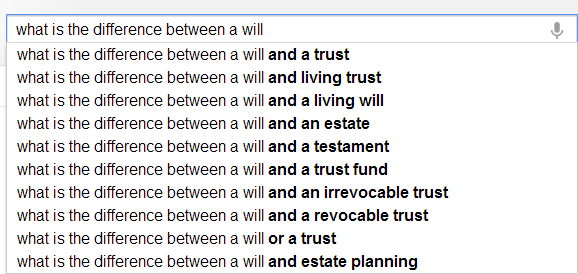
Go to Google and type in a question related to your legal services. Before you complete the sentence, Google’s autocomplete mechanism (assuming you have it enabled) will provide you with a list of possible searches based on what you have written so far.

I did just that by entering in, “What is the difference between a will” and as you can see in the graphic below, Google gave me several options for completing my search request, to wit, “What is the difference between a will and a trust,” “What is the difference between a will and a living will,” “What is the difference between a will and estate planning,” and so on, based on what other people have searched for in the past.

How to find ideas for blog posts

Armed with this information, you can write a blog post that answers the very questions your prospective clients are searching for. Use one of these search phrases as the title of your article and you will increase your chances of being found in subsequent searches.

You can use the other search queries as key word phrases in your post, or write other articles with these titles.

This can help you find “long tail” search terms, meaning longer, more specific search phrases you can use instead of the more common, shorter and highly competitive phrases.

For example, you would have a hard time getting found by targeting the search term, “slip and fall.” There are too many lawyers competing for that phrase, in both generic search and in Adwords. But type in “slip and fall” into Google and you will find another suggestion: “slip and fall statute of limitations california”. Make that the title of your article (or bid on this term in Adwords) and you should have very little competition.

I used Google to generate the title of this post. I typed in, “How to find ideas for” and it suggested, “How to find ideas for blog posts,” and not “newsletter,” “ezine,” or “articles.”

Prospective clients are looking for information. Now you know an easy way to find out what they want to know so you can give it to them.

The law is complicated. Marketing is simple.

Share

Are you playing it safe in marketing your legal services?

Share

You don’t play it safe when you advocate for your clients. So why do you play it safe when you advocate for yourself?

In marketing, you must stand out. To stand out, you can’t play it safe, you have to be different.

Have you ever noticed how most attorney’s web sites look the same? Change the name and the photo and another attorney in the same practice area could take over the site without missing a beat.

How do you expect clients to notice you when you look like everyone else? Why should anyone choose you when you don’t show them how you are different?

Being different starts with including some personal information in your marketing. Share some of the things that define you as a person–your family, your hobbies, your crusades. Give the world a glimpse into the human being behind the professional.

Being different also means saying things most attorneys don’t say. Examples? Revealing how most law schools don’t prepare lawyers for the courtroom. Or how lawyers pad their bills. Or lawyer discipline. Or what to ask a lawyer to see if they are competent.

If you’ve never spoken about these things, you should. Your colleagues may not like it, but your clients will.

You can also be different by sharing your opinion on something controversial. Most attorneys straddle the middle of the road. If there’s something you believe strongly in, you should take sides and open your mouth.

Look at Donald Trump. He’s never afraid to say what he thinks. Did he earn a fortune because of this or in spite of it? I don’t know. But I do know that whenever he opens his mouth, he makes money.

The same goes for Ted Turner. And Rush Limbaugh. The more you hate them or laugh at them, the more they earn.

I’m not saying you need to go to these extremes. But you do need to take some chances.

Here’s the challenge: On your web site, or in your newsletter, say something you know will not sit well with someone. Nothing radical. Don’t start a fight. Just say something a little different or a little out of character.

Make a few eyebrows rise. Show people a side of you they’ve never seen.

It might not be what you say but how you say it. A coarse reference, perhaps. Or gansta slang, yo.

Click the send button. If your heart beats a little faster and you wonder if you’ve made a mistake, you know you’re doing it right.

You’ll find it liberating. Maybe even exhilarating. Possibly terrifying.

You might hear from someone who likes what you said. That’s good. You might hear from someone who doesn’t like it. That’s good too.

Communication isn’t solely about delivering information. It’s about touching people on an emotional level. Making them listen. And think. And feel. And respond.

If you get no response, the odds are nobody noticed. Try again. Push harder. Keep stirring.

Eventually, you may lose some people who don’t like what you say. That’s the risk. The reward is that there will many more who take their place, who love you and want to work with you and tell all their friends about you, in great part because you aren’t like everyone else.

If you want mediocre results, keep doing what everyone else is doing. If you want superlative results, you’ve got to take some chances.

Want more ways to be different? They’re in The Formula.

Share

Do prospective clients read lawyers’ blogs?

Share

Of course they do.

They may not know that your web site is a blog or that what you wrote is a blog post. They may not know what RSS is or care about Google Reader’s impending demise. But when they have questions, they go searching for answers and when they find your blog post via Uncle Google or Auntie Facebook, they read it. If you answer their question, they’ll go read more of your content and about what you have to offer.

When they’re ready, they’ll call.

Prospective clients have questions. About their rights, about the law, about their options. They know how to use a search engine to find restaurant reviews and oil change coupons and movie times and they know how to use it to find answers to legal questions.

Give them something to find.

Answer their questions. Tell them about the law and their options. Tell them about other people like them who had the same problem and how it got resolved. You know what they want to know. What do prospects and new clients ask you when you speak to them? Write about that.

It’s true, they may never before had any interest in reading anything you wrote, and they may never again. But when they have a legal problem and they want a solution, they will read everything you have to say on the subject.

So yes, prospective clients read blogs. So do your existing clients, former clients, and others who may not need your services but know people who do. So if you don’t have a blog, now you know why you need one. And if you do, you know why you need to keep writing.

Marketing for attorneys made simple: Click here.

Share

Attorneys want to know: How often should I email my list?

Share

After yesterday’s post about email, I heard from a lawyer who wanted my take on his email signature. Ah, but it wasn’t a signature, it was an attachment (pdf). I pointed out that

  • Some email servers treat emails with attachments as spam so his emails might not get through,
  • Some people refuse to open attachments because they’re afraid it might contain a virus, and
  • Many people simply won’t take the time to open an attachment.

So, while his attachment has some good information in it, a lot of people will never see it. I recommended a simple text or rich text signature, so people can see some basic info, and a link to a web page for those who want more.

Now, pdf’s are one thing. When I get an email with an MS Office document attached that I am charged with reviewing, unless there is a reason I need to see the original formatting, I often reply and ask the sender to cut and paste the text into the body of the email. It’s not so much fear of a virus as convenience. It’s easier for me to respond to a text email with my responses or corrections, especially if where there will be a series of back and forth corrections.

Okay, maybe that’s just me. But just in case it’s not just me, my advice is to not send attachments unless you have no other choice.

Onward.

How often should should you email your list?

Often.

If you’re providing valuable information (newsletter, blog posts, resources), information people want and have signed up for, don’t hold back. Write as often as you can.

I email every day, five days a week. I hope you find value in what I write. If you don’t, or you don’t have time to read every email, you can save my emails for later, delete them, or un-subscribe.

There, I said it.

Hey, it’s not a bad word. I get a lot of people un-subscribing from my list. And that’s good.

How can that be good? Well, if they don’t value what I’m sending them for free, they’re not going to hire me or buy something from me, so why clutter up my list or their email inbox?

That’s reality. Some love ya, some don’t. Some listen to your advice, some don’t. Some only want free stuff and will never buy anything, some will.

The same goes for your list. Think about it: Would you rather have a list of 10,000 people who don’t read your emails and won’t hire you or a list of 400 people who read every email, share your content, promote your web site, hire you, and send referrals?

Exactly.

And guess what? The more often you mail, the more of your services you’ll sell. That’s a fact, Jack.

So don’t worry when someone un-subscribes from you list. It’s a good thing. And don’t worry about writing too often. As long as you are sending valuable information that (the right) people want to consume, you almost can’t mail too often.

I’m on several email lists that don’t send valuable information. Every email is either an ad or an invitation to a webinar where products will be pitched. No tips, resources, or advice. And many of these email me daily. Sometimes twice a day. Why on earth do I stay on these lists? The value to me is that it lets me see what other marketers are doing. I skim and delete. But I stay subscribed.

Value is in the eye of the beholder.

Now I don’t recommend emailing nothing but ads for your legal services. It’s true, these marketers wouldn’t continue sending nothing but ads and webinar invites if it wasn’t working for them, but they’re not selling legal services. Make your email (and website content) 90-95% valuable content, only 5-10% promotion.

And every practice is different. I doubt many people want to get daily emails from their criminal defense attorney no matter how good the information is. But every client is also a consumer so if you are sending consumer tips and advice, daily might be just fine.

There is a risk in not emailing often enough. If you email quarterly, for example, you risk people forgetting who you are and sending your email to spam. Not only do they ignore your message, you get penalized.

You need to write often enough to keep your name in front of your list. Once a month is probably the minimum, and that’s cutting it close. Once a week is much better. If you don’t think you have enough for a weekly email, write shorter emails. One or two tips is all you need.

Stay in touch with your list. You can build a very large law practice with email.

Create value. Build a list. Mail often.

Marketing made simple: The Attorney Marketing Formula

Share

Is your web site boring? Try these quick fixes

Share

Many competent and successful attorneys are, frankly, a bit dull. They live in a world of dry facts and esoteric knowledge and in that world they may be brilliant, but clients don’t usually live in that world.

The truth is, if your web site is boring people won’t read your content. If they don’t read it, they won’t know what you can do to help them. And trust me, they won’t call to find out.

How can you improve your writing? One of the best ways is to study good writing.

Think about your favorite web sites, the ones that aren’t boring. The next time you visit, save some of their articles and study them. Read them several times, slowly. Read them out loud. Copy them, by hand. Then, create an outline of the article and use it as a template for your own.

Now, what can you do right now to improve your web site’s content? Here are three quick fixes:

  1. Don’t write, speak. Dictate and record your thoughts and transcribe them. You’ll have a more natural, conversational first draft. You’ll be more likely to say what you want to say and leave out the boring bits. You could also record your content on audio or video and post that on your web site, along with a transcript.
  2. Put people in your posts. Stories breathe life into writing because they engage human emotions. Readers relate to the people in stories and keep reading to “find out what happened.” I’d much rather read about your client and what happened when he didn’t follow your advice than to only your advice.
  3. Make it visually appealing. Many people don’t read anymore, they scan, so give them something scanable. Use more white space and photos. Shorter articles, shorter paragraphs, and shorter sentences. Use bold headlines, sub-heads, and bullet points. By scanning, they’ll get the gist of what you’re saying and for now, that might be enough.

Don’t stop with quick fixes, though. Writing is one of the most valuable skills any attorney can have and worth the time and effort to improve. Read books or take courses on writing, copy writing, and sales. Make writing a daily habit. The more you practice, the better you will get. And, if you have more money than time, hire an editor or writing coach. Their feedback will help you get better.

You may be boring but your writing doesn’t have to be.

If you aren’t open minded, don’t buy this course.

Share

Law practice development tools: sports, museums, and hip hop

Share

I read a lot about marketing and productivity. That’s my field and I need to keep up. Most of what I read, however, is cumulative: things I know, things I already do and teach. There are occasional new twists on old ideas and changes in technology keep things fresh and interesting. But by and large, when you are an expert, unless you are doing original research, you already know what there is to know.

If you’ve been practicing for more than a few years, you may feel the same way about your area of expertise. Still, we read. There is always something new, something we can learn. But if we only read in our areas of expertise, eventually, we get stale.

I get some of my best ideas from reading about things that have nothing to do with marketing or the law. I read blogs and magazines and listen to radio. I talk to people in different fields. I pay attention to what’s going on in my neighborhood and in world politics. I’m not interested in sports but I know that Alabama just clobbered Notre Dame. I’ve never listened to Justin Bieber or One Direction but I know who they are.

I encourage you to read broadly, outside your field. Keep your eyes and ears open to what is going on around you, in sports and pop culture. Study history and economics. Listen to TED talks on science and psychology.

Alfred Whitehead, said, “Novel ideas are more apt to spring from an unusual assortment of knowledge – not necessarily from vast knowledge, but from a thorough conception of the methods and ideas of distinct lines of thought.”

The more diversity you have in your knowledge, the more ideas you will have and the more interesting you will be in conversation, in writing and speaking, and as a lawyer doing your job.

Would you like to earn more than you ever thought possible? Click here to find out how.

Share

New iPhone? Here are the apps I use and recommend

Share

A Facebook friend posted that they just got a new iPhone and wanted suggestions for apps. I just went through my screens and jotted down the apps I use the most and thought I would share them with you.

I’ve downloaded hundreds of apps, most of which I quickly abandoned. Some had a steep learning curve or were confusing. Some duplicated apps I already had that did the same thing, only better. And some I just didn’t like.

Of course everyone has different needs and preferences. This is just my list and it is by no means complete. Just the apps I use the most.

I’ve included a few excellent apps I don’t use that much. Dictamus is one example. You can replace your expensive dictation machine with this app. iA writer is another. I don’t do much long form writing on my iPhone. Small screen, small keyboard, old eyes. I make notes on my phone and do my writing on my laptop.

I try new apps all the time because I’m always looking for better and easier ways to do things, and because it’s fun. I like apps that are well suited for the job, and actively developed and supported. Many of my favorites are at or near the top of their categories.

I’ve organized my list by category. Please let me know (in the comments) if you use these apps, and if not, what you use instead.

Productivity

  • Evernote (Essential. Nuff said.)
  • Drafts (Great for quick notes that are uploaded to other apps (including Evernote).
  • Workflowy (I’ve been using this a lot lately; great for outlining. I use the web app mostly, and tweak my outlines on my phone; if you sign up for a free account through this link, you’ll get more free space (and so will I).
  • iA writer (Simple, distraction free writing with few options. Sync to Dropbox, iCloud, other devices.)

Business

  • Dictamus (Best dictation software; try the free version and you’ll see)
  • Jotnot Scanner Pro (I have others but mostly use this)

Utilities

  • Easy Calendar (Simple, quick to update)
  • Pocket Informant (Used this for a long time. Very capable, but more than I need; find it in Productivity)

News

  • Instapaper (Must have; anything saved for later reading, but not in Evernote, goes here)
  • Newsify (Google RSS)
  • Stitcher Radio (Live radio, podcasts)
  • Flipboard (News, social media feeds)
  • Zite (News, blog feeds, great for finding sources you don’t currently follow)
  • AppAdvice (For finding new apps and reading reviews)

Social Media

I have the native apps for Facebook, Twitter, and LinkedIn, but don’t do much updating on my phone. When I do, I usually post from other apps (i.e., Drafts, Flipboard).

Other

I also have (and use) Youtube, Google, and Kindle. I have several apps for document downloading, storage, (Dropbox, etc.) and editing, but I prefer to use their desktop or web app equivalents. I listen to Pandora and Spotify. I don’t download games any more, but I do play Words With Friends.

So that’s my list. How about yours?

Let me show you how to grow your practice and your income. Check out The Attorney Marketing Formula

Share

Please retweet this!

Share

A fundamental precept in marketing is that you get a higher response when you tell people what to do. Tell them to buy, tell them to sign up, tell them to call, and more people will.

The infographic below, about The Art of Getting Retweets, has some interesting stats about the best days and times to tweet, optimal tweet length, and the use of urls and hashtags for maximum retweetability. It also offers compelling statistics that support the efficacy of telling (asking) people what to do:

“Please retweet” has a 51% retweet rate followed by “PleaseRT” which has a 39% retweet rate. Using neither of the two yields only a 12% retweet rate.

The Art of Getting Retweets
Courtesy of: Quick Sprout

Frequency of asking for a retweet must be a factor. Someone who constantly asks for a retweet, like the boy who cried wolf, probably doesn’t get a lot of retweets. It is the rarity of this request that undoubtedly gets people’s attention and compliance.

Although it is not stated in the infographic, it is also well known that a higher response occurs when you also tell people why they should do what you ask. This may be due to associated scarcity and fear of loss implied in a statement like, “Buy now before our prices go up,” but there’s evidence that that’s not the only reason.

I read about one psychological study involving a long queue at a copy machine in a college library. A female “student,” holding a sheet of paper, asks the person at the front of the line if she can cut in. When she gives them a reason for needing to cut in line, she gets a significantly higher percentage of the subjects to agree. What was remarkable about the study is that it didn’t matter what reason the student gave for asking to cut in line. Even when the “reason” was as empty as, “. . .because I need to make a copy. . .,” she got a higher response.

So telling people what to do and giving them a reason, no matter how weak that reason may be, will increase response.

Put this in your notes because you should should have this in your notes.

(Did you?)

Buy The Attorney Marketing Formula. Excellent reason: You’ll get more clients and increase your income.

Share