Is it time to put your practice on a diet?

Share

Yesterday, I did a strategy session with an attorney who was thinking about getting out of practicing law. After several decades of practicing, he said, “I don’t have the enthusiasm for my practice I once felt. I’ve had difficulties staying focused on my practice and delivering my work product in a timely fashion.”

In other words, the thrill was gone.

He does tax and estate planning, trust and estate administration, and tax compliance. Much of his malaise was centered on a feeling of being bogged down in administrative minutia. As a sole practitioner, there was simply too much to do and too much to keep up with and he was overwhelmed.

I asked him if there was any part of what he does that he liked. He said he enjoyed working with individuals and helping them with estate planning. I said, “If you could have a successful practice doing nothing but that and none of the other things you’re currently doing, how would that be?” “That would be great,” he said.

Problem solved.

He didn’t need to get out of practicing. He needed to put his practice on a diet.

By getting rid of practice areas (and clients) that weighed him down, he could have a leaner, more robust practice doing what he enjoyed doing. I told him there was more than enough business available for the kind of estate planning he liked and that he didn’t have to do anything else.

Many attorneys suffer from “practice bloat,” a term I just made up but which seems to accurately describe what happens over a period of years. You start out lean and mean, excited, and enjoying the process of building your practice. At some point, you take on additional practice areas because the work falls into your lap or because you want to have another profit center or something to fall back on. In time, your practice no longer resembles the one you started. You have too much to do, too much to keep up with, and you start falling behind. At this point, many attorneys start thinking the law is not their calling and they start looking for something else.

Some attorneys start out doing too much. I did. I took anything that showed up. I thought I had to because I needed the money. Soon, I was overwhelmed and frustrated, convinced I’d made a mistake in becoming a lawyer.

In both cases, the answer is to put the practice on a diet.

Get rid of practice areas you don’t enjoy. Get rid of clients who drive you crazy. Get rid of work you’re not good at but continue to do because “it’s part of the job”.

The vacuum you create by getting rid of things that do not serve you will soon be filled with work that you love and are good at. You’ll breathe life into a moribund practice, attract new clients, and increase your income. Most importantly, you’ll look forward to going to work every day.

There are more than enough clients available who want and need what you love to do. If your practice is bloated and the thrill is gone, it may be time to put your practice on a diet.

Does your practice need fixing? A new focus? Do you have marketing questions? I can help.

Share

Digitize your life with Evernote’s “Paperless Challenge”

Share

When I want to find something stored in “My Documents” on my Windows machine, I have to open and close a lot of documents to find the one that has what I’m looking for. When I want to find something stored in Evernote, I rely on its ability to search through the entirety of those documents to find what I need. Very fast, very accurate.

Finding something in paper files are even more challenging, of course, and that’s one of the reasons so many people are “going paperless.”

If you’d like to join the crowd, Evernote is conducting a “Paperless Challenge” to help you. It started January 8 but there’s no reason why you can’t get started right now. Make sure you download Jaime Rubin’s “Paperless Challenge Checklist” to use as a guide.

Lifehacker just posted a comprehensive article, “How I Went Completely Paperless in Two Days.” I think two days is a bit ambitious for most attorneys due to the amount of paper in our possession, questions about security issues, and our innate resistance to change, but even if it takes two years instead of two days, it’s worth it. I’m not yet completely paperless but my file cabinets are empty, I’ve trashed dozens of boxes of paper collected over thirty-plus years, and we get very little (important) postal mail these days. I’m well on my way to digitizing and simplifying my life.

Speaking of security issues, this article has a summary of some of the options. (Hat tip to Robert Oschler, developer of the forthcoming Evernote search client for Windows desktop, BitQwik.)

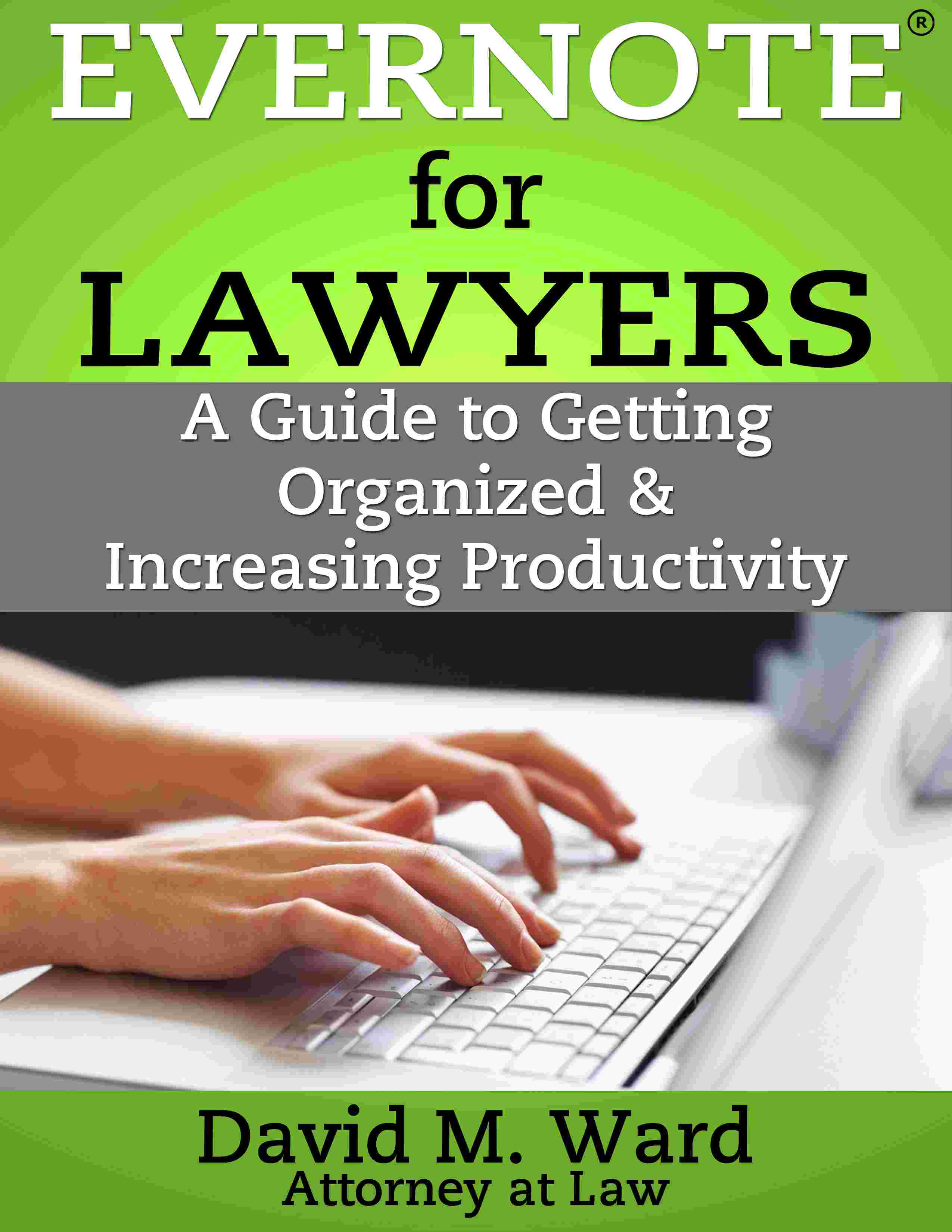
Finally, my own Evernote for Lawyers ebook discusses security issues and how to deal with them, as well as helping you through the process of going paperless.

By the way, even if you don’t use Evernote these resources can still help you in your quest to reduce or eliminate the paper in your life.

Did you know: Evernote for Lawyers has a chapter on using Evernote for marketing.

Share

Building you law practice 90 days at a time

Share

Art Williams became a billionaire building an insurance company from scratch. One of the things he taught his organization was the power of short-term bursts of effort for building momentum. It can be difficult to maintain enthusiasm and stamina for a year, “but you can do anything for 90 days,” he said.

Williams built his business with a series of 90 day sprints. He put in all out effort for 90 days, never stopping or slowing down, and was so confident and excited about what he had accomplished, he was ready to do it again. I’ve gone on many 90-day runs in my different businesses. When you get laser-focused and work hard at something every day, momentum builds, your results compound, and it is truly amazing what you can accomplish.

Right now, you may spend just 15 or 30 minutes a day on marketing. You can accomplish big things that way, if you do it consistently. But imagine what you could accomplish if, for the next 90 days, you went crazy and worked on marketing two solid hours every day. Total immersion, total focus, total effort.

90 days from today is mid-April. We’ll be there in no time. You can go about your business the same as usual or you can go on a 90-day run.

Would it be worth it if you could double your client base? Get five more solid referral sources? Get your web site producing a steady stream of traffic and leads and prospective clients?

Where would you like to be in 90 days?

Let me help you map out your 90-day run. Click here to learn how.

Share

Law practice development tools: sports, museums, and hip hop

Share

I read a lot about marketing and productivity. That’s my field and I need to keep up. Most of what I read, however, is cumulative: things I know, things I already do and teach. There are occasional new twists on old ideas and changes in technology keep things fresh and interesting. But by and large, when you are an expert, unless you are doing original research, you already know what there is to know.

If you’ve been practicing for more than a few years, you may feel the same way about your area of expertise. Still, we read. There is always something new, something we can learn. But if we only read in our areas of expertise, eventually, we get stale.

I get some of my best ideas from reading about things that have nothing to do with marketing or the law. I read blogs and magazines and listen to radio. I talk to people in different fields. I pay attention to what’s going on in my neighborhood and in world politics. I’m not interested in sports but I know that Alabama just clobbered Notre Dame. I’ve never listened to Justin Bieber or One Direction but I know who they are.

I encourage you to read broadly, outside your field. Keep your eyes and ears open to what is going on around you, in sports and pop culture. Study history and economics. Listen to TED talks on science and psychology.

Alfred Whitehead, said, “Novel ideas are more apt to spring from an unusual assortment of knowledge – not necessarily from vast knowledge, but from a thorough conception of the methods and ideas of distinct lines of thought.”

The more diversity you have in your knowledge, the more ideas you will have and the more interesting you will be in conversation, in writing and speaking, and as a lawyer doing your job.

Would you like to earn more than you ever thought possible? Click here to find out how.

Share

Why Bill Clinton wants to touch you

Share

Have you ever watched how Bill Clinton shakes hands. He doesn’t just clasp your right hand in his, he also touches your arm with his left hand. During the conversation, as he makes a point, he might reach out again to touch your arm or put his hand on your shoulder.

Clinton’s use of nonsexual touching is, arguably, one of the reasons people seem to like him so much. (No comments about his alleged use of other kinds of touching, however.)

According to psychologists, touch “can influence behavior, increase the chances of compliance, make the person doing the touching seem more attractive and friendly, and can even you help make a sale.”

Tests have shown that when touched, people are more likely to comply with requests, more likely to provide help, and more likely to buy. And touching more than once seems to increase these results.

Indiscriminate touching, however, could backfire. In a school or work place setting, any kind of touching could be misinterpreted. In some cultures, touching is generally less welcome than in others. And some individuals don’t like to be touched under any circumstances.

By and large, the rewards are probably worth the risks. Just use common sense when meeting someone new. A pat on the arm or the shoulder is probably safe. A lingering full body hug, probably not a good idea, even for Bill Clinton. Especially for Bill Clinton.

Earn more in 2013. Click here to learn more.

Share

Who decides what’s fair when it comes to attorney fees?

Share

So a law firm hires a contract attorney to do document review in a big securities case. They pay the contract lawyer $50 an hour and bill their client $550 for that hour. Is that fair? One lawyer says, “Contract lawyers feel more like a cost that should be simply passed through to the client.”

What say you?

Me? I say that asking if it’s fair is asking the wrong question. Fairness is not the issue. The issue is, “What is the client willing to pay?” Isn’t that the basis of capitalism? Willing buyer and willing seller at arm’s length?

If the client agreed to pay $550 an hour and the work performed by the contract lawyer is of no lesser quality than expected, then who’s to say the client didn’t get its money’s worth? And who’s to say the firm isn’t entitled to make a profit on what they pay outside attorneys? Don’t they earn a profit on work performed by their employees?

Since this was a class action, a judge is being asked to approve legal fees. I’m sure he or she will consider many factors in making that determination. The mark up on contract lawyers shouldn’t be one of them.

You’ll earn more and have happier clients if you DON’T bill by the hour. Find out why and what to do instead in The Attorney Marketing Formula.

Share

Private Coaching For Lawyers (New Year Special)

Share

Would you like some help getting the new year off to a good start? If so, I have a special offer for you.

It’s a private strategy session with me. You and I, on the phone, discussing your practice, your goals, and your marketing.

What will talk about? Well, what do you need help with most?

  • Your web site or blog (or how to start one)?
  • Choosing the right market(s)?
  • Setting goals? Clarifying priorities?
  • Networking, advertising, social media, speaking?
  • Building your list? Getting more traffic?
  • Getting more referrals?

During the call we will review what you are doing now, where you want to be this time next year, and how you are going to get there.

You can ask me anything. And if you don’t know what to ask, I’ll ask you questions and give you my advice.

Here’s the deal. . .

These sessions are normally $500 each.

As a special for the start of 2013, I’m offering a very limited number of “New Year strategy sessions” for the discounted price of $250 per session.

I’m limiting the number because (a) I expect there to be a boatload of interest right after the new year, and (b) I have many thousands of subscribers and limited time.

If you want to grab a slot, here’s what to do:

  1. Book your private strategy session by clicking here
  2. Email me with your contact information and let me know you paid to lock in a slot for one of these sessions.

I’ll email you back to confirm and to set up our call.

I look forward to helping you make 2013 your best year ever.

If you want to learn how to create a marketing plan that really works, click here.

Share

What’s the one thing you most want to accomplish this year?

Share

Just finished taking down the outside Christmas lights. Tis’ no longer the season.

Onward.

So, what’s next? You’re probably wondering that yourself.

You’ve got all these ideas and plans and goals for the new year but you’re overwhelmed. Too many options. Or, you don’t have any ideas, you just know you want things to improve but you don’t know how.

I know, it’s frustrating. But help is on the way. (Puts on cape and tights. . .).

First, relax. Take a deep breath and let it out. Everything is going to be okay.

Now, go for a long walk or a longer drive. I get some of my best ideas when I do that. It helps me think, or rather not think, and that’s when the most important thoughts bubble to the surface. Bring a digital recorder or smart phone app so you can record your pearls of wisdom.

Ask yourself this question: “If I could only accomplish one reasonably big goal this year, what would it be?”

It may be hard to choose only one goal, but you can do it. Pretend you’re Aladdin asking the Genie for one wish, what would it be? (No fair asking for ten more wishes. The Genie has counsel, too.)

I know you probably have lots of goals but if you think about it, most of them are sub-goals of another goal. If one of your goals is to launch or expand a web site or blog this year (an excellent goal, by the way), that’s probably tied into a bigger goal, that of increasing your income.

So let’s say your “one big goal” this year is to double your revenue. The web site is one of the ways you’ll do that.

There are lots of “rules” for writing effective goals, but here’s all you need to know for now: On January 2, 2014, if I ask you, ‘Did you reach your goal for 2013,’ you’ll be able to answer yes or no. You reached it or you did not.

With me? Good.

When you know the “one thing” you most want to accomplish this year, write it down.

Next, it’s idea time.

Grab a notebook or open a digital file and start brainstorming. Write down everything that comes to mind. Everything you can think of that might move you forward towards your one big goal. Edit nothing, eliminate nothing, write it all down. And if you already have an idea file or notebook, add the contents to this one.

It may take you a day or two to do this. That’s fine. In fact, this is something you should always be doing because there are always new ideas and new context.

Okay, so you have a goal and you have a bunch of ideas. What’s next?

Pick something. Just one thing from your list, something you can start today and finish today. It doesn’t matter what it is, just pick something and do it.

Tomorrow, I’ll ask you if you did it. I want you to be able to say, “Yes I did, thanks for asking”.

It feels good completing things and crossing them off your list. It feels good because when you accomplish things, a chemical reaction is triggered in the pleasure center of your brain. The more you accomplish (and the bigger the accomplishment) the bigger the “rush”.

Kinda like when you found out you passed the Bar exam.

You want to develop the habit of starting and completing tasks. Big ones and little ones. The more you do, the more you will want to do. In time, you’ll be addicted to that feeling. You’ll crave it, and as you satisfy that craving, you’ll get more and more done.

Nice, huh?

At some point, you’ll choose more important tasks and projects. (A project is something that takes more than one step.) You should work on no more than five or ten projects at any one time, by the way. Some will be long term, some will take you a few days, and some will wait.

The point of this isn’t to do it right, it’s to get started. You do that by knowing where you want to go and always keeping that in front of you. Like the destination on a map. “Here’s where I’m going.”

You take a step in the direction of your destination. Then another. Along the way, you cross off things you have done and eliminate those you have decided you’re not going to do (or do right now). It is a journey and there may be many detours along the way. As long as you know your destination, you can always get back on the road.

Your route (plan) may change. In fact, the plan you write today will almost never be the plan that gets you to your destination. Things change and so will your plan. That’s okay. Keep moving forward.

For growing your practice, I suggest you use the marketing plan module in The Attorney Marketing Formula. It will help you focus and help you get started.

You don’t need to figure out everything in advance. You just need to get started. Today would be a good day to do that.

Share

How I made an extra fifty-two cents in 2012

Share

Yee-ha!

Amazon just notified me that I earned fifty-two cents when someone purchased something through my affiliate link. Big deal you say? You’re darn right it’s a big deal! Passive income is a very big deal.

I don’t get much from Amazon. That’s okay. I get thousands in passive income every month from other sources. It all averages out to a very sizable “extra” income.

I’m not a big affiliate marketer. You don’t see tons of links to affiliate products in my blog posts or emails. That’s because I’m very picky about what I recommend. It’s usually something I personally use.

All you need are a few high quality products or services (and a good list) and you can earn a decent extra income this way. Even six-figures.

Why am I telling you this? Because as you contemplate your plans and goals for 2013, one of the things you should be thinking about is how you can generate income from sources other than your legal services. You might create your own products. Or offer services outside of your core practice areas. Partner up with someone and offer their products or services. Or start your own business.

The simplest way to get started is to look at the products and services you have used in the past and could recommend to your list. If you think they’re good, why wouldn’t you recommend them to your clients, prospects and professional contacts? Regardless of whether they have an affiliate program or not.

I have an affiliate program for some of my products. I haven’t promoted it because I wanted to add more products first, which I will be doing shortly, but you can sign up now and promote The Attorney Marketing Formula and my Evernote ebook. Here’s the page to get more info on my affiliate program and instructions on how to sign up.

If you like my stuff, I will pay you to recommend it to your attorney friends. Post a link on your blog, mention it in your newsletter, or post a review on one of your linkedin or facebook groups.

Anyway, over the next few days, give some thought as to how you might add additional sources of income in the coming year. I’ll have more ideas to share in future posts.

By the way, The Attorney Marketing Formula comes with a free bonus module, “How to create a marketing plan that really works”. It will help you plan for 2013.

I wish you a very happy, and very prosperous New Year.

Share

Do you know what your client knows?

Share

When I opened my first law office shortly after law school, I volunteered one day a week at a legal clinic. I got some experience dealing with real people and I got a few paying clients.

Most of those clients were family law related. I had filed a few uncontested divorces but knew nothing about the grittier aspects of family law. A friend of mine from law school was also working there and I told him I thought I was in over my head. He told me not to worry, the clients would point me in the right direction.

The clinic’s clients were poor, mostly women, and mostly those who had suffered through bad marriages and abusive husbands. They had first hand knowledge of the concept of “domestic violence”. They knew what it meant to get a restraining order. They knew what they had to prove because they had either gone through the process before or they knew women who had. Sure enough, they pointed me in the right direction. In fact, many of them brought the correct court forms with them.

I learned a lesson that day. I learned to never assume anything about what my client did or did not know. True, most clients don’t know what we lawyers do, but some do.

Today, because of the Internet, many prospective clients know a lot about the law. They read articles and blog posts. They chat with others in forums. They watch or listen to seminars. When you talk to them, it is dangerous to assume that they don’t know anything. But it is equally dangerous to assume that they do.

The best course is to make no assumptions. Ask questions and find out what they know:

  • Do you have any experience with this issue?
  • Have you talked to any other attorneys about this?
  • Is this your first claim?
  • What are you looking to accomplish?

Listen to their answers. Listen to their questions. Also, pay attention to what they don’t say and don’t ask.

Many prospective clients today have incorrect or incomplete information. They think they know the way things are and their expectations are based on what they “know”. This is when you have to be especially careful. You have to help them understand the ways things really are without making them look bad or feel embarrassed.

On the other hand, sometimes clients know things we don’t know. They’ve lived with an issue longer, dug a little deeper, found the loopholes. We must never assume that because we went to law school and they didn’t that we are right and they are wrong. If they can point you in the right direction, let them.

Never make assumptions about what your clients know. Or about what you know.

If you want to earn more in the new year, I can help you. Start here.

Share